7 Ways to Use AI Coding Agents and Models for Free in 2026
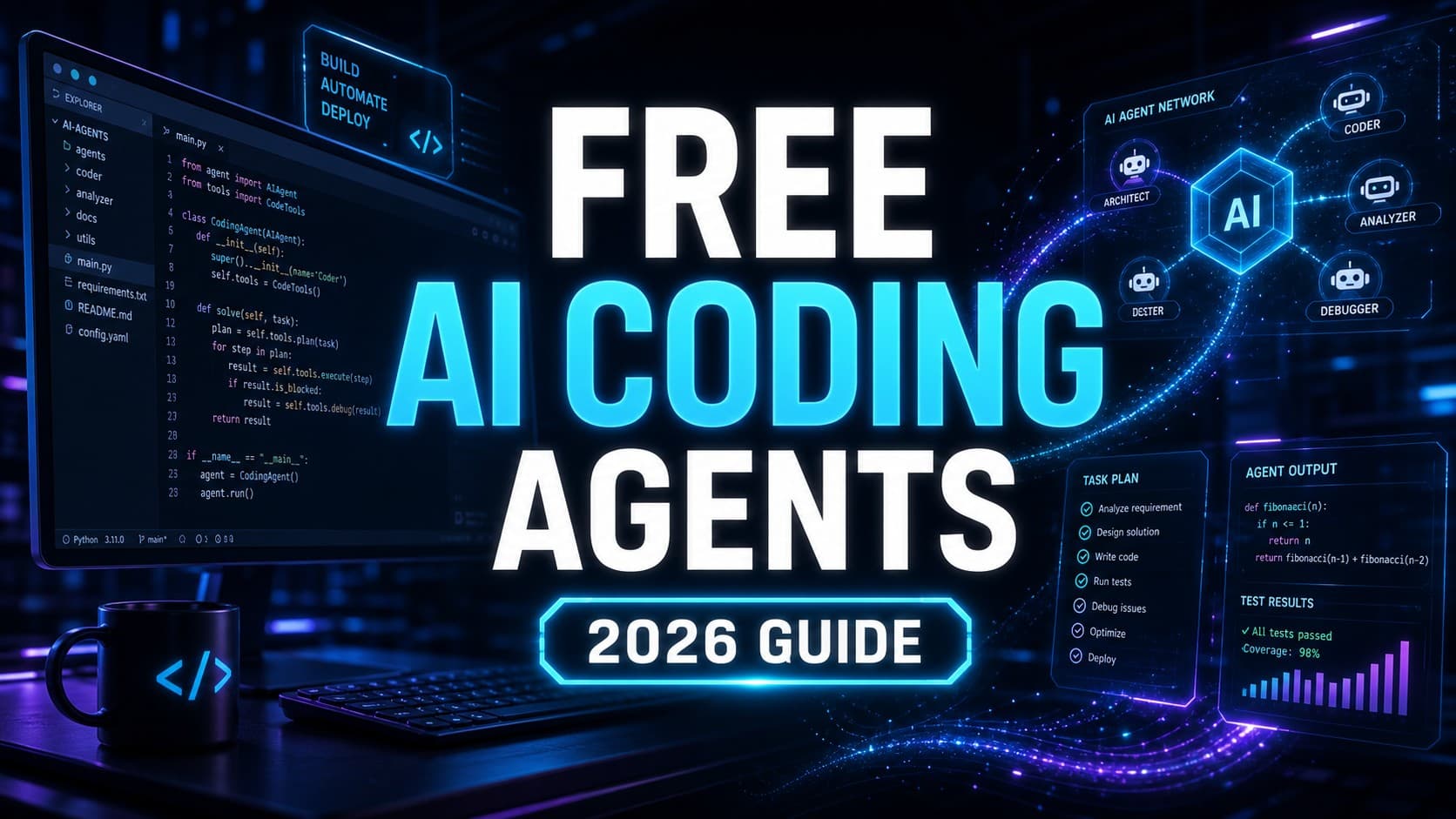
Autonomous AI coding agents have transformed modern software development. Unlike basic autocomplete plugins, these systems can parse complex repositories, refactor multi-file architectures, run terminal commands, and draft full test suites independently. Yet for many developers, running these tools regularly comes with steep costs-either through recurring platform subscriptions or compounding token bills across closed-source model APIs.
However, paying for an agentic development workflow is rarely an absolute requirement. The key lies in decoupling the agent interface from the underlying language model. By connecting open-source agents, promotional tiers, free API gateways, and local inference engines, developers can build capable, zero-dollar coding environments tailored to their hardware and privacy requirements.
This guide breaks down seven practical, verified pathways to access AI coding agents and models for free, outlining the exact setup steps, operational quotas, privacy considerations, and realistic boundaries of each approach.
What “Free” Actually Means in AI Coding
Discussions around free AI coding tools often confuse different layers of the software stack. Understanding these distinctions helps set clear expectations before configuring your development environment:
- Free Coding Agent: The software client, terminal tool, or IDE extension that orchestrates file changes and executes commands. While the agent itself may be open-source and free, it still requires a backend language model to operate.
- Free Agentic Platform: An integrated development environment where the editor, tools, execution sandbox, and language models are bundled together under a unified zero-dollar tier.
- Free AI Model: A language model made available without per-token charges by a provider, whether hosted in the cloud or distributed as open weights, subject to provider-specific terms and rate limits.
- Free API Tier: A rate-limited quota of requests or tokens granted by cloud providers for testing and personal development, typically resetting on a daily, hourly, or monthly basis.
- Bring Your Own Key (BYOK): An architecture where you plug your own provider API key into a third-party agent interface, routing billing or free allocations directly to your account.
- Local Model Runtime: Running open-weight models directly on your computer’s hardware. This eliminates cloud API fees entirely, shifting the performance bottleneck to your local CPU, GPU, and RAM.
1. OpenCode with Dynamic Free Models & Multi-Provider Flexibility
OpenCode has emerged as a premier open-source AI coding agent designed to run across terminal interfaces, desktop clients, and major IDE environments. Its primary strength lies in its modularity: it supports connections to more than 75 model providers alongside direct integrations with local inference engines.
Getting Started & Setup Requirements
Developers can install the OpenCode CLI or IDE extension and immediately access built-in free model options via its configuration dashboard. Connecting external commercial or open-source providers is handled straightforwardly through connection commands and API key bindings.
Free Allocations & Operational Limits
OpenCode provides access to rotating pools of experimental and partner-sponsored models without upfront billing. Active selections frequently include offerings such as MiMo-V2.5 Free, Ling 3.0 Flash Fin Free, Nemotron 3 Ultra Free, and Nemotron 3.5 Lightning Free. As documented by the project maintainers, these free selections are promotional and subject to change based on provider capacity and testing cycles.
Data Privacy Notice
Promotional cloud models often operate under data collection policies that permit prompt inspection for model fine-tuning and infrastructure benchmarking. Developers should avoid routing proprietary codebases, credentials, or production secrets through these temporary endpoints.
Best Suited For
Engineers seeking an unopinionated, open-source agent client that allows frictionless switching between cloud-based experimental models and locally hosted runtimes.
2. OpenAI Codex via the ChatGPT Free Tier
OpenAI’s Codex capabilities have been integrated across consumer tiers, offering agentic code comprehension, multi-file inspection, and automated code generation directly within standard personal accounts.
Getting Started & Setup Requirements
Access begins simply by signing into a standard ChatGPT account. Developers can interact with the agent through the ChatGPT desktop application, the Codex CLI, IDE extensions, or the browser interface-bypassing the need to provision or manage separate API keys.
Free Allocations & Operational Limits
The free tier provides a functional agent environment capable of understanding project structure and proposing contextual patches. However, usage quotas fluctuate dynamically based on overall platform demand, the complexity of the requested task, the size of the repository context window, and the specific tools invoked during execution.
Best Suited For
Everyday refactoring tasks, targeted bug isolation, and rapid scripting where a developer wants an immediate, zero-configuration agent experience without maintaining backend infrastructure.
3. Google Antigravity Agentic Platform
Google Antigravity represents a dedicated agentic development environment designed to blend code editing, workspace terminal execution, and multi-model agent collaboration into a unified workspace.
Getting Started & Setup Requirements
Developers can register for Antigravity by selecting the Individual plan, which Google offers at zero dollars per month without mandatory commercial upgrades.
Free Allocations & Operational Limits
The Individual zero-dollar tier provides access to flagship agent models alongside unlimited inline tab completions and command executions. To preserve shared infrastructure stability, deep autonomous agent loops operate under baseline weekly rate allocations.
Best Suited For
Programmers who want a fully integrated, turnkey development platform that handles environment setup, language server tooling, and model orchestration within a single cloud-backed application.
4. Kilo Code with Auto Free Mode
Kilo Code is an AI coding agent built for modern code editors that assists with inline editing, full-file generation, and project-wide refactoring. It features a specialized routing mechanism known as Auto Free (kilo-auto/free).
Getting Started & Setup Requirements
After installing the Kilo Code extension in your editor, select the kilo-auto/free provider from the model settings menu to initiate zero-cost agent sessions without entering credit card details.
Free Allocations & Crucial Setup Details
Auto Free automatically dispatches agent tasks to healthy, currently available free models, capped at a generous rate limit of 200 requests per hour per IP address. However, achieving a completely free experience requires careful configuration: developers must ensure that Agentic Interactions, Autocomplete, and Background Tasks are all explicitly pointed to free options or BYOK connections, as default autocomplete settings may otherwise route through credit-consuming models like Codestral.
Data Privacy Notice
Because Auto Free load-balances across third-party community endpoints that may log inputs to improve system performance, developers should avoid transmitting confidential API keys, customer records, or sensitive proprietary algorithms.
Best Suited For
Developers seeking a lightweight in-editor agent capable of handling high-volume daily coding tasks without manual model provisioning.
5. OpenRouter Free Models Gateway
Unlike standalone coding agents, OpenRouter functions as a unified API gateway that aggregates hundreds of AI models behind a single standardized interface. It maintains a dedicated collection of zero-cost models accessible via the openrouter/free endpoint.
Getting Started & Setup Requirements
Create an account on OpenRouter, generate an API key, and paste it into any BYOK-compatible coding agent (such as OpenCode, Cline, or OpenHands) while selecting the free model collection.
Free Allocations & Operational Limits
The gateway provides access to more than 25 free models spanning prominent open-source releases from Meta, Mistral, and independent research labs. Free tier accounts receive an allocation of 50 API requests per day. Developers should keep in mind that a single complex agentic task involving multiple tool calls or linting loops can consume several API requests in sequence.
Best Suited For
Benchmarking diverse open-weights models and maintaining a reliable, single-key fallback provider across various coding agent clients.
6. Groq API for Ultra-Fast Cloud Inference
Groq has gained widespread recognition among engineers for delivering exceptionally fast inference speeds via its Language Processing Unit (LPU) architecture. It offers developers a accessible developer tier to run open models with minimal latency.
Getting Started & Setup Requirements
Sign up on the GroqCloud console, generate a developer API key, and insert it into your chosen coding agent using standard OpenAI-compatible protocol settings.
Free Allocations & Operational Limits
Groq provides access to high-performance open models under tier-specific rate limits measured in Requests Per Minute (RPM), Tokens Per Minute (TPM), and Requests Per Day (RPD). While execution speed is industry-leading, dispatching massive multi-file codebase dumps in a single prompt can rapidly exhaust per-minute token allocations.
Best Suited For
Rapid unit test drafting, focused code reviews, and single-function generation where instantaneous response times significantly streamline developer workflow.
7. Local Model Execution via Ollama
Running models locally shifts the entire inference pipeline directly onto the developer’s workstation. By utilizing open-source runtimes like Ollama, engineers can run specialized coding models without transmitting code over the internet.
Getting Started & Setup Requirements
Install Ollama on your machine, download a dedicated programming model (such as modern Qwen-Coder or DeepSeek-Coder variants), and configure your coding agent to point to your local endpoint at http://localhost:11434/v1.
Free Allocations & Operational Limits
Local inference incurs zero API fees and removes external daily request quotas entirely. However, performance is governed strictly by hardware capabilities-specifically available VRAM on dedicated GPUs, unified system memory, and processor throughput. Note that this applies to local weights; Ollama also offers distinct cloud-hosted options that operate under different authentication and compute models.
Best Suited For
Strict privacy environments, proprietary intellectual property, compliance-heavy corporate development, and offline programming workflows.
Realistic Boundaries: Free Setups vs. Large Codebases
While zero-dollar pathways unlock substantial capability, understanding their technical limitations prevents workflow bottlenecks during mission-critical development.
Where Free Workflows Excel
- Implementing self-contained functions, helper classes, and algorithmic utilities.
- Reviewing pull requests for logical inconsistencies and style errors.
- Drafting comprehensive unit, integration, and mocking tests.
- Generating accurate inline docstrings, schema files, and Markdown documentation.
- Rapid prototyping of microservices and architectural proofs of concept.
Challenges in Enterprise-Scale Projects
- Context Window Saturation: Massive enterprise repositories spanning hundreds of thousands of lines can quickly overflow the context limits of lightweight free models.
- Mid-Session Rate-Limit Interruptions: Hitting hourly or daily cloud caps during deep refactoring loops can halt an agent midway through multi-file edits.
- Dynamic Model Lifecycle: Promotional cloud endpoints may modify model availability, adjust context lengths, or retire experimental variants without prior notice.
Comparison of All 7 Free Pathways
The following overview summarizes the architectural trade-offs across all seven methods:
- OpenAI Codex (via ChatGPT):
- Solution Type: Autonomous Coding Agent.
- API Key Required: No (operates via App, CLI, Web, and IDE extensions).
- Local Inference: No (Cloud-backed).
- Free Terms: Built into Free tiers with dynamic usage caps based on context and task complexity.
- Google Antigravity:
- Solution Type: Integrated Agentic Platform.
- API Key Required: No.
- Local Inference: No (Cloud-backed).
- Free Terms: Individual plan at $0/month with unlimited completions and weekly agent rate limits.
- OpenCode:
- Solution Type: Open-Source Coding Agent.
- API Key Required: Dependent on selected provider.
- Local Inference: Yes (supports Ollama and local runtimes).
- Free Terms: Rotating promotional models included, with support for 75+ external providers.
- Kilo Code:
- Solution Type: In-Editor Coding Agent.
- API Key Required: No for Auto Free; supports BYOK for custom providers.
- Local Inference: Yes (via local endpoints).
- Free Terms: Auto Free capped at 200 requests/hour/IP; requires configuring autocomplete and background tasks to free tiers.
- OpenRouter:
- Solution Type: Centralized API Gateway.
- API Key Required: Yes.
- Local Inference: No (Cloud-aggregated).
- Free Terms: Access to 25+ open models with a standard quota of 50 API requests/day.
- Groq API:
- Solution Type: High-Speed Cloud Inference Provider.
- API Key Required: Yes.
- Local Inference: No (Cloud-hosted LPUs).
- Free Terms: Fast inference tier governed by RPM, TPM, and RPD rate limits.
- Ollama (Local Models):
- Solution Type: Local Model Runtime.
- API Key Required: No (for local open weights).
- Local Inference: Yes (100% on-device).
- Free Terms: Completely free of cloud billing; performance scales with workstation hardware.
Frequently Asked Questions
Is OpenAI Codex completely free to use?
Codex capabilities are accessible within standard ChatGPT Free plans across desktop applications, CLI environments, IDE plugins, and the web interface, operating under usage limits that scale with server demand and prompt complexity.
Is Google Antigravity really zero dollars?
Yes. Google offers an Individual plan at $0 per month that includes access to supported agent models, unlimited tab completions, and command execution, bounded by basic weekly usage quotas for compute-intensive tasks.
How do you ensure Kilo Code remains 100% free?
To prevent accidental credit consumption, activate Auto Free mode and explicitly verify in settings that inline Autocomplete (which defaults to Codestral) and Background Tasks are assigned to free model routes or personal BYOK connections.
Does a free coding agent mean the language model is also free?
Not necessarily. A coding agent is simply the orchestration layer. Unless the agent includes bundled free models (like OpenCode or Antigravity), you must pair it with a free cloud API key or a locally hosted model runtime.
Can you run AI coding agents without any API keys?
Yes. Platforms like Codex and Antigravity provide turnkey cloud environments without separate API key provisioning, while open-source agents connected to local Ollama instances run entirely on local endpoints.
Are free models suitable for commercial enterprise projects?
Free solutions work well for localized refactoring, documentation, and test scaffolding. However, large production repositories often require the expanded context windows, high concurrency limits, and guaranteed uptime found in dedicated commercial tiers.
How can developers minimize data privacy risks when using free tools?
The safest approach is running open-weight models locally via Ollama. When utilizing free cloud tiers, thoroughly audit provider logging terms, and always inspect connected IDE extensions to verify where repository telemetry is being routed.
Do local models require an ongoing internet connection?
No. Once the runtime engine and model weights are downloaded to your disk, local inference executes completely offline on your device’s hardware without sending data across external networks.