Qwen3.8-Flash-Next: How Alibaba Reduced Compute Costs While Boosting Coding Performance
On August 26, 2026, Alibaba’s Qwen team released the open weights for Qwen3.8-Flash-Next, alongside the commercial launch of its managed API, Qwen3.8-Flash, on Qwen Cloud. Similar to how Qwen3-Next served as an early testing ground for the Qwen3.5 series, this release provides a practical preview of the architecture planned for the upcoming Qwen4 model family.
The primary focus of this release is efficiency. By redesigning its attention, memory, and residual systems, Qwen3.8-Flash-Next reduces training compute costs to roughly one-tenth of its predecessor, Qwen3.7-Plus (about a ninth of the compute budget). Despite activating just 6 billion parameters per token from a total pool of 125 billion parameters, the model posts competitive results on repository-level coding benchmarks and agent tasks compared to larger proprietary models like Claude Opus 4.6 (Max).
Four Technologies Behind Qwen3.8-Flash-Next’s Efficiency
Rather than simply increasing parameter counts, Alibaba focused on separating compute requirements from memory usage across four core areas:
- Hybrid Attention: Combines three layers of Gated DeltaNet (GDN) to compress context history with one layer of Qwen Sparse Attention (QSA) for targeted data retrieval.
- Gated Residual Paths: Splits internal data flow into four parallel streams, using dynamic read and write gates with FP8 memory storage.
- External N-gram Memory: A 51-billion-parameter lookup table stored in system RAM instead of GPU memory.
- Optimized MoE Routing: An ultra-sparse Mixture-of-Experts design that activates only 6B parameters per token during generation.
1. Hybrid Attention: Balancing Speed and Precision
Standard attention mechanisms become slow and memory-intensive as input text grows. Qwen3.8-Flash-Next addresses this by organizing its 48 layers into an alternating pattern:
- Three layers of Gated DeltaNet (GDN): Continuously summarize past context into a compact, fixed-size state.
- One layer of Qwen Sparse Attention (QSA): Handles precise information lookup across the entire document.
Instead of scanning every token individually, QSA groups text into small blocks (micro-blocks) to estimate relevance before retrieving only the most important sections. At a 1-million-token context length, this setup delivers:
- 7.6x faster initial prompt processing (prefill).
- 4.9x faster generation speeds (decode).
- 8.6x higher throughput compared to Qwen3.7-Plus in environments with a 90% prefix cache hit rate.
2. Four Pathways for Cleaner Signal Flow
In standard Transformer models, information passes through a single residual pathway. In deep networks, this often causes early signals to fade as they mix with later calculations.
Qwen3.8-Flash-Next widens this pathway into four parallel streams. Dynamic gates decide how much information to read and write at each step, creating a direct route that carries early attention features straight to deeper layers without distortion. To further reduce memory bandwidth demands, the residual state is stored in FP8-a lower-precision format that saves memory while maintaining calculation accuracy.
3. N-gram Memory: Using System RAM Instead of GPU VRAM
Alibaba added a 51-billion-parameter N-gram lookup table at layer 2, building on concepts from Gemma 3n and DeepSeek Engram.
This table acts as a memory bank for common phrases and local word patterns. Because the model knows what to look up in advance, these 51B parameters are stored in regular computer memory (system RAM) rather than expensive GPU VRAM. They are loaded asynchronously in parallel with GPU calculations, providing the benefits of a much larger model without adding to the per-token compute cost.
4. 125B Total Parameters with 6B Active
The model uses an ultra-sparse Mixture-of-Experts (MoE) design with 512 specialized expert networks (125 billion parameters in total). For each processed token, the router selects only 10 routed experts plus 1 shared expert. This caps actual processing at 6 billion active parameters per token.
Additionally, a 4-billion-parameter Multi-Token Prediction (MTP) module speeds up generation by predicting multiple future tokens simultaneously. Training was carried out using the Muon optimizer for 2D weight matrices alongside AdamW for embeddings. By updating its scaling laws, the team bypassed the traditional batch-size warmup phase, saving 18.8% in total training steps.
Benchmark Performance: Results Across Core Evaluations
Published evaluations show that Qwen3.8-Flash-Next performs strongly on software development and workplace tasks, while trailing top proprietary models on abstract, exam-style reasoning tests:
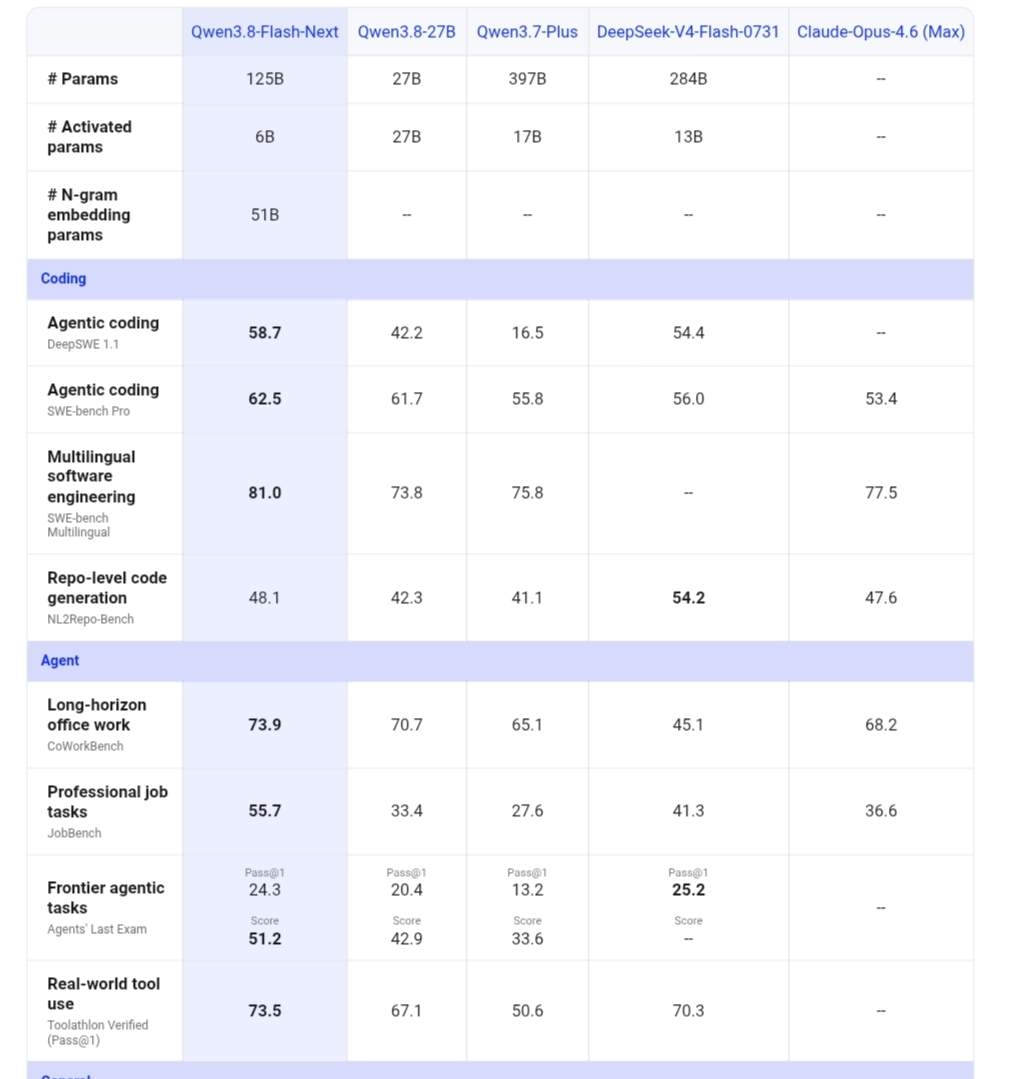
- SWE-bench Pro (Software Fixes): Scored 62.5, ahead of Claude Opus 4.6 (Max) at 53.4, DeepSeek-V4-Flash-0731 at 56.0, and Qwen3.7-Plus at 55.8.
- SWE-bench Multilingual: Reached 81.0, compared to 77.5 for Claude Opus 4.6 (Max).
- DeepSWE 1.1 (Agentic Coding): Scored 58.7 under the mini-SWE-agent harness, leading DeepSeek-V4-Flash-0731 (54.4).
- CoWorkBench (Office Productivity): Achieved 73.9 on long-horizon business and administrative workflows, ahead of Claude Opus (68.2).
- JobBench (Professional Tasks): Reached 55.7, leading Claude Opus (36.6).
- Toolathlon Verified (Tool Use): Completed 73.5% of practical tool-use tasks, compared to DeepSeek (70.3%).
- LiveCodeBench v6 (Competitive Coding): Scored 91.9, slightly ahead of Claude Opus (88.8).
- GPQA Diamond (Scientific Reasoning): Scored 91.7, matching Claude Opus (91.3).
- Humanity’s Last Exam (HLE): Trailed behind, scoring 35.9 compared to Claude Opus 4.6 (40.0).
Coding Capabilities: Practical Repository Engineering
The benchmark results reflect strong capabilities in real-world software maintenance:
- On SWE-bench Pro, evaluated using the Claude Code harness, the model achieved a 62.5 resolution rate, demonstrating reliable bug fixing across complete codebases.
- In SWE-bench Multilingual, an 81.0 score confirms broad programming language coverage across languages including Python, Java, C++, and Go.
- On NL2Repo-Bench (full repository generation), the model posted 48.1, slightly ahead of Claude Opus (47.6), while DeepSeek-V4-Flash-0731 led the category at 54.2.
Workplace Tasks: Autonomous Agent Performance
Beyond writing code, the model is designed to handle structured operational workflows:
- Long-Horizon Execution: A score of 73.9 on CoWorkBench reflects the model’s ability to maintain context over complex legal, financial, and analytical assignments.
- Structured Deliverables: The margin on JobBench (55.7 vs. 36.6) shows consistent output quality in professional task simulations.
- API and Tool Execution: A 73.5% success rate on Toolathlon Verified demonstrates reliable schema following when executing external function calls.
Vision and Multimodal Capabilities
The open-weight release includes a native vision encoder that handles text, images, and video through a unified interface:
- Mobile UI Interaction (AndroidWorld): Scored 84.5, compared to 62.0 for Claude Opus 4.6 (Max).
- Visual Math (MathVision): Reached 95.7 with step-by-step reasoning, ahead of Opus (65.5).
- Chart Analysis (CharXiv): Scored 90.6, compared to 66.0 for Opus.
- General Perception (RealWorldQA & LVBench): Posted 88.5 on visual QA and 76.6 on long video comprehension.
Boundaries and Practical Limitations
Despite strong performance in coding and practical tasks, several operational considerations remain:
- Complex Academic Reasoning: On multidisciplinary academic tests like Humanity’s Last Exam (HLE), the model scored 35.9, behind Claude Opus 4.6 (40.0). It also scored 24.3% on Agents’ Last Exam, slightly behind DeepSeek (25.2%).
- Multi-Turn Loop Stability: Developer feedback notes occasional performance drops in very long agent loops, as well as sensitivity when tools return malformed JSON outputs.
- Content Moderation: Qwen uses less restrictive default guardrails than Anthropic’s models, meaning enterprise deployments in sensitive environments may require custom validation rules.
API Pricing and Running Costs
For production deployments, Alibaba provides the managed model on Qwen Cloud under the ID qwen3.8-flash:
- Input Pricing: $0.15 – $0.16 per million tokens.
- Output Pricing: $0.47 per million tokens.
- Comparison with Flagship Tiers: The flagship 2.4-trillion parameter Qwen3.8-Max is priced at $2.00 input and $6.00 output per million tokens. Flash-Next costs roughly 10x less on input and 12x less on output, making it well-suited for high-volume pipelines.
Open Weights vs. Managed Cloud Service
There are practical differences between the two available options:
- Qwen3.8-Flash-Next (Open Weights): Hosted on Hugging Face and ModelScope for self-hosting. It includes the vision encoder and supports a native 262,144-token context window, which can be extended to 1,000,000 tokens using YaRN in engines like vLLM and SGLang.
- Qwen3.8-Flash (Managed API): Available on Qwen Cloud with a default 1-million-token context window, built-in search grounding, automated prompt caching, and compatibility with OpenAI and Anthropic API formats.
Deployment and Ecosystem Support
The model supports standard protocols, making integration straightforward across major developer tools:
- Coding Assistants and Agent Tools: Integrates directly with Claude Code, OpenAI Codex, QwenWork, Qoder CLI, and OpenClaw.
- Inference Frameworks: Supported natively in vLLM, SGLang, and TokenSpeed.
- Multi-Model Platforms: Available on unified platforms like GlobalGPT for teams wanting to compare models side-by-side.
Comparison: Qwen3.8-Flash-Next vs. GLM-5.3-Flash
Launched on the same day, Zhipu AI’s GLM-5.3-Flash represents the closest direct alternative:
- Hardware Footprint: Qwen activates 6B parameters per token (out of 125B), while GLM activates 18B parameters (out of 320B). This gives Qwen an advantage in self-hosted serving speed and hardware efficiency.
- Benchmark Trade-Offs: GLM leads on DeepSWE 1.1 (63.4 vs. 58.7) and offers a native 1M context window without needing YaRN. Qwen leads on SWE-bench Pro (62.5) and workplace productivity benchmarks like CoWorkBench and JobBench.
Frequently Asked Questions (FAQ)
What is the difference between Qwen3.8-Flash and Flash-Next?
Qwen3.8-Flash-Next refers to the open-weight release for self-hosting and research. Qwen3.8-Flash is the fully managed cloud API on Qwen Cloud with built-in tools and a default 1M context window.
What are the official API rates?
On Qwen Cloud, base pricing is $0.15 to $0.16 per million input tokens and $0.47 per million output tokens.
Does the open-weight model include vision support?
Yes. The open-weight model includes an integrated Vision Encoder capable of processing text, image, and video inputs.
How does the model handle inputs longer than 262K tokens?
The base weights support 262,144 tokens natively. For context lengths up to 1,000,000 tokens, developers can enable YaRN positional encoding in serving engines such as vLLM or SGLang.
Final Assessment
Qwen3.8-Flash-Next highlights an important trend in AI development: efficiency gains driven by architectural design rather than raw parameter scaling. By combining sparse attention with offloaded N-gram memory and dynamic residual routing, Alibaba has delivered an active 6B-parameter model that competes effectively in software engineering and enterprise tasks at a fraction of the cost.
For engineering teams looking to deploy cost-effective coding assistants, tool-use pipelines, and long-document processing, Qwen3.8-Flash-Next offers a compelling balance of speed, capability, and price.