Anthropic Launches Claude Sonnet 5.5: What’s New in the Mid-Tier Workhorse?
Anthropic has officially released Claude Sonnet 5.5, the second model in its next-generation Claude 5.5 family following the launch of the flagship Opus 5.5. Designed as the primary workhorse for enterprise developers and knowledge workers, Sonnet 5.5 delivers a tangible performance upgrade over its predecessor, generating responses more than 30% faster while reducing total task completion costs by up to 30% through improved token efficiency and streamlined reasoning loops.
Introducing Claude Sonnet 5.5, the second model in the Claude 5.5 family.
It’s a clear upgrade over Sonnet 5, runs more than 30% faster, and costs up to 30% less for most work. pic.twitter.com/UvXD8mDTF1
– Claude (@claudeai) September 28, 2026
Rather than merely cutting sticker prices, Anthropic has focused on functional execution. The new model is engineered to handle everyday engineering and operational workloads with high precision, including codebase debugging, document synthesis, financial modeling, and polished user interface design. This release sets the stage for Claude Haiku 5.5, a lightweight model aimed at high-volume, cost-sensitive automation, scheduled to debut in the coming weeks.
Where Does Sonnet 5.5 Fit in the Claude 5.5 Family?
Anthropic has established a clear three-tier hierarchy for the Claude 5.5 generation, aligning specific computational profiles with distinct enterprise needs:
- Claude Opus 5.5: The flagship tier, built for highly ambiguous challenges, sustained multi-hour reasoning, and open-ended strategic decisions that require deliberate human-level judgment.
- Claude Sonnet 5.5: The core daily engine, optimized for agentic software engineering, fast data analysis, and iterative multi-step workflows where speed and cost efficiency matter most.
- Claude Haiku 5.5: The high-throughput option, tailored for massive transactional pipelines, rapid classification, and lightweight consumer integrations.
This structural clarity provides engineering teams with practical economic predictability. Organizations no longer need to deploy an expensive top-tier model for everyday development tasks, as Sonnet 5.5 matches premium performance benchmarks across the vast majority of practical software engineering workloads.
Token Price vs. Task Cost: The Economics of Efficiency
Anthropic has kept the standard API list pricing for Claude Sonnet 5.5 identical to its predecessor at $2.00 per million input tokens and $10.00 per million output tokens, alongside $0.20 per million tokens for prompt cache reads and $2.50 per million tokens for cache writes.
By comparison, the flagship Opus 5.5 costs $4.00 per million input tokens and $20.00 per million output tokens. However, Anthropic’s core commercial argument centers on total task economics rather than raw token rates. A model with a cheaper per-token headline rate often ends up costing more if it requires redundant tool calls, repeated reasoning retries, or excessive output tokens to arrive at the correct solution.
Because Sonnet 5.5 batches external tool calls and completes complex assignments in fewer execution steps, it delivers an effective operational cost reduction of up to 30% inside real-world production pipelines.
Global Benchmark Rankings: Securing Second Place in Independent Indexes
Independent evaluations across leading AI testing organizations place Claude Sonnet 5.5 at the upper echelon of global frontier models, consistently capturing the second spot worldwide behind only Claude Opus 5.5:
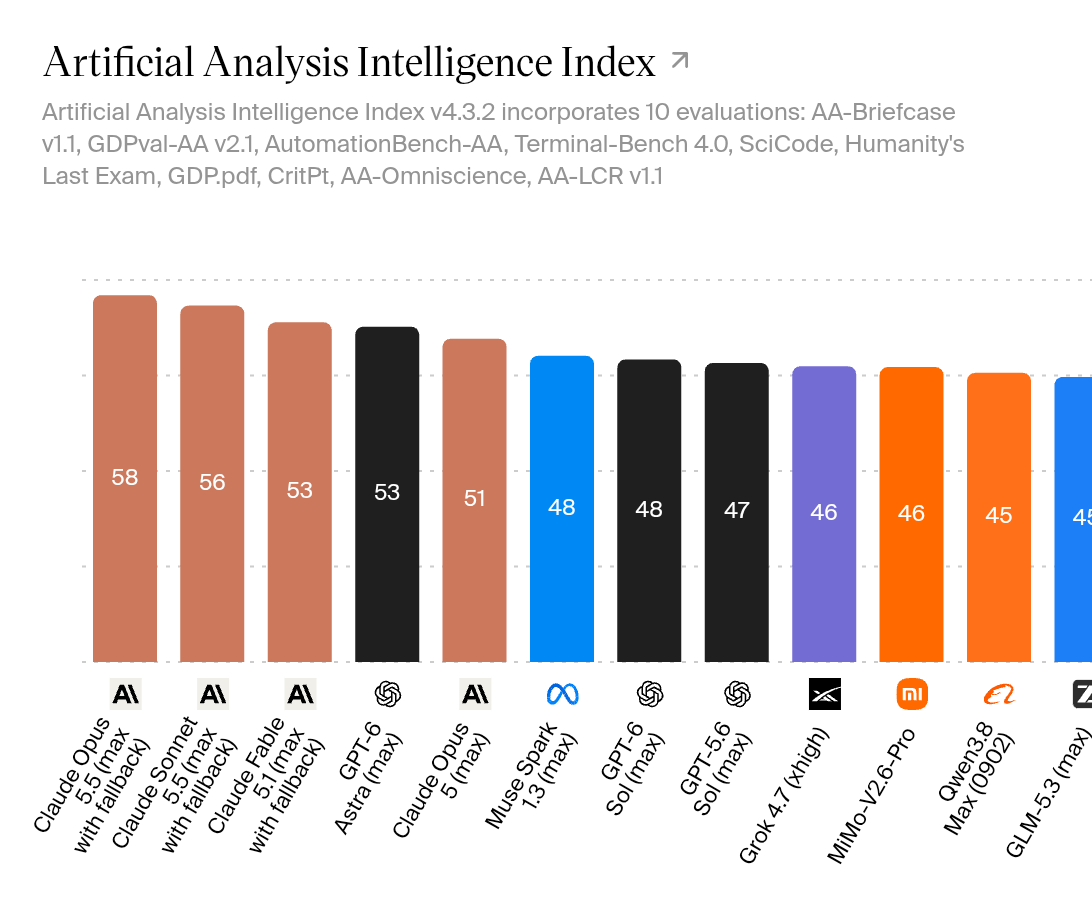
- Artificial Analysis Intelligence Index: Sonnet 5.5 scored 56 points on the comprehensive Intelligence Index (v4.3.2) at maximum effort, finishing just two points behind Opus 5.5 (58 points), while outpacing OpenAI’s GPT-6 Astra (53 points) and Claude Fable 5.1 (53 points), marking an 18-point leap over Sonnet 5 (38 points).
- Vals Index (Vals AI): The model achieved an overall score of 69.22%, ranking second among 65 evaluated frontier systems and closely trailing Opus 5.5 (69.69%). The Vals Index measures economic utility across software engineering, corporate finance, and legal analysis, with results weighted by each industry’s contribution to gross domestic product.
Independent researchers noted an important architectural characteristic: at maximum reasoning effort, Sonnet 5.5 generated approximately 193,000 output tokens per task on the Artificial Analysis suite. This demonstrates that while maximum reasoning unlocks near-flagship accuracy, teams running high-frequency production tasks can dial effort levels to medium to maintain rapid response times and optimal budget control.
Agentic Coding: The Arena Where Sonnet 5.5 Excels
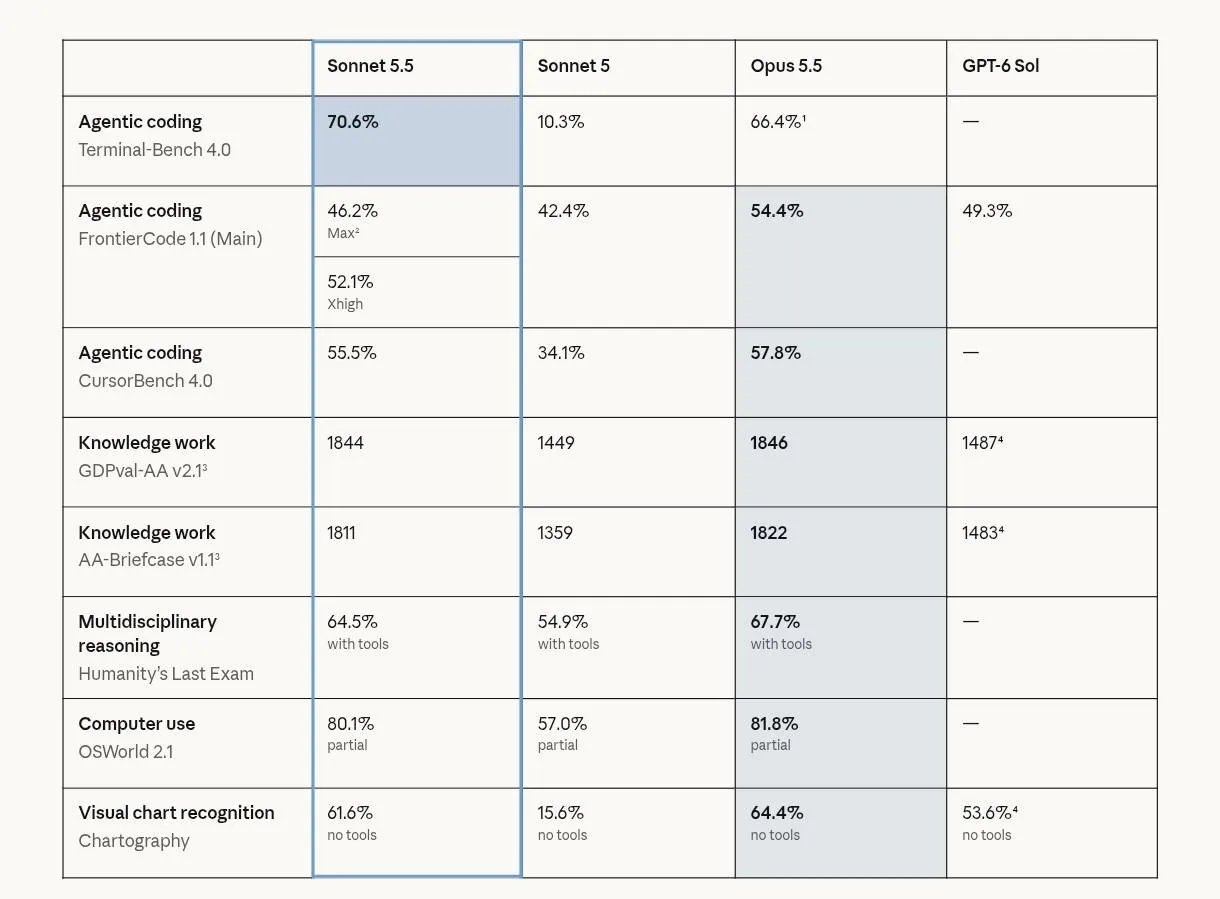
Software development represents the single largest performance jump for Sonnet 5.5, with benchmark gains reflecting substantial improvements in autonomous command-line execution and IDE workflows:
- Terminal-Bench 4.0: Sonnet 5.5 scored 70.6% on autonomous terminal-based engineering tasks, surpassing even Opus 5.5 (66.4%) and demonstrating a massive improvement over Sonnet 5’s 10.3%, which frequently encountered timeouts in multi-step terminal environments.
- CursorBench: Recreating real-world developer sessions inside code editors, Sonnet 5.5 reached 55.5%, landing within two percentage points of Opus 5.5 (57.8%).
- FrontierCode 1.1: At the Extra-High effort setting, the model achieved 52.1% on pull-request integration benchmarks without requiring human intervention.
Anthropic)
These figures highlight the model’s ability to quickly parse tens of thousands of lines of code, map system dependencies, and execute complex refactoring tasks without getting caught in repetitive tool-calling loops.
Beyond Code: Multimodal Reasoning and Complex Office Workloads
Sonnet 5.5’s capabilities extend well beyond software engineering, proving equally capable in visual interpretation and enterprise knowledge work:
- GDPval-AA: Scoring 1,844 Elo points on professional tasks spanning 44 occupations and nine major industries, Sonnet 5.5 sits virtually level with Opus 5.5 (1,846 points).
- OSWorld 2.1: In autonomous computer-use evaluations involving graphical interface navigation, Sonnet 5.5 scored 80.1%, closely trailing Opus 5.5 (81.8%).
- Chartography: In visual diagram and chart comprehension without external tool assistance, the model leaped to 61.6%, up from 15.6% in the previous generation.
In practical workplace testing, Sonnet 5.5 generated complete 10-slide operational review presentations directly from raw corporate earnings transcripts and formatting templates, producing drafts judged ready for distribution without manual edits. In visual reasoning tests, it also became the first Sonnet model capable of navigating the video game Pokémon Red solely through static screenshot analysis.
The Competitive Landscape: Sonnet 5.5 in the Pricing and Performance Battle
The arrival of Sonnet 5.5 intensifies competition in the high-capability everyday model category. Comparing standard API pricing shows how the leading providers are positioning their offerings:
- Claude Sonnet 5.5: $2.00 per million input tokens, $10.00 per million output tokens.
- GPT-6 Sol: $2.00 per million input tokens, $10.00 per million output tokens (with a 1.05M token context window).
- Gemini 3.8 Flash: $0.75 per million input tokens, $3.75 per million output tokens (introductory pricing through late 2026).
While models like DeepSeek-V4.1 and open-weights alternatives such as Xiaomi’s MiMo-V2.6 series offer lower entry prices, Anthropic is banking on operational accuracy. A model that resolves complex issues on the first attempt without repeated token overhead frequently provides lower net cloud infrastructure expenditure over sustained production cycles.
Enterprise Cybersecurity and Anti-Distillation Safeguards
Because Sonnet 5.5 possesses cybersecurity analysis capabilities comparable to top-tier flagship systems, Anthropic has equipped a Sonnet-class model with defensive safeguards for the first time.
Routine software vulnerability remediation and bug fixing operate normally. However, requests categorized as high-risk security operations automatically route to Sonnet 5. Qualified cybersecurity defenders can apply to Anthropic’s Cyber Verification Program for tiered access to advanced testing features across Sonnet, Opus, and Mythos models.
Additionally, Anthropic has deployed safety classifiers designed to prevent industrial-scale model distillation attacks, alongside expanding its preserved-thinking architecture so a model’s intermediate reasoning steps remain securely tethered to the account that generated them. To support regulatory compliance under the European Union AI Act, the model includes invisible text watermarking that aids in detecting generated material without impacting readability, backed by a strict Zero Data Retention policy across all major clouds.
Real-World Use Cases: Where Sonnet 5.5 Shines
Sonnet 5.5’s blend of speed, structural understanding, and visual processing makes it particularly effective across several enterprise applications:
- Autonomous Software Engineering: Rapid codebase auditing, architectural refactoring, legacy code modernization, and automated pull request generation.
- Document Intelligence & Synthesis: Processing complex legal contracts, regulatory filings, and multi-document corporate disclosures with high factual fidelity.
- Executive Deck & Spreadsheet Automation: Transforming unstructured financial summaries into styled presentations and formula-verified spreadsheets.
- UI/UX Layout Refinement: Translating design mockups and wireframes into clean, production-ready frontend components.
- Multi-Agent Tool Orchestration: Serving as the primary execution engine in autonomous agent frameworks that query APIs, execute shell commands, and verify deliverables.
Developer Availability and Next Steps
Claude Sonnet 5.5 is available immediately across all major enterprise cloud environments and developer interfaces:
- The native Claude Platform via the model identifier
claude-sonnet-5-5. - Amazon Web Services (AWS Bedrock).
- Google Cloud (Vertex AI).
- Microsoft Azure (Azure Foundry).
Developers who previously ran Claude with intermediate thinking disabled will need to transition to the new between_tools parameter when integrating Sonnet 5.5 to maintain proper API call coordination. With Haiku 5.5 arriving soon, Anthropic’s updated product family provides organizations with a complete spectrum of AI capabilities calibrated for precision, speed, and long-term operating efficiency.