
Anthropic Model 4: METR Report Reveals How AI Is Accelerating the Company’s Research
A new report from independent AI evaluation organization METR has revealed the breakthrough progress of three advanced internal frontier models developed by Anthropic, led by Model 4, which achieved scores above 50% across all 15 tasks in the evaluation suite. Beyond the benchmark results, the findings document a fundamental shift in frontier AI engineering: Anthropic is increasingly leveraging its own models to drive research, accelerate software development, and engineer its most capable successors.
According to METR’s quantitative analysis, the capability trajectory of Anthropic’s models has accelerated by approximately 1.9 times since October 2025. Critically, the report confirms that this acceleration is driven directly by integrating AI tools into research and development workflows, rather than by simply expanding compute resources.
Anthropic Has Developed Three Unreleased Internal Models
METR’s assessment examines three internal frontier models, designated as Model 2, Model 3, and Model 4-technical benchmarks utilized by researchers to track capabilities prior to any commercial deployment within the Claude family.
The models were developed across an exceptionally tight timeline: Model 2 completed training in July 2026, followed by Model 3 in August and September, with Model 4 concluding training between September and October 2026. This rapid succession highlights the engineering velocity inside Anthropic’s labs, with successive generations of frontier models emerging within months.
By auditing primary training logs, benchmark progression, and internal performance records directly provided by Anthropic, METR obtained a high-resolution window into frontier R&D workflows. This access enabled the research team to rigorously analyze the real-world performance curve of Model 4 from within its native development environment.
Model 4 Scores Above 50% Across 15 Evaluation Tasks
Model 4’s standout milestone is its performance across all 15 tasks in METR’s AECI evaluation suite, surpassing the 50% threshold on every single benchmark. This achievement demonstrates uniform mastery across a broad spectrum of complex problem spaces, rather than isolated competence on narrow benchmarks.
The AECI metric is designed to measure longitudinal progress across model generations. Model 4’s dominant showing highlights its position at the frontier of machine intelligence: by pushing established tests toward ceiling effects and benchmark saturation, the model demonstrates performance levels so high that researchers must now construct even more demanding evaluation suites to measure its full headroom.
Anthropic’s AI Capabilities Are Improving 1.9 Times Faster
The central finding of METR’s report is that the rate of capability growth across Anthropic’s models has surged by approximately 1.9 times since October 2025. In practical terms, Anthropic achieved progress in a single year that would have previously required nearly two full years of research.
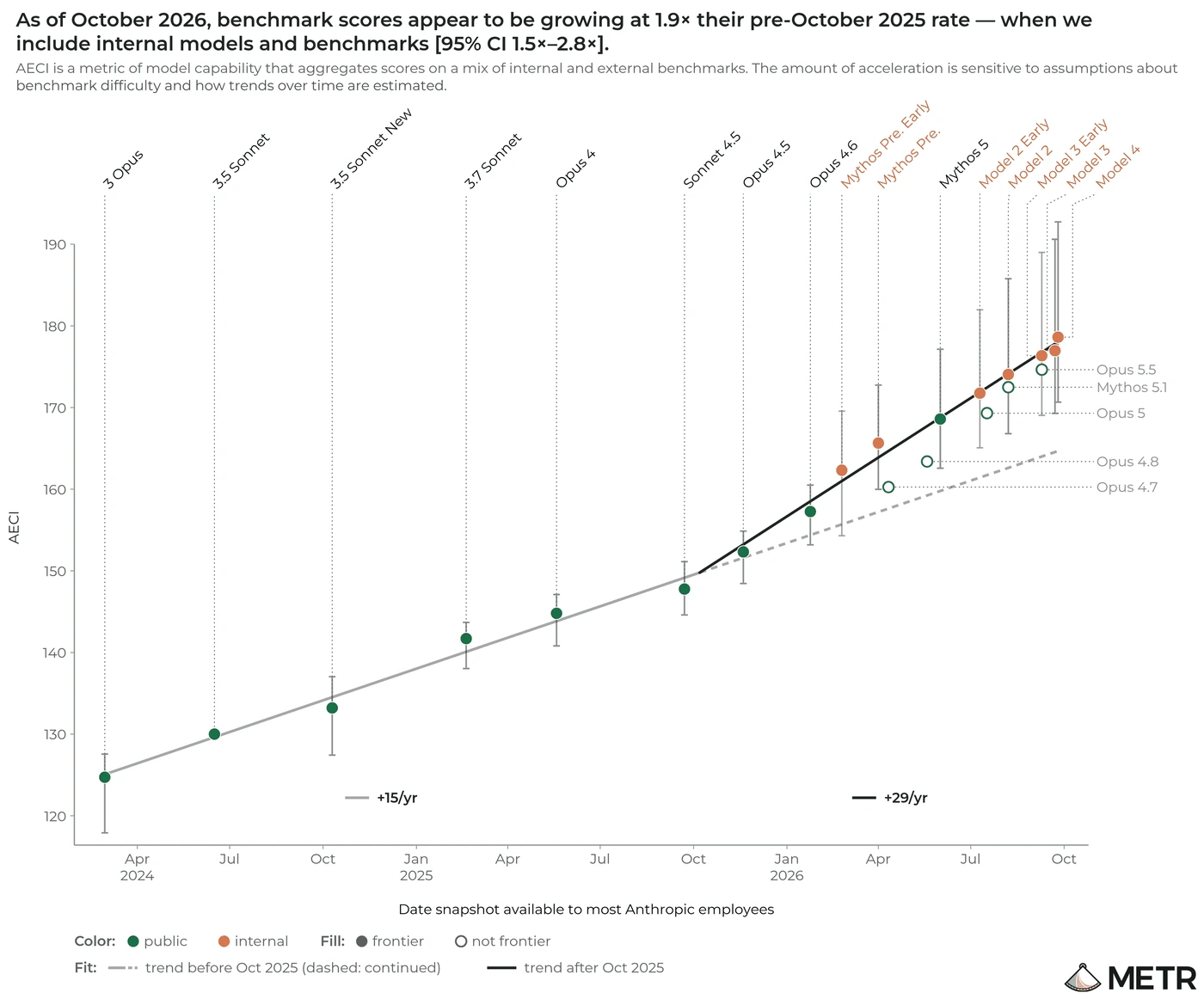
Statistical modeling firmly confirms this upward trajectory, establishing a robust acceleration window between 1.5× and 2.8× at a 95% confidence interval, verifying that the accelerated pace of capability growth remains consistent across diverse analytical assumptions.
Most notably, METR’s investigation ruled out compute expansion as the primary driver of this breakthrough. Instead, the evidence indicates that AI-assisted research and development accounts for approximately 80% of the observed acceleration-demonstrating that Anthropic’s models have transitioned from passive outputs into active catalysts for building the next generation of AI.
Anthropic Employees Report Major Productivity Gains
The report provides field evidence of how deeply integrated these models are within Anthropic’s technical operations. Internal workplace surveys conducted via Slack documented productivity gains of up to 12 times by October 2026 among employees working with the latest internal models.
Far from theoretical projections, these metrics quantify the tangible velocity AI systems unlock across technical teams. Engineers and researchers leverage the models to write and inspect production-grade code, analyze complex empirical datasets, design experiments, and test algorithmic hypotheses in real time.
By automating these demanding implementation layers, technical teams can compress long research cycles into rapid iterations, enabling Anthropic to run vastly more experiments and validate architectural breakthroughs at unprecedented speed.
How AI Is Helping Anthropic Build More Advanced Models
These findings demonstrate how advanced models are becoming foundational infrastructure for creating future AI systems. When a frontier model assists with software engineering, debugging, and empirical analysis, it creates a powerful compounding dynamic.
This manifests as a self-reinforcing R&D loop: a more capable model enhances the efficiency of the training and research cycle, producing an even stronger successor, which is then deployed to tackle higher-order engineering challenges.
While human researchers and engineers continue to guide core architectural decisions and strategic hypotheses, delegating complex technical workflows to advanced models marks the operational reality of accelerated AI research-shortening development phases that previously required months of manual engineering.
Is Anthropic Moving Toward AI Self-Improvement?
METR’s evaluation places the AI industry on the threshold of applied recursive acceleration, where intelligent systems actively contribute to building their own next generation.
Rather than waiting for purely autonomous recursive self-improvement to appear overnight, Anthropic’s results document the practical, human-guided foundation of this transition: as models assume larger shares of critical R&D workflows, they tangibly compress the development timeline of each successive generation.
The critical insight lies in the momentum of this shift. As model competence increases, its utility inside the laboratory expands, accelerating the discovery of new training paradigms and pulling the arrival of future frontier systems into the present.
Why the METR Report Matters for the AI Industry
The implications of METR’s report extend across the global AI ecosystem. The findings prove that algorithmic progress and AI-driven automation provide a vital engine of progress that compounds alongside hardware investments.
Furthermore, METR’s analysis identified no fundamental bottlenecks in compute, data, or experimental methodology that would halt this accelerated pace over the next 12 months.
While Anthropic redacted proprietary implementation details to safeguard core intellectual property and competitive advantage, the rigorous 11-week assessment (August 12 to October 29, 2026) provided METR with ample empirical proof that AI integration is driving the current acceleration.
Could Model 4 Lead to a New Claude Release?
Model 4 stands as an empirical benchmark of Anthropic’s private technological leap, establishing the architectural and capabilities baseline destined to define the next generation of commercially deployed Claude models when the company chooses to release them.
The broader significance of the report defines the new competitive reality of the AI industry: market leadership is no longer determined solely by cluster size or raw compute, but by how effectively an organization can operationalize its existing AI models to engineer the future.