Roast Room: A Claude Code Skill to Examine Business Decisions with 7 AI Advisors
Developer Nate Herk has released Roast Room, an open-source Claude Code skill designed to evaluate business decisions through a simulated board of advisors. The project uses seven AI sub-agents based on well-known founders and investors, including Jeff Bezos, Warren Buffett, and Paul Graham. The agents review the decision from different angles and deliver their recommendation in a PDF report.
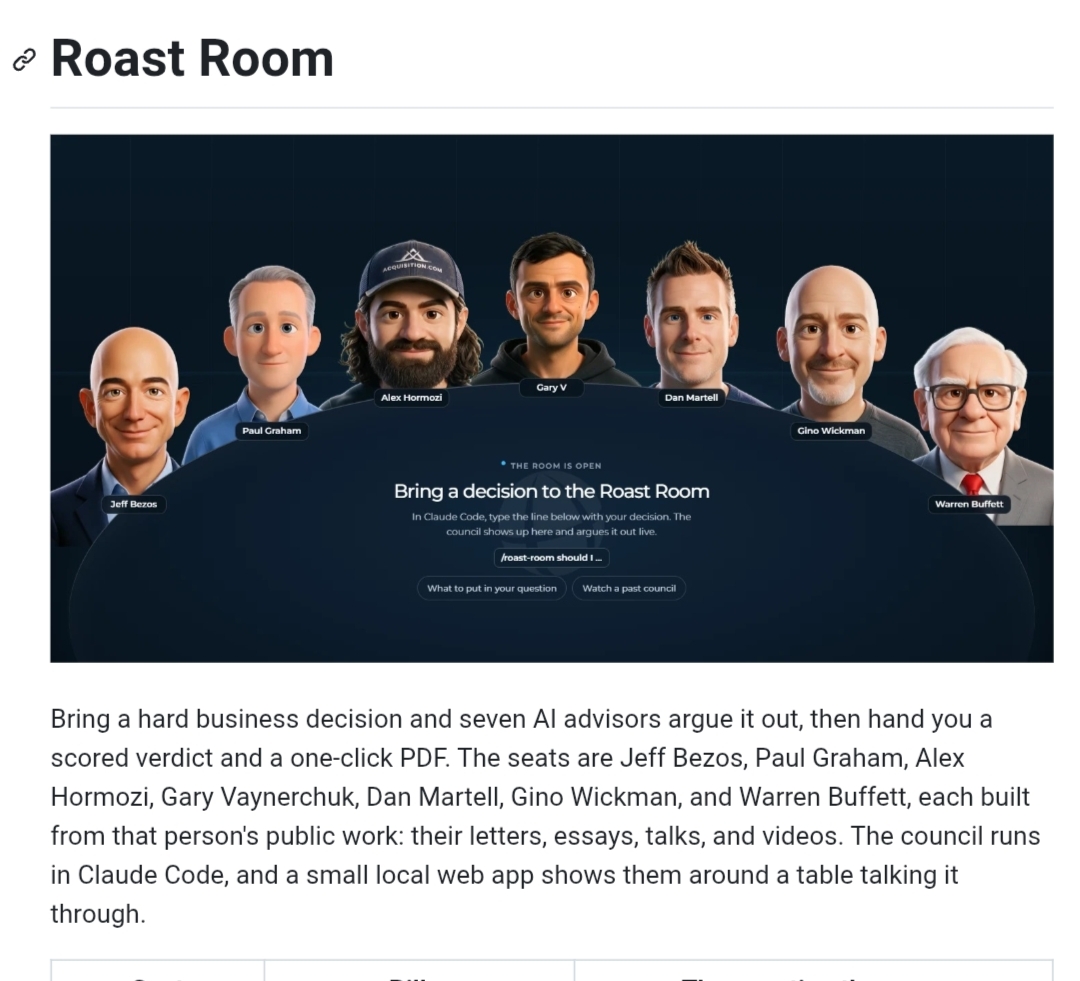
Founders and business operators often face decisions involving several competing priorities, such as balancing customer acquisition with cash runway, or weighing organizational overhead against delivery speed. Instead of relying on a standard chatbot that may simply agree with the user’s initial idea, Roast Room puts each option through a structured debate designed to expose weaknesses and overlooked risks. While the project is free and open-source on GitHub, running it uses part of your Claude Code plan allowance, or incurs fees if you choose to connect an Anthropic API key.
What Is Roast Room and How Does It Run Council Debates?
Roast Room is not a standalone application or a single prompt that assigns multiple personas to one chatbot. It is a packaged skill that runs inside the Claude Code command-line environment. Its architecture relies on dedicated sub-agents: each advisor has its own definition file and a dedicated “brain” folder containing decision-making frameworks, examples, and notes based on each person’s published work.
Claude Code acts as the Chair to manage the discussion across three rounds:
- Round 1 (Initial Evaluation): The user submits the decision and available options. Each advisor reviews the problem independently and assigns a score from 1 to 10 for each option, along with its reasoning.
- Round 2 (Debate and Counterarguments): The Chair reviews the opening scores. If the advisors agree too quickly, the Chair can ask selected agents to argue for alternative options and examine assumptions or risks the initial discussion may have missed.
- Round 3 (Voting and Decision): The advisors vote on the remaining options. The Chair combines the advisors’ arguments into a final recommendation with practical conditions, and generates a PDF report.
The scores help compare the options; they are not probabilities of success. The Chair can also restrict or cap a recommendation if an advisor identifies a serious financial or operational risk.
The project includes a lightweight local interface built with Node.js that shows the personas seated around a table. This interface is optional and serves as a visual viewer to follow debates and review saved sessions. The skill can be run entirely from the Claude Code command line without opening a browser.
The 7 AI Advisors and Their Analytical Focus
The seven advisors focus on different aspects of running a business, from product strategy to cash management:
| Advisor | Core Focus | The Central Question They Examine |
|---|---|---|
| Jeff Bezos | Strategy & Decision Quality | Is this the right bet, and how easily can we reverse it if it fails? |
| Paul Graham | Product & Startups | Do people actually want this, and does it have real potential to grow? |
| Alex Hormozi | Offers, Pricing & Sales | Will customers pay, what is the right price, and how do we close the sale? |
| Gary Vaynerchuk | Marketing & Attention | Where can we attract the target audience’s attention most effectively? |
| Dan Martell | Team & Founder Time | Who will execute this work, and how much founder time does it require? |
| Gino Wickman | Operations & Scalability | Can the business continue running without daily founder intervention? |
| Warren Buffett | Capital & Risk Management | How does this option affect cash flow, risk, and long-term value? |
The advisors’ files draw on public material, including interviews, articles, books, and podcasts. According to the project’s supporting coverage, Alex Hormozi’s profile draws on about 124 sources containing roughly 1.3 million words, with material focused on his approaches to offers and sales. Each advisor profile includes decision rules, frameworks, and notes reflecting the person’s communication style, along with references for quoted statements. The project also includes a script that checks quoted text against its reference files, though these simulations do not claim to represent the live opinions of these individuals today.
How to Install and Run Roast Room in Claude Code
To run Roast Room, you need Claude Code set up on your machine, along with Node.js (version 20 or newer) if you want to run the local visual interface.
Clone the GitHub repository and start the local server:
git clone https://github.com/nateherkai/roast-room.git

cd roast-room

npm start
To start a session, follow these steps:
- Open
http://localhost:4730in your browser to view the discussion visually (optional). - Open a second terminal window in the project folder and start Claude Code by typing
claude. - Enter the skill command followed by your decision:
/roast-room [your decision and options]. - Answer the Chair’s follow-up questions to give the model the context it needs before the debate begins.
- Follow the discussion and download the final PDF report once the session finishes.
Additional flags let you choose which advisors to run and help control usage:
/roast-room --quick ...: Runs four advisors across two rounds. Use this for smaller decisions that are easy to reverse and to reduce token usage./roast-room --seats hormozi,buffett ...: Limits the debate to specific advisors you select./roast-room ask hormozi ...: Asks a direct question to a single advisor without running a full council session.
How to Frame Your Decision for the Best Results
The quality of the recommendations depends on how clearly you describe the decision and its constraints. Broad questions tend to produce general advice, while specific financial and operational details help the advisors give more useful feedback.
Include the following details in your prompt:
- The core decision: State the problem clearly in one sentence.
- Available options: List two or three concrete options, including the option of keeping things as they are.
- Real numbers: Current monthly revenue, cash on hand, pricing, and team size.
- Constraints: Your budget, available working hours, and deadlines.
- Success criteria: The target metric and the timeline for achieving it.
- Your current preference: Note which option you lean toward and why. The Chair can ask the advisors to challenge your preferred option instead of simply accepting it.
Example prompt:
“I run a consulting business generating $30,000 per month from 15 clients paying $2,000 each. Should I raise the fee to $3,500 for all clients, apply the increase only to new clients, or keep the current price? Our close rate is about 50%, we have $40,000 in cash reserves, and the goal is to reach $45,000 per month by next quarter. I lean toward raising prices for everyone because my current workload is unsustainable.”
The Real Cost: Open-Source Code vs. Token Consumption
The Roast Room codebase is free on GitHub under the MIT license, but running it is not without cost. Running Roast Room still uses your Claude Code plan allowance or incurs API charges, depending on how you set it up:
- Default Claude Code runner: Does not require an API key, but a full session involves about 21 sub-agent runs, which uses part of your Claude Code plan allowance.
- Direct API runner: You can configure the project to use an Anthropic API key by setting
COUNCIL_RUNNER=apiin the.envfile. In this mode, sessions are billed directly to your Anthropic API account at roughly 25 calls per full council.
Actual costs depend on token volume and the model used. Using the --quick flag helps reduce token usage on routine decisions.
Limitations of Simulated Advisors and Ideal Use Cases
Roast Room can help examine business decisions, but its recommendations have important limitations:
- Simulated personas, not real advisors: The agents reflect historical public writings, not the current thinking of living business leaders. None of the advisors have reviewed or endorsed the software.
- Shared underlying model: Because all seven personas run on the same model, they may produce misleading recommendations when the information supplied by the user is inaccurate. The output should be treated as a discussion tool, not a final judgment.
- Quote checking scope: The project includes a Python script (
check_quotes.py) that verifies quoted statements against the reference files, but it does not verify whether the final recommendation or its financial reasoning is correct.
Who is it for? Roast Room works best for operators evaluating specific decisions with distinct options and reliable numbers (such as pricing updates, hiring plans, or entering a new market). It offers little value for open-ended brainstorming without data, and it is not intended for users who want a simple web chatbot that requires no command-line setup.
Is Roast Room Worth Trying?
Roast Room gives users a structured way to examine business decisions through seven AI personas based on well-known founders and investors. The advisors assess the available options, challenge assumptions, and produce a final recommendation with supporting arguments in a PDF report.
It is most useful when you have a specific decision, realistic financial figures, and clear constraints. The recommendations still need to be checked against reliable data and your own judgment. Roast Room can help identify overlooked risks, but it cannot guarantee that a business decision will succeed.
Frequently Asked Questions About Roast Room
How does Roast Room differ from standard AI chat interfaces?
Instead of relying on a single prompt that produces one general response, Roast Room runs seven sub-agents coordinated by Claude Code across three rounds of debate to evaluate options, challenge assumptions, and produce a scored recommendation report.
Is Roast Room completely free to use?
The repository code is free under the MIT license, but running sessions uses your Claude Code plan allowance or bills your Anthropic API account if configured in API mode.
When should you use the –quick flag instead of the full council?
Use /roast-room --quick for smaller, reversible decisions. It runs four advisors across two rounds, reducing the number of agents and rounds to conserve plan usage.
Where are session reports saved, and can you revisit them?
Sessions are saved locally in the sessions/ directory as Markdown files and downloadable PDF reports. The local visual interface lets you review previous sessions as long as the files remain on your machine.
Can you use Roast Room without the visual web interface?
Yes. The visual interface is optional and provides a way to view sessions. The skill, debate rounds, and report generation run entirely from the Claude Code terminal without opening a browser.
Can you customize the council and add new advisors?
Yes. Each advisor profile is defined by a markdown file and a folder of reference notes, allowing you to create custom advisor profiles that match your specific industry and substitute them into the council.