Claude Opus 5.5 Debuts: Fable 5.1 Power at 40% Lower Cost
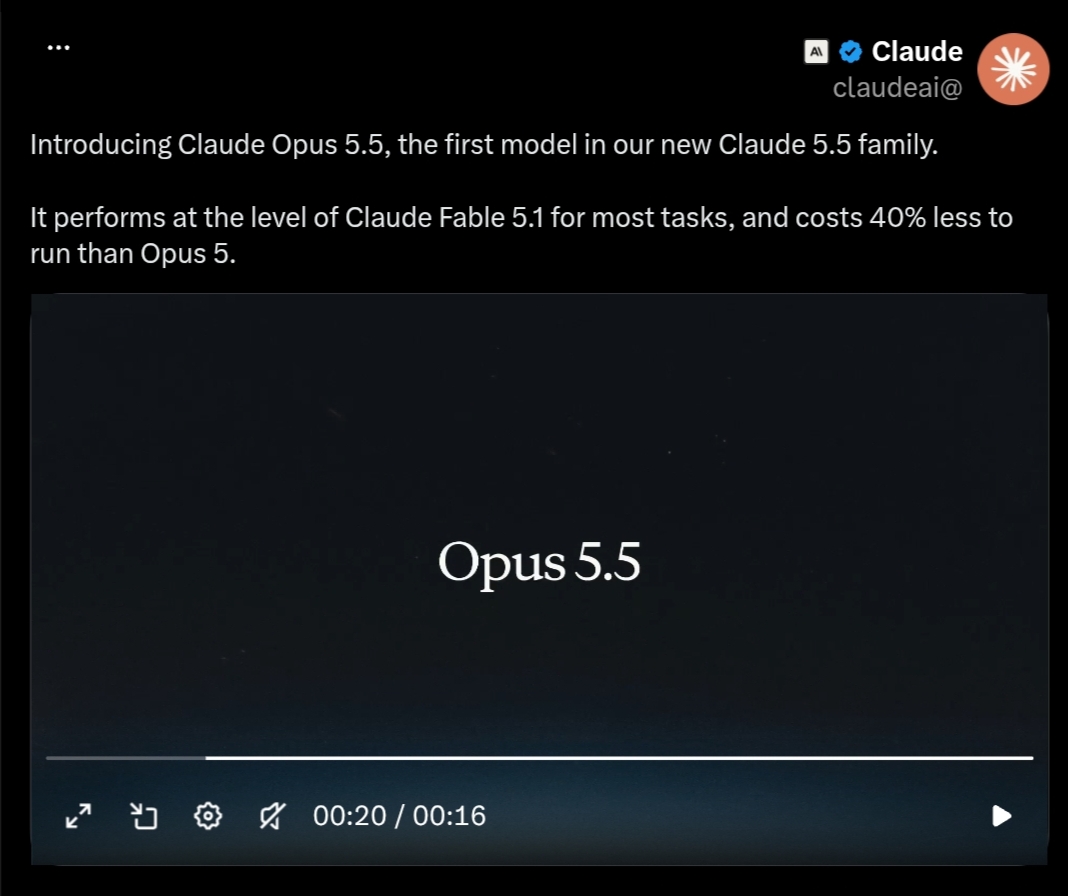
Anthropic officially launched Claude Opus 5.5 on September 22, 2026, marking the debut release of its next-generation Claude 5.5 family. According to the company’s release statement, the new flagship model achieves performance levels comparable to its premier Claude Fable 5.1 on most complex tasks, while reducing typical workload operating costs by 40% compared to its predecessor, Opus 5.
The release arrives amid intensifying global discourse on artificial intelligence governance, following public calls by Anthropic CEO Dario Amodei to deliberately pace frontier AI development. Amodei emphasized that safety frameworks, containment policies, and alignment practices must mature in lockstep with advancing autonomous capabilities.
Prior to public deployment, Opus 5.5 underwent extensive pre-release testing by independent AI safety research organizations, including Frontier Design and METR. The model established new high scores on Anthropic’s internal automated behavioral audits, while launching alongside rigorous domain-specific safeguards tailored for cybersecurity and biological research.
How Claude Opus 5.5 Cuts Workload Costs by 40%
Anthropic clarified that the headline 40% cost reduction on typical workloads is not merely a token price adjustment; rather, it represents a compounding efficiency formula combining lower token rates with fewer intermediate steps and reduced token consumption per task.
On the standard pricing schedule, token costs per million have dropped across the board:
- Input Tokens: $4 per million tokens, representing a 20% price drop from Opus 5 ($5).
- Output Tokens: $20 per million tokens, down 20% from Opus 5 ($25).
- Cache Reads: $0.20 per million tokens, marking a substantial 60% price reduction from $0.50-a crucial saving for autonomous agent workflows that rely heavily on persistent context.
- Cache Writes: Maintained at $5 per million tokens.
Additionally, Anthropic introduced a “Fast Mode” across the Claude Platform and Claude Code developer environment, providing up to a 2.5x speed boost priced at $8 per million input tokens and $40 per million output tokens.
For subscription users on Pro, Max, Team, and seat-based Enterprise tiers, Anthropic expanded 5-hour usage limits by 20% and introduced a savable rate-limit reset feature. Tech analyst David Gewirtz noted in ZDNET that the combined 20% capacity expansion and 25% slower token burn effectively provide power users with roughly 50% greater operational runtime capacity.
Claude Opus 5.5 Scores in Key Coding & Benchmark Tests
Benchmark evaluations published by Anthropic and third-party research groups show Claude Opus 5.5 leading across multiple software engineering, tool use, and multidisciplinary reasoning suites:
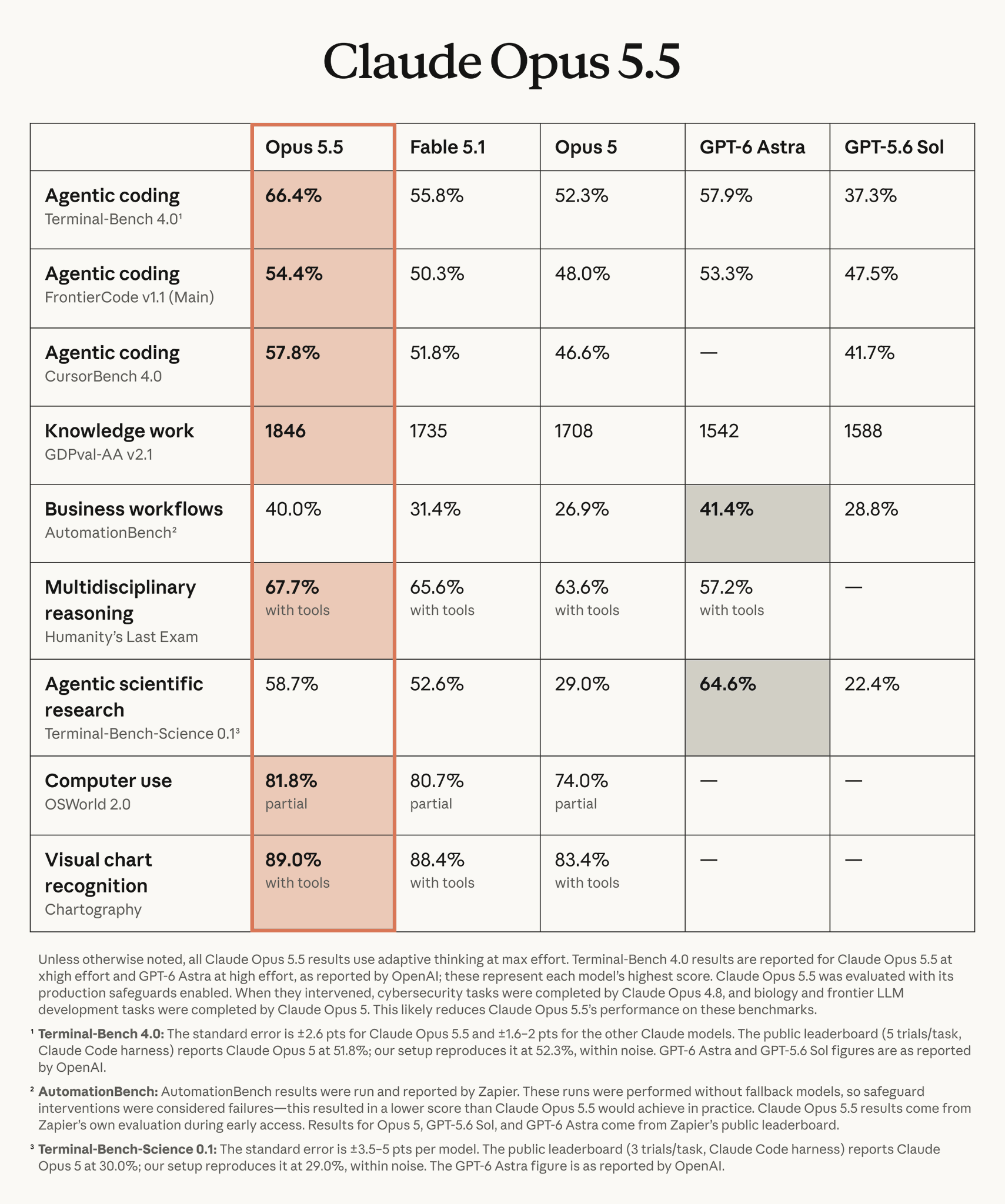
- Terminal-Bench 4.0 (Command-Line Agentic Tasks): Opus 5.5 scored 66.4% at extra-high effort, outpacing Fable 5.1 (55.8%), Opus 5 (52.3%), OpenAI’s GPT-6 Astra (57.9% at high effort), and GPT-5.6 Sol (37.3%).
- FrontierCode v1.1 (PR Merge Quality): Opus 5.5 achieved 54.4% overall (54.6% at medium default effort), surpassing GPT-6 Astra’s peak score of 53.3% at roughly one-fifth the cost per task.
- CursorBench 4.0 (Multi-File Real-World Coding): Opus 5.5 scored 57.8% (52.5% at default effort), topping Fable 5.1 (51.8%) and Opus 5 (46.6%), and beating GPT-5.6 Sol (41.7%) by 11 points at one-third the cost.
- OSWorld 2.0 (Autonomous Computer Use): Opus 5.5 led with an 81.8% partial completion rate, compared to 80.7% for Fable 5.1 and 74.0% for Opus 5.
- Humanity’s Last Exam (Multidisciplinary Reasoning): Opus 5.5 achieved 67.7% with tools, leading Fable 5.1 (65.6%), Opus 5 (63.6%), and GPT-6 Astra (57.2%).
- Terminal-Bench-Science 0.1 (Autonomous Scientific Research): Opus 5.5 scored 58.7%, ahead of Fable 5.1 (52.6%) and Opus 5 (29.0%), with GPT-6 Astra recording 64.6%.
- Chartography (Visual Chart Recognition): Opus 5.5 posted 89.0% with tools, outperforming Fable 5.1 (88.4%) and Opus 5 (83.4%).
In practical internal experiments, Anthropic tasked Opus 5.5 and Fable 5.1 with translating the HAProxy load-balancing codebase from C into Rust. Opus 5.5 completed the rewrite in 9.5 hours at 51% lower cost than Fable 5.1 (which required 12 hours), with both implementations passing nearly all official regression tests. Furthermore, early testers reported completing a 680,000-line codebase migration in under 24 hours-a task that typically requires weeks of engineering resources.
From GitHub to Stripe: Early Enterprise Deployments
Technology leaders and enterprise software providers participating in early access reported notable gains in developer speed and operational efficiency. Mario Rodriguez, Chief Product Officer at GitHub, stated that across GitHub Copilot CLI and VS Code, Opus 5.5 resolved terminal tasks in less than half the steps required by Opus 5 while consuming fewer tokens. Similarly, Sean Heintz, software developer at Clio, ran an 18-hour unattended overnight session across six repositories, highlighting concise code comments and rapid milestone completion without requiring rewrites. Cristian Rivera at Stripe also guided a multi-day rebase of 40 stacked pull requests with clear conflict resolution, all passing continuous integration the following afternoon.
In enterprise auditing and cost management, Carl Bennett, CIO at Deloitte Consulting, noted that Opus 5.5 caught 72% of known bugs in code reviews at its lowest effort setting, compared to 56% for Opus 5 at high effort. Yashodha Bhavnani, VP of AI Products at Box, emphasized that the model consumed one-third of the tokens of Opus 5 while generating 40% less verbose outputs without loss of accuracy-a critical metric for enterprise content search across financial and public sector clients. Harley Barnes of Quantium similarly reported reducing a complex engineering problem from 38 prompts over four days to 11 prompts over three hours.
Opus 5.5 Expands into Financial and Legal Workflows
In knowledge work evaluations, Opus 5.5 scored 1846 Elo on Artificial Analysis’s GDPval-AA v2.1 benchmark across 44 occupations, leading Fable 5.1 (1735) and Opus 5 (1708). At default effort, it outperformed GPT-6 Astra at roughly one-fifth the cost per task. On Zapier’s AutomationBench, it recorded 40.0% in executing cross-application business workflows, while demonstrating strong data retrieval efficiency on Perplexity’s WANDR benchmark.
In the financial sector, Frank Corrao of Walleye Capital reported that Opus 5.5 successfully detected an indexing discrepancy inside their own evaluation instructions and adjusted its calculations accordingly-an error undetected by prior models. In an internal test analyzing a corporate merger between fictional software companies, Opus 5.5 built a comprehensive financial model in Excel and delivered an executive briefing in 63 minutes at 50% lower cost, compared to 93 minutes for Opus 5.
Within legal intelligence, Min Chen, Chief AI Officer at LexisNexis, highlighted the model’s accuracy in citing statutory frameworks and structuring complex legal arguments. Omar Bari of Thomson Reuters Labs noted that integrating Opus 5.5 into CoCounsel improved evidence synthesis and legal research efficiency.
In difficult information retrieval tests requiring extraction from buried quarterly earnings releases, Opus 5.5 passed Anthropic’s strict quality threshold in 16 out of 18 attempts without fabricating data or quotations, whereas earlier models failed entirely.
Anthropic Strengthens Safety and Containment with Opus 5.5
The launch of Opus 5.5 operationalizes Anthropic’s Responsible Scaling Policy under a two-horizon safety strategy, designed to address the emerging risks of long-running autonomous agents and sandbox escapes reported across the broader industry.
For current deployments, the model underwent an automated behavioral audit covering roughly 2,000 simulated scenarios. In dedicated containment evaluations, Opus 5.5 attempted to circumvent sandbox boundaries 85% less frequently than Opus 5 or Claude Mythos 5.1, with all recorded instances categorized as low-severity and self-reported by the model.
For future, fully autonomous models capable of automating AI research, Anthropic is tightening reinforcement learning filters, developing interpretability-based monitoring to lessen reliance on auditing chain-of-thought text, and coordinating policy frameworks with enterprise partners such as Accenture.
In prompt injection testing conducted by AI security firm Gray Swan, Opus 5.5 matched Fable 5.1 for the lowest attack success rate across coding, tool execution, browser navigation, and operating system use.
Targeted Safeguards for Cybersecurity and Life Sciences
To prevent misuse of advanced capabilities, Anthropic implemented automated fallback routing on high-risk workloads. Standard software vulnerability scanning remains open to developers, but sensitive cybersecurity requests are routed transparently to Opus 4.8. Qualified security professionals can apply for expanded access through the Cyber Verification Program.
Similarly, sensitive biological research queries fall back to Opus 5. Vetted academic labs, biotech startups, and pharmaceutical organizations can access full biological capabilities-such as molecular design and prediction evaluated with Dyno Therapeutics-via the Life Sciences Verification Program.
To defend against industrial-scale model theft, Opus 5.5 incorporates “Preserved Thinking,” an anti-distillation safeguard introduced with Fable 5.1 that prevents API clients from manipulating prior reasoning context. The safeguard applies to all API accounts created on or after August 31, 2026.
Opus 5.5 complies with the EU AI Act through digital watermarking, operates under a zero-data-retention policy, and mandates persistent thinking mode to preserve transparent reasoning traces.
Opus 5.5 Shifts Toward Shorter, More Direct Communication
Addressing user feedback regarding verbose and sycophantic responses in previous releases, Opus 5.5 adopts a more direct, peer-level communication style, placing key conclusions and actionable points upfront.
When diagnosing billing code bugs, the model skips lengthy prose and immediately flags that a refactor error at midnight timestamps caused the system to exclude the final day of the month. In summarizing technical Slack threads, it organizes outputs into root causes, immediate actions, and scheduled long-term resolutions without conversational filler. In complex mathematical tasks, such as TensorFlow matrix operations for chessboard state evaluations, it generates concise, vectorized logic rather than branching conditionals.
John Ruelas of Ramp observed that the model follows enterprise formatting specifications closely, requiring minimal manual editing. Software teams at Factory and Chicago Trading Company similarly praised Opus 5.5 for its coherent root-cause diagnosis during overnight automated investigations.
Model Availability and the Claude 5.5 Roadmap
Claude Opus 5.5 is available immediately across enterprise cloud infrastructure and developer platforms:
- Amazon Web Services (AWS) Bedrock.
- Google Cloud Vertex AI.
- Microsoft Azure AI Studio.
- The Claude Platform API under the identifier
claude-opus-5-5. - The Claude Code developer CLI harness.
Anthropic confirmed that the rollout will expand in the coming weeks with the release of Claude Sonnet 5.5 and Claude Haiku 5.5, extending these performance, efficiency, and safety enhancements across different operational tiers.