AI Agent Comparison: Claude Duet vs. Grok Bot vs. Meta Muse vs. OpenAI Dots
AI assistants are moving beyond answering questions, writing content, and summarizing documents. Companies are developing AI agents that can work in the background, interact with digital services, and handle tasks over extended periods without requiring users to supervise every step.
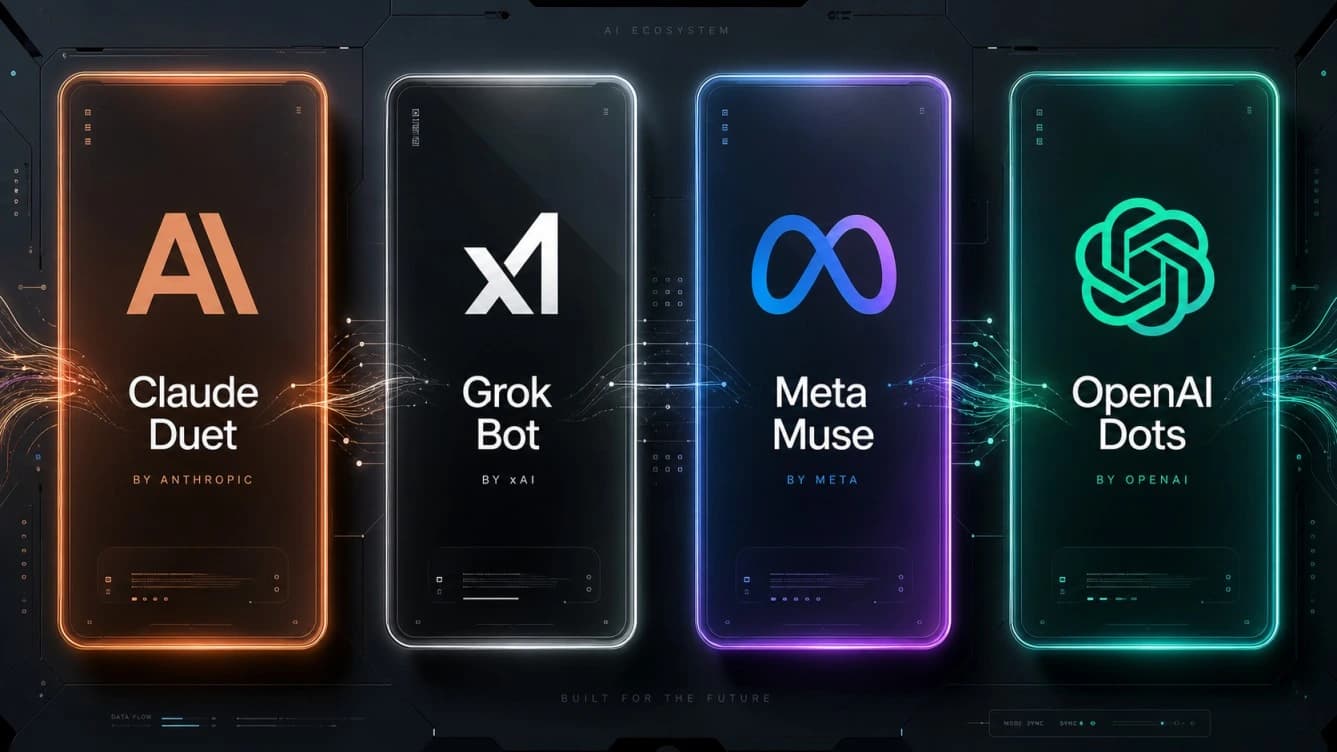
Four products illustrate this shift: Claude Duet from Anthropic, Grok Bot from xAI, Meta Muse, and OpenAI Dots. While all four aim to move AI beyond conversational assistance toward task execution, they differ in their integrations, pricing, availability, and the level of control users retain over their actions.
Which AI agent is better suited to personal tasks? Which is designed for professional workflows? And what should users consider before relying on one of these systems?
What Are Always-On AI Agents?
Traditional chatbots generally respond to prompts and wait for the next instruction. Always-on AI agents take a different approach: they can work in the background, organize multi-step tasks, interact with connected services, and return with results or request human input when a decision is needed.
Potential applications include managing email, tracking appointments, preparing reports, researching information, and coordinating work across multiple applications. Some agents operate within cloud-based computing environments, allowing them to continue executing tasks without requiring the user’s computer to remain open.
However, the term always-on does not mean an agent has unlimited permissions or can complete every task independently. Its actual capabilities depend on available integrations, granted permissions, usage limits, and the safeguards governing sensitive actions.
Claude Duet vs. Grok Bot vs. Meta Muse vs. OpenAI Dots: Key Differences
| Feature | Claude Duet | Grok Bot | Meta Muse | OpenAI Dots |
|---|---|---|---|---|
| Developer | Anthropic | xAI | Meta | OpenAI |
| Underlying models | Claude Opus 5.5 | xAI models and Cursor | Muse Spark 1.3 for free users; Muse Wonder for paid users | GPT-6 Astra |
| Primary use | Professional workflows and business tasks | Task execution through an environment connected to xAI services | Personal assistance and background tasks | Persistent tasks within the ChatGPT ecosystem |
| Integrations | More than 6,000 connectors and extensions through the marketplace, including Gmail, Slack, Stripe, QuickBooks, Gusto, DocuSign, and Shopify | Model Context Protocol (MCP) connectors, including Notion, GitHub, Gmail, and X, plus direct cloud browsing of websites such as WhatsApp Web | Meta apps, including WhatsApp and Instagram, partner services, and virtual payment cards through Stripe Link | More than 4,000 third-party apps and extensions, with deep integrations into Slack and Microsoft Teams |
| Availability | Limited research preview through a waitlist for eligible users in the United States | Available globally through eligible subscription tiers on the web and in supported apps | Gradual rollout in the United States, Canada, and Mexico through a standalone app, the web, and WhatsApp | Gradual rollout for eligible subscription tiers, excluding the European Union, United Kingdom, and Switzerland |
| Pricing | Included at no additional charge with Claude Pro ($20/month) and Max, with tasks counting toward the account’s shared usage limits | Starts at $30/month with X Premium, with higher tiers at $100 for Super and $200 for Ultra; not included with Plus | Limited free access of up to 100 million tokens per week, with paid Power ($20) and Maximum ($100) plans | Available exclusively to ChatGPT Pro subscribers ($100/month) and eligible enterprise plans; not included with Plus or Go |
| Key strength | Professional workflows and business integrations | Connection to the xAI ecosystem and a full Linux environment | Personal assistance and background work | Persistent tasks integrated into ChatGPT |
This comparison outlines the intended focus of each product. Pricing, regional availability, and permissions may change as the services expand. An integration with a particular service also does not necessarily mean an agent can perform every operation within it without restrictions.
Claude Duet: A Business Assistant That Goes Beyond Chat
Anthropic’s Claude Duet is designed to handle professional tasks rather than simply provide answers. Its core idea is to let users delegate work to Claude, which can continue working within an environment connected to the tools and services required for the task.
Powered by Claude Opus 5.5, Duet targets workflows that involve multiple steps, such as gathering information from different sources, organizing work, and following processes that span business applications.
Business integrations
One of Claude Duet’s main strengths is its broad integration ecosystem. Supported services include Gmail, Slack, QuickBooks, Stripe, Gusto, LinkedIn, DocuSign, HubSpot, Canva, and Shopify.
These connections can allow the agent to work across several services as part of a single workflow, reducing the need to move information manually between applications. This could be particularly useful for small businesses and teams that regularly handle correspondence, documents, financial data, and customer management.
Access still depends on the permissions granted to each connected service and the operations that its integration supports. Connecting Claude Duet to an application does not automatically give it unrestricted access to all account data or the ability to modify every item.
Pricing and availability
Claude Duet is available through a limited research preview, with access beginning for eligible subscribers in the United States on Claude Pro and Max plans. There is no separate subscription fee for eligible users, but activity counts toward the usage limits shared with Claude.
This means the agent does not necessarily require an additional subscription, although the amount of work users can delegate remains tied to their available usage allowance. Someone using Duet for short tasks may have a very different experience from someone relying on it for long, recurring workflows.
What should users consider?
Tasks involving sending messages, making payments, signing documents, or deleting data require particular care. Claude Duet requests user approval before certain sensitive actions. Some operations, including securities trading and transfers between financial accounts, remain outside its permitted scope even with approval.
The agent may also misunderstand instructions or make mistakes. Its access to files and projects may be limited, and it may not be able to modify every part of a user’s work within Claude.
For these reasons, users should define tasks clearly and review the results before relying on them for important decisions.
Grok Bot: An Agent Within the xAI Ecosystem
Grok Bot represents xAI’s effort to extend Grok from a conversational assistant into a system that can carry out tasks. It is associated with a subscription ecosystem that combines AI services and related tools, making it part of a broader offering rather than an entirely separate product.
The basic approach is to delegate work to an agent that can use the tools and resources available to it and follow the steps required to complete a task. Its capabilities depend on the environment in which it operates, its permissions, and the subscription tier being used.
Pricing and subscription tiers
xAI offers several subscription tiers, but not every plan includes Grok Bot. The pricing structure described here includes a free tier, Plus at approximately $8 per month, Premium at $30 per month, Super at $100 per month, and Ultra at $200 per month.
Grok Bot is included with Premium, while Plus does not include the agent. Usage is also tied to the weekly allowance associated with the subscription, making usage limits an important consideration alongside the monthly price.
Choosing the least expensive tier is not necessarily the best approach simply because it provides access to Grok. Users should check whether the plan includes the specific agent they need, how much work they can delegate, and whether the available allowance fits their daily workload.
Who is Grok Bot for?
Grok Bot may appeal to users who want to work within the xAI ecosystem and consolidate their AI tools under one subscription, particularly if they already use the company’s services.
However, its value depends on more than the number of tasks it can perform. Reliability, usage limits, and the suitability of its available integrations also matter.
As with other always-on agents, background execution does not mean complete independence from the user. Tasks that require special permissions or involve consequential actions remain subject to the service’s rules and settings.
Meta Muse: A Personal Assistant That Works in the Background
Meta is pursuing an approach centered on a personal assistant that can continue handling tasks in the background rather than requiring the user to guide every step. Muse fits into this direction, with limited free access and paid upgrade options.
The aim is to make the assistant more useful for everyday activities by allowing it to follow up on work and handle connected tasks instead of serving solely as an interface for answering questions. This approach could help users organize personal activities, manage recurring tasks, and reduce repetitive manual work.
Background execution and permission controls
An important part of the Muse experience is its ability to work in the background and use a dedicated environment for task execution. This gives the agent room to continue working without displaying every step to the user, but it also makes permission management especially important.
The more access an assistant has to accounts and services, the more important it becomes to understand what it can view and change. Users should review available permissions and their limitations before assigning tasks involving personal information or actions that may be difficult to reverse.
Pricing and usage limits
Meta offers free access to Muse within defined limits, alongside paid upgrade options. Free access should not be interpreted as unlimited usage, nor does it necessarily include every available capability.
The actual experience depends on the account’s eligibility, the selected plan, and the features available in the user’s region. These details may evolve as the service’s rollout expands.
For practical use, Muse is best evaluated by how well it handles the tasks a user actually needs, how it connects to their existing services, and how clearly its controls govern its actions.
OpenAI Dots: Bringing Persistent Tasks Into ChatGPT
OpenAI Dots aims to extend ChatGPT beyond conventional conversations by allowing users to delegate tasks to an agent that can continue working in the background rather than simply suggesting the next steps.
This approach shifts the experience from a conversation that ends with an answer to a workflow that can involve multiple stages and take time to complete. Depending on the available features and permissions, those tasks may involve research, organization, and interaction with connected services.
Availability and pricing
Dots is being rolled out gradually to eligible users on supported plans, including ChatGPT Pro and Business Premium in supported markets. Users on Enterprise, Edu, and Healthcare plans may also be able to try the preview when their organization’s administrator makes it available.
The eligible plan includes the first agent at no additional charge, subject to the service’s terms. Access still depends on account eligibility, region, and rollout status, so a paid ChatGPT subscription does not automatically guarantee that Dots is available to every user.
What makes the experience different?
Dots builds on the ChatGPT ecosystem, giving users a familiar environment for delegating and tracking tasks. Its workflow can also extend to connected channels and services, depending on the integrations and settings supported by the product.
However, the ability to read information is not the same as the ability to perform an action in an external application. Different operations have different permission requirements, and not every integration provides the same level of control or automation.
Reviewing results remains important, particularly when a task involves sensitive information or professional decisions. Background execution can reduce the need to monitor every step, but it does not remove the need to verify the final outcome.
Security and Privacy: Who Controls the Agent’s Actions?
An AI agent’s value is not determined by its ability to complete tasks alone. As agents gain access to email, files, accounts, and financial services, safeguards become increasingly important in deciding what they can do and when they need the user’s approval.
The four products use different approaches to security and control, so their policies should not be treated as interchangeable. One service may require explicit approval before sending a message or carrying out a financial action, while another may rely on permission settings or different restrictions.
Before relying on an AI agent, users should consider several factors:
- Access permissions: Review which applications and accounts the agent can connect to. Avoid granting broader access than the task requires.
- Sensitive actions: Check which operations require manual approval, especially sending messages, deleting files, signing documents, and handling payments.
- Personal data: Understand how information accessed by the agent is processed and whether a task requires sharing sensitive data with an external service.
- Result verification: Do not automatically trust outputs used for important financial or professional decisions, even if the agent has completed similar tasks successfully in the past.
- Automation limits: Confirm that the service can actually perform the required task rather than relying on broad claims about autonomy or continuous operation.
Limiting permissions and reviewing results before consequential actions is generally safer than allowing an agent to make every decision without oversight.
Which AI Agent Best Fits Your Needs?
There is no single option that is necessarily best for every use case. The practical choice depends on the work involved, the services a user already relies on, their budget, and the usage limits attached to each plan.
For professional workflows and business applications: Claude Duet stands out for its focus on structured work and integrations with a broad range of professional services. It may suit users who want to gather information and coordinate processes across multiple tools, subject to its availability and usage limits.
For users invested in the xAI ecosystem: Grok Bot is worth considering if their subscription includes it and its available tools fit their needs. The cost should be evaluated in terms of both the subscription tier and the usage allowance, not just the monthly price.
For personal assistance and background tasks: Meta Muse takes a personal-assistant approach to ongoing work. Its suitability depends on which features are available to the user’s account, the applicable limits, and the integrations they need.
For existing ChatGPT users: Dots may be a natural option for extending ChatGPT into tasks that continue in the background, provided the feature is available in their region and plan and its permissions match the intended work.
Before subscribing to any of these services, it helps to answer three questions: What task do you want to delegate? Which applications will the agent need to access? How often will you use it each month?
These questions help establish the service’s actual value instead of basing a decision on general promises or the number of integrations alone.
Choosing the Right Always-On AI Agent
The competition between Claude Duet, Grok Bot, Meta Muse, and OpenAI Dots reflects a broader change in how people use AI. The goal is no longer just to obtain a useful answer, but to delegate work to an agent that can follow a sequence of steps and execute tasks within a connected digital environment.
Each product has a different emphasis. Claude Duet focuses on professional workflows and business integrations, Grok Bot is tied to xAI’s ecosystem and subscription tiers, Meta Muse targets personal assistance and background work, and OpenAI Dots extends the ChatGPT experience toward persistent tasks.
Ultimately, the best choice is not determined solely by the model’s name or the number of tools it supports. What matters is whether the agent can handle the tasks a user actually needs, whether its cost makes sense within the available usage limits, and whether it provides an appropriate level of control over data and actions.
The most useful agent is not necessarily the one with the greatest autonomy. It is the one that saves time and effort while allowing users to understand, review, and control what it does.