GLM-5.3-Flash Solves the “Ox Alpha” Mystery: How Z.ai Built a 320B Open Model at Flash Cost
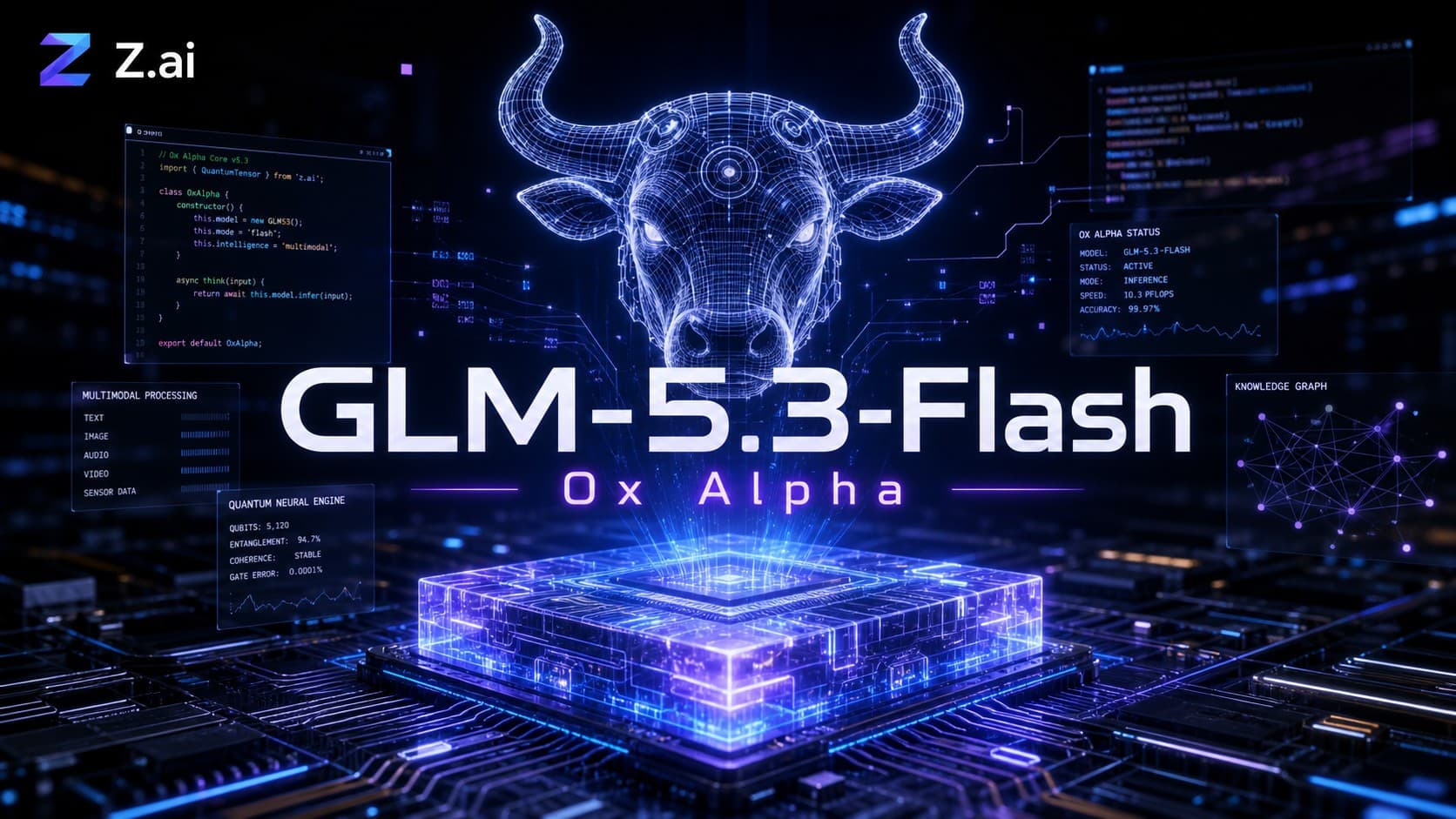
Beijing-based AI lab Z.ai (formerly Zhipu AI), which made history earlier this year as the world’s first publicly traded frontier LLM developer on the Hong Kong Stock Exchange, has officially unveiled GLM-5.3-Flash. The announcement resolves a week of intense speculation across Silicon Valley and developer communities regarding the identity of a mystery model previewed as “Ox Alpha.” Sporting a total parameter footprint of 320 billion with an ultra-sparse activation of just 18 billion parameters per token (320B-A18B), the model is natively multimodal, offers a 1-million-token context window, and is distributed under a permissive MIT open-weights license on Hugging Face. Crucially, Z.ai revealed that the entire deployment runs on a massive domestic cluster of Chinese AI accelerators, delivering near-frontier intelligence at a fraction of standard inference costs amid tightening international chip restrictions.
Inside the “Ox Alpha” Mystery: How a Stealth Preview Captivated Developers
Over the past week, online developer hubs, Reddit’s machine learning forums, and AI benchmarks were gripped by the sudden appearance of an unbranded model codenamed “Ox Alpha” on routing platforms OpenRouter and OpenCode. Within six days of its anonymous debut, Ox Alpha processed over 20 trillion tokens, setting a record on OpenRouter as the fastest-growing model launch by token volume. Offered free of charge with generous rate limits, it quickly surged to the top of usage leaderboards as developers tested its coding agility and sustained agent workflows.
The model earned immediate praise from high-profile technology figures, including Stripe CEO Patrick Collison, who highlighted its impressive performance on X. While some analysts initially hypothesized that the model originated from Microsoft’s internal MAI research, seasoned reverse-engineers noted undeniable behavioral fingerprints: tokenizer patterns, prompt structures, and internal server error codes (specifically error 1214) matched the infrastructure of Z.ai, which had previously run anonymous tests under the moniker “Pony Alpha.”
Culturally, Chinese social media users on Weibo connected the “Ox” alias to Niu Lai (“Here Comes the Ox”), a viral animated meme of the summer, correctly deducing the model’s domestic Chinese origin. Z.ai’s official announcement confirmed these suspicions while clarifying an important technical distinction: Ox Alpha served as an early, anonymous preview environment designed to stress-test real-world agent interactions, whereas the official GLM-5.3-Flash release represents the refined, stable production checkpoint.
The Architecture Behind “Flash”: 320 Billion Parameters at 18B Compute
The engineering philosophy behind GLM-5.3-Flash directly tackles the economic bottleneck of large-scale inference. Rather than training a massive dense model that demands enterprise-scale compute for every token generated, Z.ai engineered a highly sparse Mixture-of-Experts (MoE) architecture. The model stores 320 billion total parameters but selectively routes requests to activate only 18 billion parameters per token. Furthermore, the engineering team slashed the depth of the network from 92 layers (used in the GLM-4.5 generation) down to 45 layers, nearly halving latency overhead.
To master long-context workloads without quadratic compute explosions, GLM-5.3-Flash introduces a breakthrough hybrid attention mechanism combining Linear Attention and Sparse Attention:
- Linear Attention: Efficiently captures local token dependencies through state-space modeling, bypassing traditional memory bottlenecks.
- Sparse Attention: Dynamically retrieves critical global context from long-term memory via a lightweight indexer.
- IndexPool Compression: Compresses four indexer key vectors into a single vector via weighted pooling, drastically reducing memory bandwidth overhead during 1-million-token context queries.
Trained on a curated 30-trillion-token multimodal dataset and stabilized using Manifold-Constrained Hyper-Connections (mHC), the architecture achieves a 3.0x reduction in attention computation and a 4.4x reduction in Key-Value (KV) cache size compared to the base GLM-5.3 flagship. This design allows the model to retain needle-in-a-haystack precision across its full 1M-token window at unprecedented inference speeds.
Native Multimodality in the Coding Loop: Beyond Raw Text
Most AI coding assistants operate in a purely text-based silo, generating code without ever “seeing” what that code produces. Z.ai structured GLM-5.3-Flash around the realization that modern engineering-particularly frontend design, game development, and 3D simulation-is intrinsically visual. Bugs, misalignments, and rendering failures often only become apparent when the software is actually executed and displayed on a screen.
GLM-5.3-Flash natively integrates computer vision directly into its agentic execution loop, operating under a closed paradigm of “Observe → Implement → Use → Refine”. This visual feedback loop enables diverse autonomous capabilities:
- Frontend Web Engineering: The model accepts UI screenshots, screen recordings, or design mockups and translates them into full-stack Next.js and TypeScript repositories. After launching the local server, the agent captures rendered page screenshots, compares them visually against the reference design, and iteratively corrects layout discrepancies, padding errors, typography, and animation states.
- 3D Scene Synthesis (Blender): Rather than outputting blind Python scripting, the agent iteratively constructs spatial assets, configures lighting, and positions cameras in Blender, performing multi-round fixed-camera test renders to verify scale and surface textures before delivering ready-to-use
.blendproject files. - Game Prototyping (Godot 4): Translates gameplay rules into functional Godot mechanics, testing movement logic, collision boundaries, and UI score counters across complete interactive gameplay sessions.
- Parametric CAD Blueprints: Interprets mechanical engineering drawings and part blueprints, generating parametric 3D models via
build123dand exporting validated STEP/STL manufacturing files.
Autonomous Enterprise Workflows: Office Tasks & Financial Modeling
Beyond traditional coding environments, GLM-5.3-Flash extends its visual-reasoning capabilities to unstructured enterprise knowledge work. Most corporate workflows revolve around complex documents containing interwoven text, formulas, layout constraints, and charts.
In standard business administration, the model autonomously authors and audits complete presentation decks and documentation across PPTX, PDF, DOCX, and XLSX formats. Using post-rendering visual inspection, the model scans output pages to proactively detect and repair text overflow, misaligned margins, image cropping flaws, and chart overlapping. In financial research, the agent ingests quarterly corporate filings, dissects balance sheets, and constructs dynamic, formula-driven valuation models in Excel, strictly separating disclosed accounting facts from analytical forecast assumptions.
Through integrated Computer Use (CUA) and Browser Use (BUA) agents, the model can navigate graphical user interfaces lacking structured APIs-clicking buttons, filling forms, and validating web application workflows exactly as a human QA engineer would.
Scaling on Domestic Hardware: Bypassing the GPU Bottleneck
The geopolitical backdrop of GLM-5.3-Flash’s deployment adds a profound dimension to its release. With strict US export controls barring Chinese firms from acquiring cutting-edge hardware such as Nvidia’s Blackwell architecture or upcoming Rubin systems, frontier AI development in China has faced severe hardware constraints. Z.ai countered this challenge by deploying GLM-5.3-Flash across a massive cluster powered entirely by domestically developed Chinese AI accelerators.
To overcome single-chip memory bandwidth limitations, Z.ai co-designed an optimized software serving stack built on the open-source SGLang framework. In an impressive display of recursive engineering, the team deployed an internal “Infrastructure Agent” powered by GLM-5.3, which analyzed kernel bottlenecks, wrote custom optimizations, and assisted engineers in refining the runtime engine serving the model itself.
The resulting architecture incorporates an Encode-Prefill-Decode (EPD) disaggregated design that decouples multimodal visual encoding, prompt prefill, and token generation into independently scaled worker pools. Combined with W8A8 weight quantization, hybrid INT8/FP8/BF16 cache strategies, and intra-node tensor parallelism, Z.ai achieved a 3x throughput improvement over initial baselines, matching the per-token inference economics and hardware efficiency of mainstream Nvidia enterprise clusters.
Benchmark Analysis: Examining the Numbers and Real-World Limits
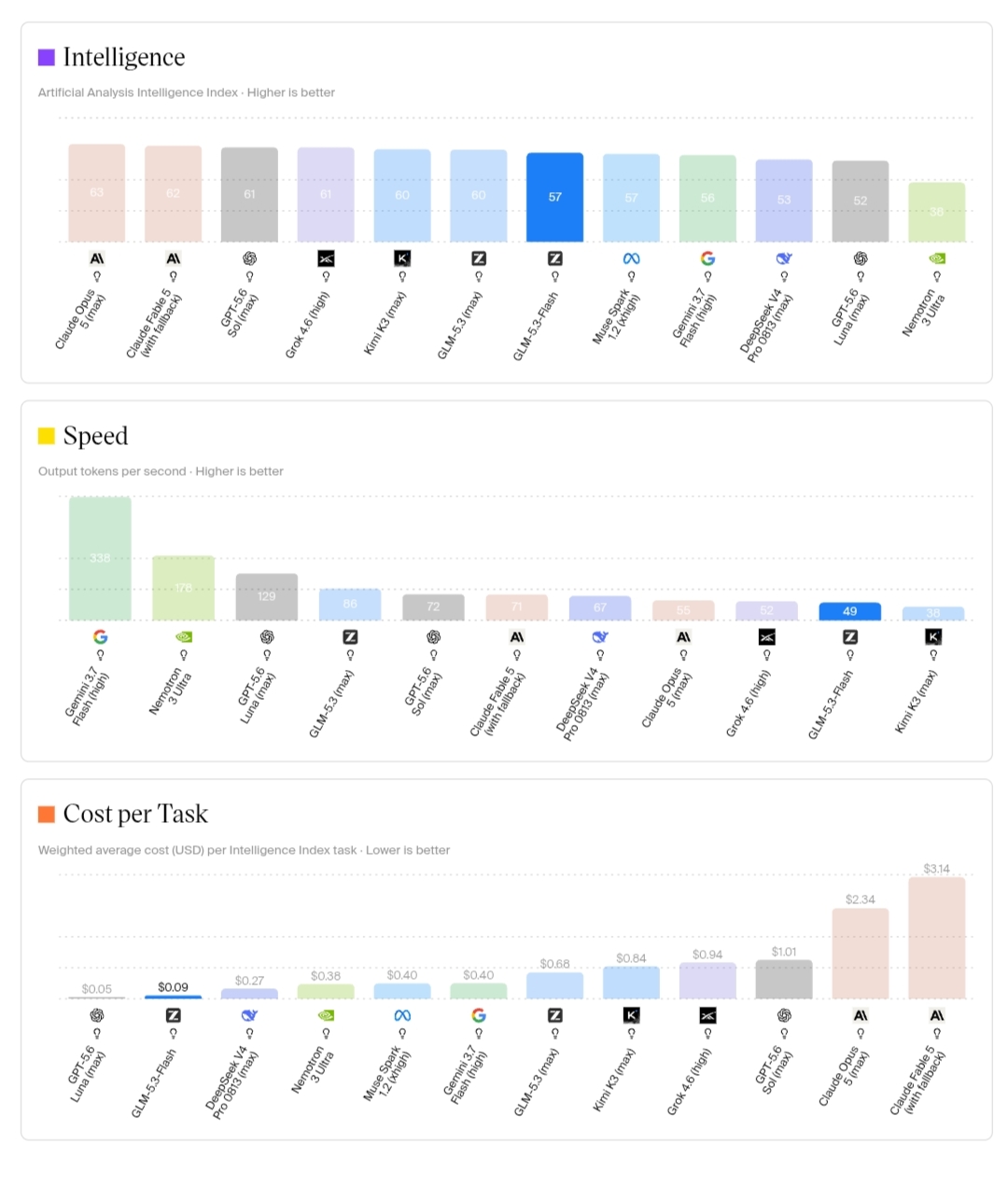
Editorial & Reporting Note: The performance comparisons detailed below are drawn from official evaluation data published by Z.ai and Artificial Analysis. They demonstrate directional engineering progress under specified evaluation harnesses rather than a single unified, third-party benchmark encompassing all closed models under identical conditions.
1. Coding & Software Engineering Benchmarks
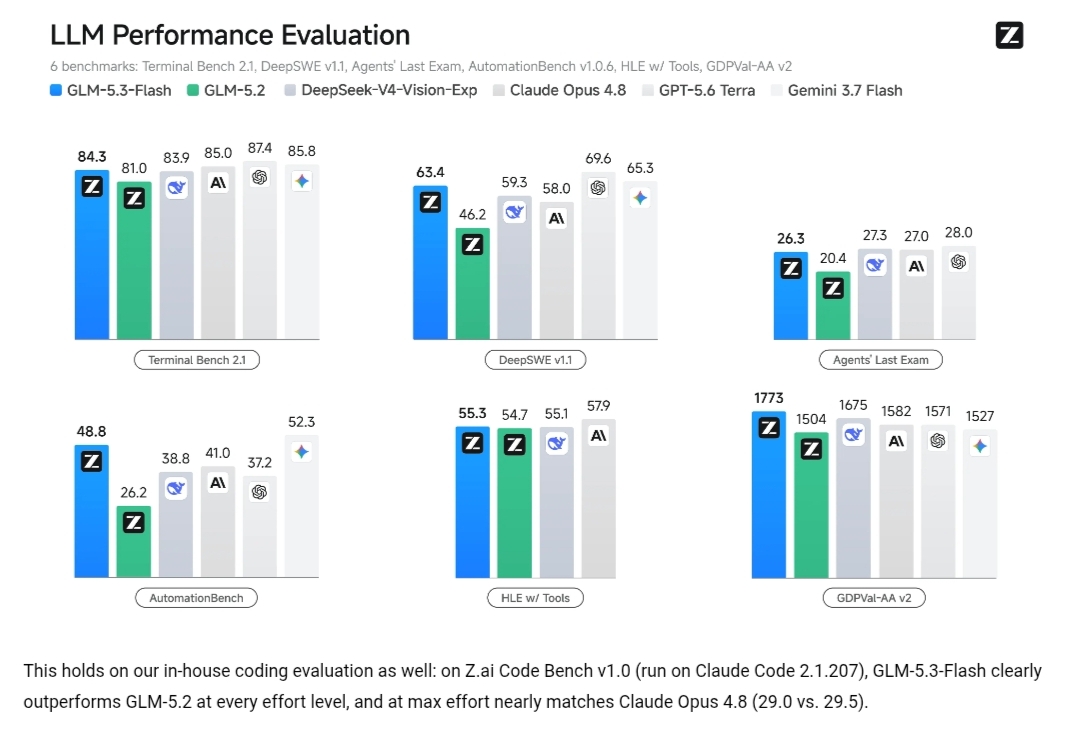
- DeepSWE v1.1: Scored 63.4%, representing a major leap over GLM-5.2 (46.2%), while surpassing Claude Opus 4.8 (58.0%) and DeepSeek-V4-Vision-Exp (59.3%). However, it trails closed frontier giants such as GPT-5.6 Terra (69.6%) and Gemini 3.7 Flash (65.3%).
- Terminal-Bench 2.1: Reached 84.3%, outpacing GLM-5.2 (81.0%) and DeepSeek (83.9%), while sitting within close range of Claude Opus 4.8 (85.0%).
- LiveCodeBench-Base: The base model variant recorded 37.6%, outperforming GLM-4.5-Base (28.1%), GLM-5-Base (34.4%), and DeepSeek-V4-Flash-Base (29.9%).
- Z.ai Code Bench v1.0 (Max Effort): Reached 29.0, effectively matching Claude Opus 4.8 (29.5) under identical Claude Code harness setups.
2. Agentic & Visual Reasoning Benchmarks
- AutomationBench v1.0.6: Recorded 48.8%, nearly doubling GLM-5.2 (26.2%) and surpassing Claude Opus 4.8 (41.0%) and GPT-5.6 Terra (37.2%).
- GDPval-AA v2: Scored 1773, outranking Claude Opus 4.8 (1582), GPT-5.6 Terra (1571), and Gemini 3.7 Flash (1527).
- Multimodal Reasoning (CharXiv w/ Tools): Reached 89.4%, demonstrating high-fidelity chart parsing on par with Claude Opus 4.8 (89.9%) and ahead of GPT-5.6 (88.0%).
- OfficeQA Pro: Scored 62.4% on complex PDF corpora, well ahead of Claude Opus 4.8 (48.9%) and DeepSeek (57.9%).
A rigorous journalistic reading makes clear that GLM-5.3-Flash does not dominate the frontier across every metric. In complex repository-level refactoring evaluations like NL2Repo, Claude Opus 4.8 retains a substantial lead (69.7% vs. 56.3%). Similarly, closed models still hold advantages in multi-stage cyber-exploit scenarios. The core narrative is therefore not absolute supremacy, but the delivery of 90-95% frontier capability at 10% of the cost, backed by open weights.
Getting Started: Access Guide for End-Users & Developers
Z.ai has deployed multiple pathways to access GLM-5.3-Flash, spanning turnkey hosted interfaces for non-technical professionals to direct open-weight deployment for infrastructure engineers.
1. For End-Users, Analysts, and Non-Technical Teams
- Web Access: Available directly via the official portal at
z.ai/subscribethrough Personal and Team subscription tiers. - GLM Coding Plan Quota: Provides 3x the active usage quota compared to the flagship GLM-5.3. Calls made during off-peak windows (including all day on weekends) consume only 50% of the standard usage point allowance.
- No-Code Document & Web Agents: Users can generate, visually audit, and correct PPTX, PDF, and XLSX deliverables directly within the chat workspace, or invoke Browser Use agents to summarize live web data.
2. For Developers & Software Engineers (Hosted API)
The hosted endpoint is fully compatible with OpenAI-style Chat Completion schemas:
- Model Identifier:
glm-5.3-flash - Recommended Runtime Parameters:
- Context Window: Native support up to 1,048,576 tokens.
- Sampling:
temperature: 1.0,top_p: 0.95. - Reasoning Mode:
reasoning_effort: maxwiththinking.type: enabledandthinking.clear_thinking: false. - Streaming: Enable both
stream: trueandtool_stream: true.
- Standard API Pricing: Listed at $0.15 per 1M input tokens ($0.03 for cached input) and $0.50 per 1M output tokens, with an active 50% promotional discount running through September 9, 2026, according to the official pricing schedule.
- IDE Integration: Supported natively inside the ZCode environment with
/goalmode for full Computer Use terminal execution.
3. For Infrastructure Engineers (Open Weights & Self-Hosting)
The complete model weights are accessible on Hugging Face at zai-org/GLM-5.3-Flash under an MIT license. However, self-hosting requires careful infrastructure sizing:
- Storage & Checkpoint: The official FP8 checkpoint occupies approximately 306 GiB of disk storage.
- vLLM Reference Deployment: Standard FP8 serving requires approximately 386GB of VRAM across Nvidia Hopper (or equivalent) accelerator clusters. BF16 unquantized serving requires ~772GB.
- Heterogeneous CPU-GPU Offloading (KTransformers): Allows direct FP8 weight loading with a minimum recommended system memory of 350GB RAM, bounded to 8 images or 1 video per multimodal query.
- Hardware Reality Check: While the model executes only 18B active parameters per token, holding the entire 320B routing table in memory means it cannot be hosted on consumer laptops. High-concurrency enterprise pipelines should also maintain fallback routes to manage latency and request timeouts during long multi-hour agent jobs.
Strategic Implications: Architectural Efficiency Over Raw Scaling
The emergence of GLM-5.3-Flash, following its mysterious run as Ox Alpha, signals a pivotal inflection point in the global AI landscape. The frontier race is no longer solely governed by brute-force parameter scaling or massive capital expenditure on monolithic dense foundations. Instead, sustainable progress is increasingly driven by sparse hybrid architectures, self-verifying multimodal training loops, and rigorous hardware-software co-design.
By proving that a 320B sparse model can achieve near-frontier coding parity on domestic accelerators while offering open weights to the global research community, Z.ai has established a compelling blueprint for cost-effective AI sovereignty. For developers and enterprises worldwide, GLM-5.3-Flash provides a potent, open-source alternative that substantially lowers the barriers to deploying autonomous agentic intelligence at scale.