GLM-5.3 Closes in on Leading Models: What is the Secret Behind the Chinese Model’s Big Performance Leap?
Chinese AI pioneer Z.ai (Zhipu AI) has made a remarkable leap with the release of its new model, GLM-5.3. However, the most intriguing aspect of this release isn’t the addition of hundreds of billions of parameters or building a new base model from scratch.
Quite the opposite.
Z.ai states that GLM-5.3 is built on the exact same base model as GLM-5.2, and that most of the performance gains stem from scaling the post-training phase, alongside expanding the size and diversity of reinforcement learning environments and long-horizon tasks.
The company clearly summarizes its philosophy behind the release: “Scaling post-training is all we did for GLM-5.3.”
The result is remarkable. The model achieved significant leaps in coding and agentic benchmarks, closing the gap with some proprietary frontier models and even outperforming them in specific tests, particularly in vulnerability detection.
However, the picture is not that simple.
GLM-5.3 does not outperform all leading models, and most of the currently shared benchmark figures come directly from evaluations published by Z.ai itself, which have yet to undergo extensive independent replication.
This is precisely where the significance of this release lies: not just in the benchmark scores, but in the broader question of how much capability can be squeezed out of an existing model through advanced post-training and real-world environments.
The Big Leap Stemmed From Post-Training
Unlike many new releases that combine a fresh pre-training dataset, a modified architecture, and post-training adjustments, Z.ai chose to keep the core base model for GLM-5.3 virtually unchanged.
The model utilizes a Mixture-of-Experts architecture with a total capacity of around 743-744 billion parameters-essentially the same foundation as GLM-5.2, but with heavily scaled-up post-training.
According to Z.ai’s reports, the new training focused heavily on long-horizon coding tasks and execution environments that closely mirror real-world software engineering workflows.
This is a notable choice because it challenges how we view model progression. Instead of tying every performance leap to a larger base model, Z.ai is extracting untapped capabilities from an existing foundation through more intensive training and complex environments.
The results of this approach are clearly visible in targeted programming and agentic benchmarks.
Major Improvements in Coding and Agentic Tasks
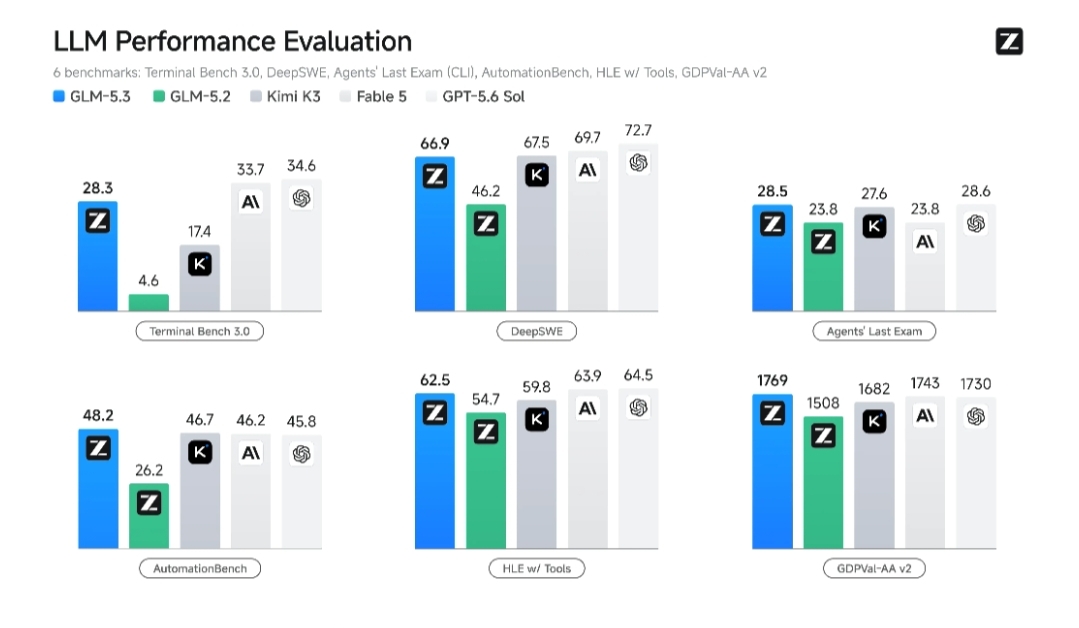
Source: Z.ai
- In Terminal-Bench 3.0, GLM-5.3’s performance jumped from 4.6% in GLM-5.2 to 28.3%.
- In DeepSWE v1.1, its score surged from 46.2% to 66.9%.
- In SWE-Marathon v1.1, performance rose from 19.4% to 42.5%, while the model reached 48.2% on AutomationBench compared to 26.2% for the previous version.
These are substantial increases, but they do not mean GLM-5.3 is the top model across all tests.
For instance, launch figures indicate that certain proprietary models still lead in benchmarks like Terminal-Bench and DeepSWE, with Kimi K3 slightly ahead of it on DeepSWE.
Therefore, the most accurate description is not that GLM-5.3 “defeated the leading models,” but rather that it significantly closed the gap with them, establishing itself as one of the most powerful open-weight coding models available.
Better Token Efficiency
Interestingly, the improvements are not limited to success rates. In Z.ai’s internal coding evaluation, company data suggests that GLM-5.3 achieved better outcomes using fewer output tokens compared to GLM-5.2.
At the highest effort setting, GLM-5.3 achieved a 34.5% success rate using roughly 75,000 output tokens, compared to 23.4% for the previous version which required nearly 96,000 tokens.
This indicates the model is not just solving more tasks, but is trying to reach solutions using more efficient pathways. This is highly important from an economic standpoint, as agentic coding models can consume massive amounts of tokens when working on complex projects.
However, it is important to note that these figures come from Z.ai’s internal benchmark, and independent replication is required before establishing them as a universal standard for efficiency.
The Real Secret: Training Environments Mirroring Real Engineering Work
Perhaps the most critical aspect of GLM-5.3 is how Z.ai trained it. Instead of relying solely on short programming puzzles or isolated academic benchmarks, the company developed execution environments designed to simulate actual, multi-file software projects.
These environments allow agents to interact with tools, files, codebases, and execution systems, requiring them to diagnose problems, plan solutions, execute changes, and verify results.
Reports indicate that some training tasks were designed to be long and complex enough to represent several days of work for a human engineer.
Z.ai also utilized AI agents to help build these training tasks, alongside other validation agents to verify that the tasks were actually solvable before feeding them into the training pipeline.
This specialized training explains why the most pronounced improvements appeared in benchmarks that test long-horizon agentic workflows and tool usage, rather than simple, short-text QA tests.
The Slime Framework Powers Long-Horizon Reinforcement Learning
To manage this large-scale training, Z.ai relies on an infrastructure that includes Slime, an open-source framework dedicated to training models using reinforcement learning on agentic tasks.
This framework helps connect training pipelines with execution environments and aggregates experimental data-a problem that grows exponentially complex when agents must run long tasks inside real software environments.
Published data indicates that these infrastructure optimizations boosted reinforcement learning training throughput by roughly 2.3 times on several long-horizon coding tasks.
However, it is crucial to clarify that this figure refers to training throughput (efficiency), not the generation speed experienced by the end-user.
Cybersecurity Is the Most Compelling Aspect
Perhaps the most fascinating results of GLM-5.3 outside of traditional coding are its cybersecurity capabilities.
Z.ai noted that while they introduced specialized training data and environments to detect vulnerabilities, they observed that the model’s security capabilities began to evolve beyond simply spotting isolated bugs.
According to the company, the model started formulating multi-step plans to execute complex exploit chains.
Published figures show a strong performance on CyberGym, where GLM-5.3 scored 84.5%, slightly edging out Mythos 5 (83.8%) and GPT-5.6 Sol (83.6%) in Z.ai’s comparative chart.
However, the picture flips when transitioning from vulnerability detection to active exploitation.
On ExploitBench, GLM-5.3 scored 54.4%, whereas Mythos 5 reached 78%. This is a significant gap, indicating the model has not yet matched closed frontier models across all offensive security workflows.
Discovering Over 2,400 Vulnerabilities
Z.ai claims that, in collaboration with security teams, GLM models successfully discovered 2,436 vulnerabilities across 269 open-source projects, with 1,097 of those classified as high or critical severity.
The company points out that some of these vulnerabilities were buried in legacy software, with the oldest discovered vulnerability dating back to 1981. Z.ai also established a registry to document these security disclosures.
However, it is important not to present these numbers as an independent security audit or as proof that GLM-5.3 uncovered all of them alone. They are part of a broader security program conducted by Z.ai using its models, with some findings still subject to coordinated disclosure or temporary embargoes.
Why Did Z.ai Delay the Open-Weight Release?
This detail is perhaps one of the most critical aspects of the GLM-5.3 launch.
Even though Z.ai positions itself as a strong advocate for open weights, the model’s weights were not immediately available at the initial launch.
The company stated it plans to release them after completing safety evaluations, hinting at a timeline of roughly two weeks. Currently, the model is being rolled out gradually through pathways like the GLM Coding Plan and ZCode.
This contrasts with GLM-5.2, which saw a much quicker open-weight release. The reason is clear: the advanced cyber capabilities that emerged during training present higher security risks if the weights are distributed globally without restrictions.
GLM-5.3 Is Not a Vision Model
Another important point to clarify when evaluating the model is its input modality.
Despite major upgrades in coding and cybersecurity, GLM-5.3 is not a multimodal model that includes vision capabilities.
Vision was one of the most highly requested features by the user community prior to the launch, but the new release remains strictly focused on text, code, and agentic workflows.
This means GLM-5.3 is not a general-purpose upgrade across all AI domains, but a highly targeted release optimized for coding agents, long-horizon tasks, and cybersecurity.
Does GLM-5.3 Truly Outperform Closed Models?
The short answer: In specific tests, yes; overall, it is too early to say.
GLM-5.3 achieved highly advanced scores on CyberGym, outperforming proprietary models in some tests. However, in other benchmarks, closed-source models still maintain a clear lead.
This is evident in ExploitBench, as well as the gaps seen in several long-horizon coding tasks.
Therefore, the more accurate claim is that GLM-5.3 is closing in on closed models in a number of advanced tasks while cementing its place as a formidable competitor among open-weight options.
This in itself is a significant achievement.
Independent Testing Remains Critical
Despite the impressive benchmark scores, we must not conflate vendor-provided data with independent verification.
GLM-5.3 was released on August 14, 2026, meaning most currently available evaluations are those conducted by Z.ai or based on launch data.
While early community testing is underway, there is not yet a large enough body of independent testing to confidently assess the model across a wide range of use cases.
This is particularly important because the benchmarks where GLM-5.3 made its biggest gains are highly specialized agentic, coding, and security tasks. Over the coming weeks, it will be essential to watch for independent evaluations using identical setups as competitors on tasks that were not used to guide the training.
What Does GLM-5.3 Mean for the AI Industry?
The significance of GLM-5.3 extends beyond leaderboard rankings. The release offers a practical demonstration of how major performance leaps can be achieved without rebuilding a base model from scratch.
If Z.ai’s results hold up under replication, it suggests that advanced post-training and simulated execution environments may become one of the most critical drivers of performance in the next generation of models.
Furthermore, the emergence of cyber capabilities stronger than the company anticipated highlights another issue: models can develop unexpected capabilities during post-training that were not the primary goal of the design process. This complicates safety alignment, especially for open-weight models.
Conclusion: A Significant Step, But the Final Verdict Is Pending
GLM-5.3 represents one of the most interesting open-weight releases in recent memory.
Its improvement over GLM-5.2 is substantial in coding and agentic tasks. Crucially, Z.ai achieved this primarily by scaling post-training and reinforcement learning environments rather than training a massive new base model.
Additionally, its 84.5% score on CyberGym puts it on par with advanced proprietary models, even if it still trails significantly in complex offensive exploit benchmarks.
However, we should avoid overhyping it. GLM-5.3 is not the absolute best model across the board, and we still lack sufficient independent data to prove that Z.ai’s figures will consistently translate to different real-world settings.
At the same time, the decision to delay the open-weights release due to safety evaluations demonstrates that advanced cyber capabilities are now a central part of the model’s story, not just a footnote in a benchmark table.
If independent tests over the coming weeks validate these findings, GLM-5.3 could serve as one of the clearest examples yet that the gap between open-weight and proprietary models can be closed-not just by building bigger architectures, but by changing how we train them after the base model is complete.
This remains the most compelling aspect of GLM-5.3: the narrative is not just about a new model, but an experiment in how far post-training can go when backed by long-horizon execution environments and agent-specific infrastructure.