MiniMax Launches M3.1-Flash-Preview: High-Speed AI Coding Model Integrated into MiniMax Code
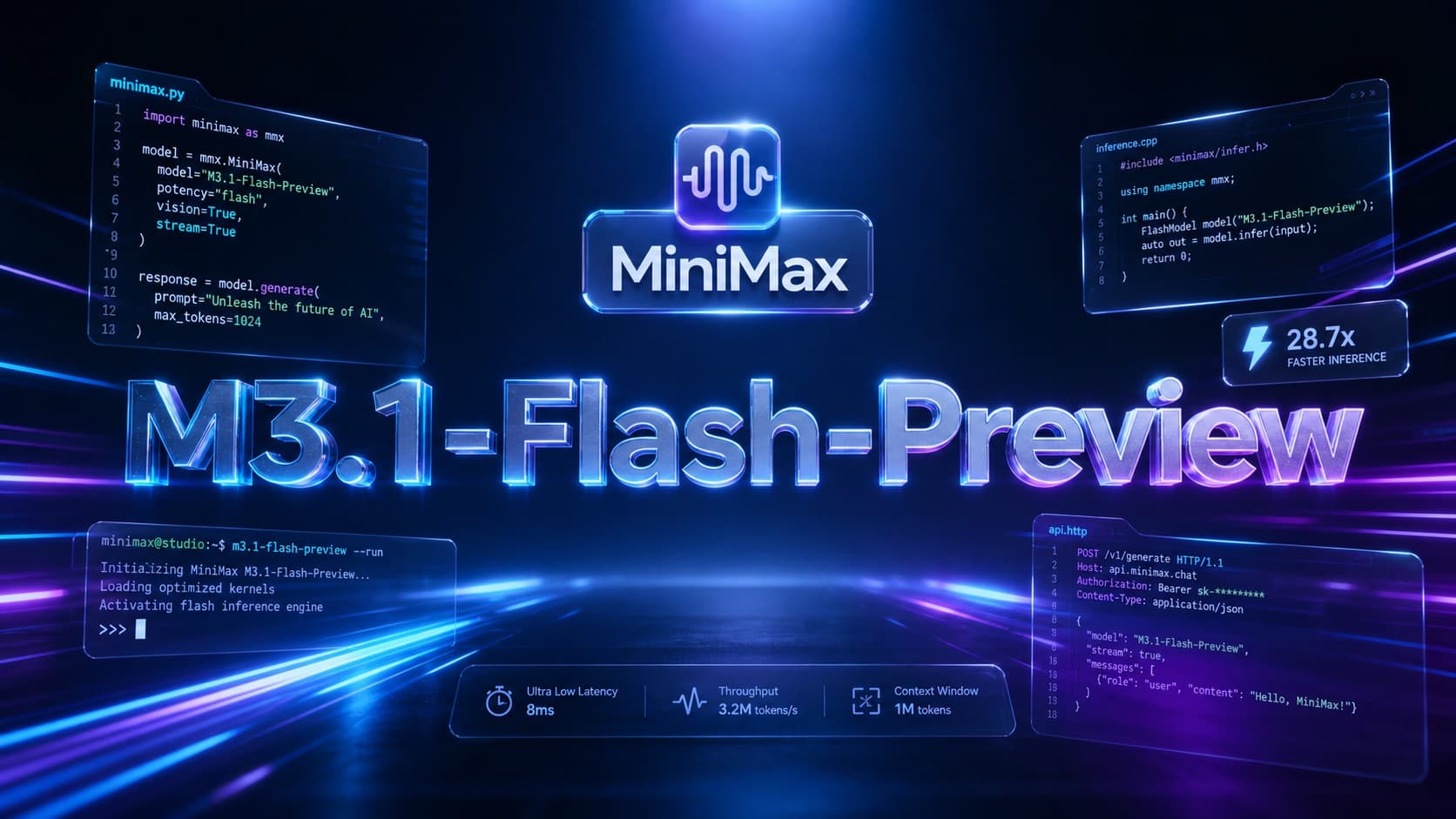
MiniMax has officially released its latest AI model, M3.1-Flash-Preview, deploying it directly inside MiniMax Code, the company’s dedicated developer platform. The new model is engineered specifically for everyday engineering workflows, spanning bug fixes, code refactoring, and end-to-end feature implementation.
Rolled out on September 27, M3.1-Flash-Preview introduces configurable reasoning effort levels, giving developers granular control over how the model balances inference depth against response latency.
Native Integration Inside MiniMax Code
Rather than launching as a standalone general-purpose API first, MiniMax integrated M3.1-Flash-Preview directly into MiniMax Code, establishing an integrated coding experience as its primary deployment vector.
Within the platform, developers can select M3.1-Flash-Preview alongside other available models and customize its reasoning depth across five distinct tiers:
- Low
- Medium
- High
- XHigh
- Max
This tiered approach provides developers with flexibility: lightweight syntax adjustments and quick edits can be handled at lower reasoning tiers with near-instant responses, while complex logic issues and multi-step refactoring can utilize higher tiers for deeper analytical passes.
From Bug Fixing to Multi-File Feature Development
The primary objective of M3.1-Flash-Preview centers on assisting software engineers throughout their daily coding cycle.
Core target use cases include:
- Rapid bug detection and patch generation
- Codebase refactoring and optimization
- Scaffolding new features and functions
- Navigating and modifying multi-file project structures
Because the model runs natively inside the MiniMax Code environment, developers do not need to switch context between an external chatbot window and their code editor. The model operates directly on the project files, focusing on context awareness and precise execution rather than isolated snippet generation.
Five Tunable Reasoning Levels
A central highlight of the M3.1-Flash-Preview release is its five-level reasoning selector: Low, Medium, High, XHigh, and Max.
This structure moves beyond one-size-fits-all AI inference:
- Low / Medium: Ideal for routine tasks such as generating boilerplate, formatting, or creating simple utility functions where ultra-low latency is paramount.
- High / XHigh / Max: Suited for architectural reviews, intricate debugging, edge-case analysis, and complex algorithms that demand step-by-step verification.
These controls are embedded directly into the MiniMax Code user interface, making reasoning depth an active, adjustable parameter of the developer experience.
The “Flash” Focus: Prioritizing Developer Velocity
The Flash moniker reflects MiniMax’s emphasis on throughput and low-latency interaction. In real-world software development, engineers make dozens of iterative queries per session-from checking error stack traces to adjusting single lines of code.
For an AI coding companion to be effective in daily workflows, responsiveness is as critical as reasoning power. MiniMax is positioning M3.1-Flash-Preview to minimize waiting time while maintaining consistent code generation quality.
A Shift Toward Agentic Development Environments
M3.1-Flash-Preview highlights a broader industry shift: moving away from standalone conversational chatbots toward purpose-built developer agents.
Users open MiniMax Code, select the model, and assign tasks within an active codebase. With adjustable reasoning tiers, the model can adapt its compute budget based on task difficulty-an essential capability for handling large code repositories where context comprehension and localized modifications are required.
Promotional Campaign and Token Plan Updates
The rollout coincides with updates to the MiniMax Code platform, including revised token plans and incentive programs for active developers.
MiniMax announced a daily check-in campaign running from September 28 through October 7 (UTC+8), offering double daily token credits to encourage early testing of M3.1-Flash-Preview across real-world development tasks.
Early Performance and Developer Feedback
Early community tests have begun emerging, with developers evaluating the model across various coding scenarios-including frontend generation (HTML/SVG), script automation, and debugging sessions.
While individual experiences vary based on task complexity and selected reasoning tiers, standardized industry benchmarks will provide a clearer picture of how M3.1-Flash-Preview stacks up against competing coding models. For now, its primary advantages lie in high response speeds, native platform integration, and adjustable reasoning control.
The Bottom Line
MiniMax M3.1-Flash-Preview represents a focused step toward practical, high-speed AI assistance for software engineers. By combining five levels of reasoning with direct integration into MiniMax Code, MiniMax is prioritizing developer efficiency and fluid, low-latency interaction.
As more developers test the model on production-grade codebases, the upcoming weeks will demonstrate how effectively it handles long-context reasoning, complex architectural dependencies, and autonomous multi-file workflows.