MiniMax Officially Launches M3.1 Flash,Unveiling Space Bunny Identity
MiniMax has officially rolled out its latest generative AI model, M3.1 Flash, solving the weeks-long mystery across the developer community regarding the viral anonymous model known as Space Bunny. Announced on October 19, the launch follows intense industry speculation after the stealth model posted chart-topping benchmark results. According to the company, M3.1 Flash delivers generational gains in autonomous agent workflows, software development, computer use, and cybersecurity, while nearly tripling inference speeds and slashing overall usage costs by 70% compared to its predecessor.
Space Bunny’s Identity and Rise to Global Leaderboards
In a short video published to its official accounts, MiniMax confirmed the connection by featuring a carrot-shaped rocket lifting off alongside the caption “Welcome back, Space Bunny.” According to financial news agency Cailian Press, the experimental model processed more than 200 trillion tokens in stealth mode, quietly building a massive following among international developers and researchers.
Welcome back. Space Bunny. 🚀
MiniMax-M3.1-Flash is coming. https://t.co/HsgukLyb9E pic.twitter.com/geIOTBBLRr– MiniMax (official) (@MiniMax_AI) October 19, 2026
MiniMax had quietly rolled out an M3.1 Flash Preview in September prior to the official October 19 unveiling.
Meanwhile, decentralized routing platforms such as OpenRouter and OpenCode saw unprecedented demand, with Space Bunny rocketing to the number-one spot in daily token call volume within just three days. The newcomer went toe-to-toe with established alternatives DeepSeek V4.1 Flash and GLM 5.3 Flash, cementing a fast-moving Chinese trio that captured the bulk of developer attention in the high-speed, lightweight model tier. The release also buoyed market sentiment: MiniMax shares listed on the Hong Kong Stock Exchange (0100.HK) gained 1.45% to close at HK$182.1.
M3.1 Flash Performance in Coding and Task Automation
On real-world task execution, M3.1 Flash demonstrated strong proficiency in handling complex, multi-step agentic workflows without constant human prompting. The model placed among the top tier on AutomationBench-AA, completing end-to-end operational routines across cloud SaaS ecosystems-including enterprise sales, marketing campaigns, logistics operations, customer support, treasury management, and human resources.
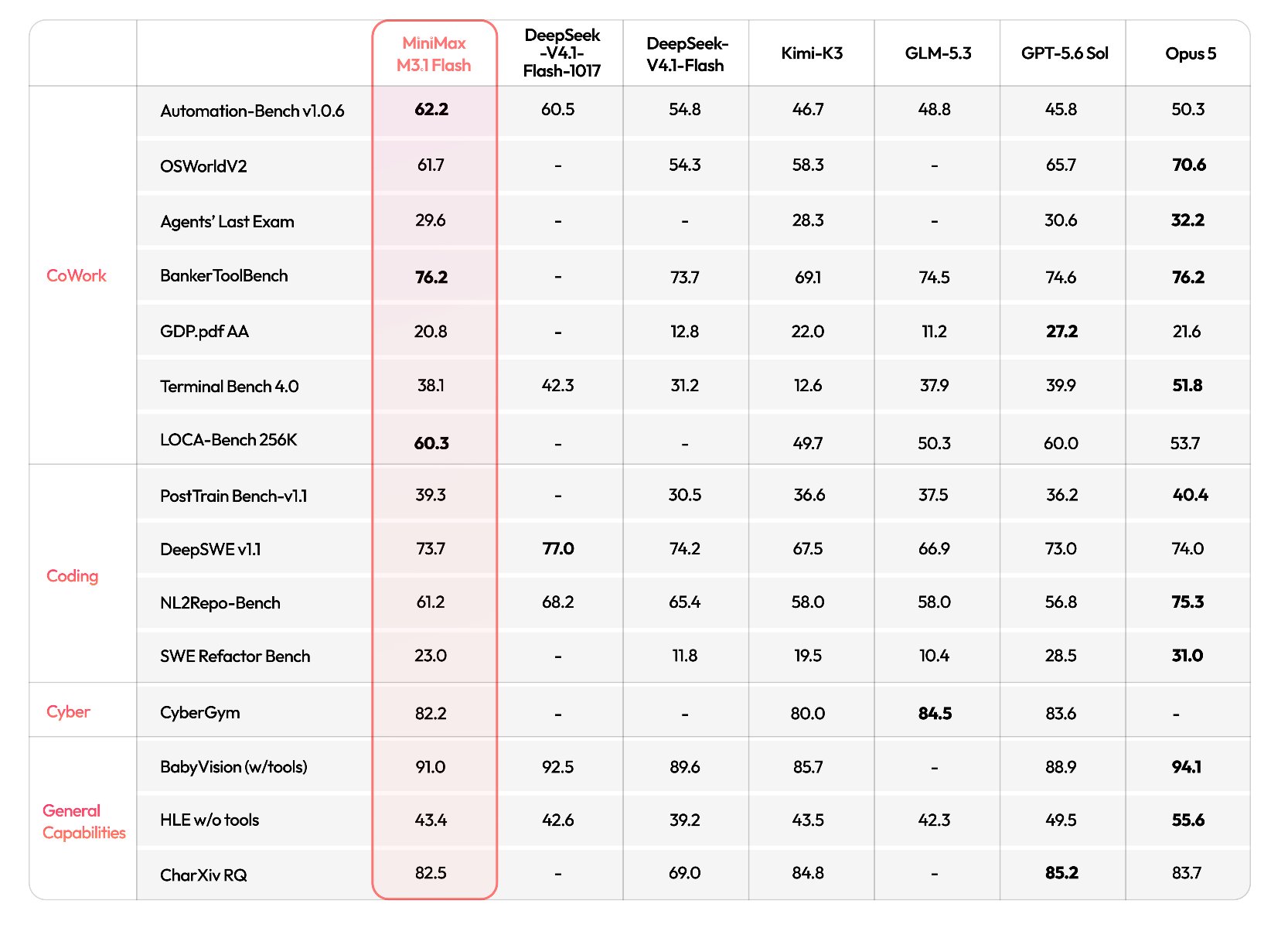
In the financial benchmark BankerToolBench, designed to evaluate complex real-world banking challenges, M3.1 Flash scored 76.2 points. The result reflects solid performance across multi-step planning, strict cross-file document consistency, regulatory compliance, and chained tool calls. In software engineering, the model recorded 73.7% on DeepSWE v1.1-a rigorous benchmark that tests an AI’s capacity to independently comprehend codebases, develop new features, resolve technical bugs, and validate results through automated unit testing. That places M3.1 Flash alongside top-tier global models at a fraction of standard operational costs.
Computer Use Benchmarks and Cybersecurity Capabilities
M3.1 Flash showed notable strength in direct operating system interaction and cross-application execution. It scored 61.7 points on OSWorld V2, which benchmarks AI desktop navigation, and 29.6 points on Agents’ Last Exam (ALE), which measures performance on high-value, professional tasks. These scores earned M3.1 Flash the top ranking among all Chinese models on both benchmarks, demonstrating a shift from basic text parsing toward executing multi-step action sequences in live environments.
On defensive security, the model achieved an 82% score on CyberGym, an evaluation platform focused on vulnerability discovery and validation. Internal assessments confirmed the model’s proficiency in automated code auditing, vulnerability patching, penetration testing, malware analysis, and reverse engineering-giving cybersecurity teams a scalable, low-cost utility for hardening digital infrastructure.
M3.1 Flash Inference Speed and API Pricing
To achieve faster response times, MiniMax engineered the model with aggressive sparsity optimizations. In routine production workloads, output throughput regularly exceeds 200 tokens per second (TPS), with median (P50) speeds holding steady above 170 TPS. This sustained throughput provides the low latency required for real-time customer systems and interactive agent loops.
Alongside performance tuning, MiniMax unveiled an aggressive pricing tier that cuts the cost of running agentic workloads by 70% relative to the prior generation. Flat rates per one million tokens are priced as follows:
- Input Tokens: $0.15
- Output Tokens: $0.60
- Cached Input Tokens: $0.015
The aggressive pricing strategy is explicitly aimed at removing compute barriers for startups and enterprise developers running high-frequency tool calls.
Access Methods and MiniMax’s Upcoming Roadmap
MiniMax confirmed that M3.1 Flash is immediately available through its developer API platform, the paid M Plan subscription, and its dedicated desktop environment, MiniMax Code. The company added that open model weights will be released at a later date, while teasing an upcoming flagship “Pro” model designed to push the frontier of raw reasoning capability.
Ultimately, the rollout reflects an industry-wide pivot: competition is moving away from brute-force parameter counts toward high-throughput, low-cost inference tailored for automated work. With the traction gained during its stealth run as Space Bunny, MiniMax’s primary challenge will be defending this market share as international and domestic rivals intensify the price-to-performance race.