DeepSeek-V4.1-Flash Challenges Frontier AI Models With a New Architecture and Lower Costs
Chinese AI startup DeepSeek has officially released its latest flagship-grade model, DeepSeek-V4.1-Flash, integrating native visual understanding into the smallest model of its new architectural generation while slashing API pricing by up to 60% for cached inputs.
According to technical documentation released by the company on September 10, 2026, the new model leverages an asymmetric 552-billion-parameter Mixture-of-Experts (MoE) architecture that reduces high-bandwidth memory (HBM) consumption by fourfold compared to its predecessor.
The launch coincided with international reports confirming that DeepSeek is actively preparing for an initial public offering (IPO) on Shanghai’s tech-focused STAR Market amid a funding round that could value the company at approximately 500 billion RMB (~$75 billion USD), alongside an official announcement retiring the previous V4-Pro model after DeepSeek said the new model had surpassed V4-Pro across performance, cost, speed, and total execution time.
The New Architecture: Why DeepSeek Split Compute Between Input and Output
In a major architectural departure from conventional Transformer designs, DeepSeek transitioned to an asymmetric Causal Encoder-Decoder (CED) framework inspired by the YOCO paradigm. The backbone features 40 Transformer layers divided evenly into a 20-layer causal encoder for prompt ingestion and a 20-layer decoder for autoregressive text generation, incorporating 552 billion total parameters in the core MoE network and an additional 196-billion-parameter Engram conditional memory module distributed across dedicated layers.
The core breakthrough of this design lies in its asymmetric parameter activation during inference. When processing large input prompts (prefill), the model activates only 8 billion parameters per token. In contrast, during token generation (decode), activation scales up to 16 billion parameters per token. This setup directly mirrors the operational workflow of autonomous AI agents, which spend the vast majority of their compute reading large code repositories, execution traces, and historical logs before outputting relatively concise reasoning steps or commands.
Furthermore, this architecture eliminates the need for the decoder to compute its own global Key-Value (KV) cache. Instead, generation layers derive KV states directly from the encoder’s final hidden state via dedicated per-layer projection weights. This design significantly curbs compute overhead during prompt processing, delivering consistent execution efficiency across long context windows scaling up to one million tokens.
How the New Design Slashes Memory Footprint Across Long Contexts
For large-scale language models, maintaining the KV cache across million-token sequences has long been a primary bottleneck, placing immense pressure on fast GPU memory (HBM) and secondary persistent storage (SSD). DeepSeek-V4.1-Flash tackles this constraint head-on, shrinking the global KV cache footprint to just 890 bytes per token-roughly four times smaller than V4-Flash and an astounding 437 times smaller than the original DeepSeek-V1 architecture.
To achieve this reduction, DeepSeek deployed Compressed Sparse Attention 2 (CSA2), organizing model layers into three distinct attention modes:
- Full Mode: Computes the primary KV representations and initiates indexing. A hierarchical sparse indexer restricts subsequent searches to a candidate pool of up to 512 token locations, dramatically narrowing compute overhead in deeper layers.
- Reindex Mode: Leverages the primary KV cache from the preceding Full layer while re-evaluating attention weights using its own query states.
- Reuse Mode: Directly inherits both the primary KV representations and top-K candidate indices, bypassing indexing calculations entirely.
Additionally, DeepSeek quantized the primary KV cache to FP4 (E2M1 format) during post-training rather than standard FP8, while offloading the 128-token sliding-window attention (SWA) cache to host DRAM with temporary time-to-live (TTL) buffers. Combined, these engineering optimizations cut GPU HBM memory requirements to one-quarter and reduced persistent SSD storage needs to one-eighth compared to the previous generation.
Native Vision Capabilities and 1-Million-Token Context Support
A key milestone in this release is the direct integration of native multimodal visual understanding into the main API model, succeeding previous standalone experimental checkpoints such as V4 Flash Vision Exp.
The model can process images natively alongside text, making it suitable for visual software-engineering and agentic workflows where UI screenshots, architecture diagrams, and charts must be analyzed in combination with codebases.
Furthermore, V4.1-Flash introduces granular, continuous control over Reasoning Effort. Developers can dynamically tune inference depth to balance logical precision against token consumption and latency, with maximum-effort settings boosting performance on complex reasoning tasks at the expense of higher output volume.
Benchmark Results: How V4.1-Flash Stacks Up Against Flagship Rivals
DeepSeek-V4.1-Flash underwent extensive pre-training on 45 trillion multimodal tokens, training sparse attention mechanisms initially at 64K sequence lengths before extending context capacity to 1 million tokens. The model was then post-trained using supervised fine-tuning (SFT), reinforcement learning (RL), and on-policy distillation, backed by large-scale automated synthesis of verifiable agent tasks and environments.
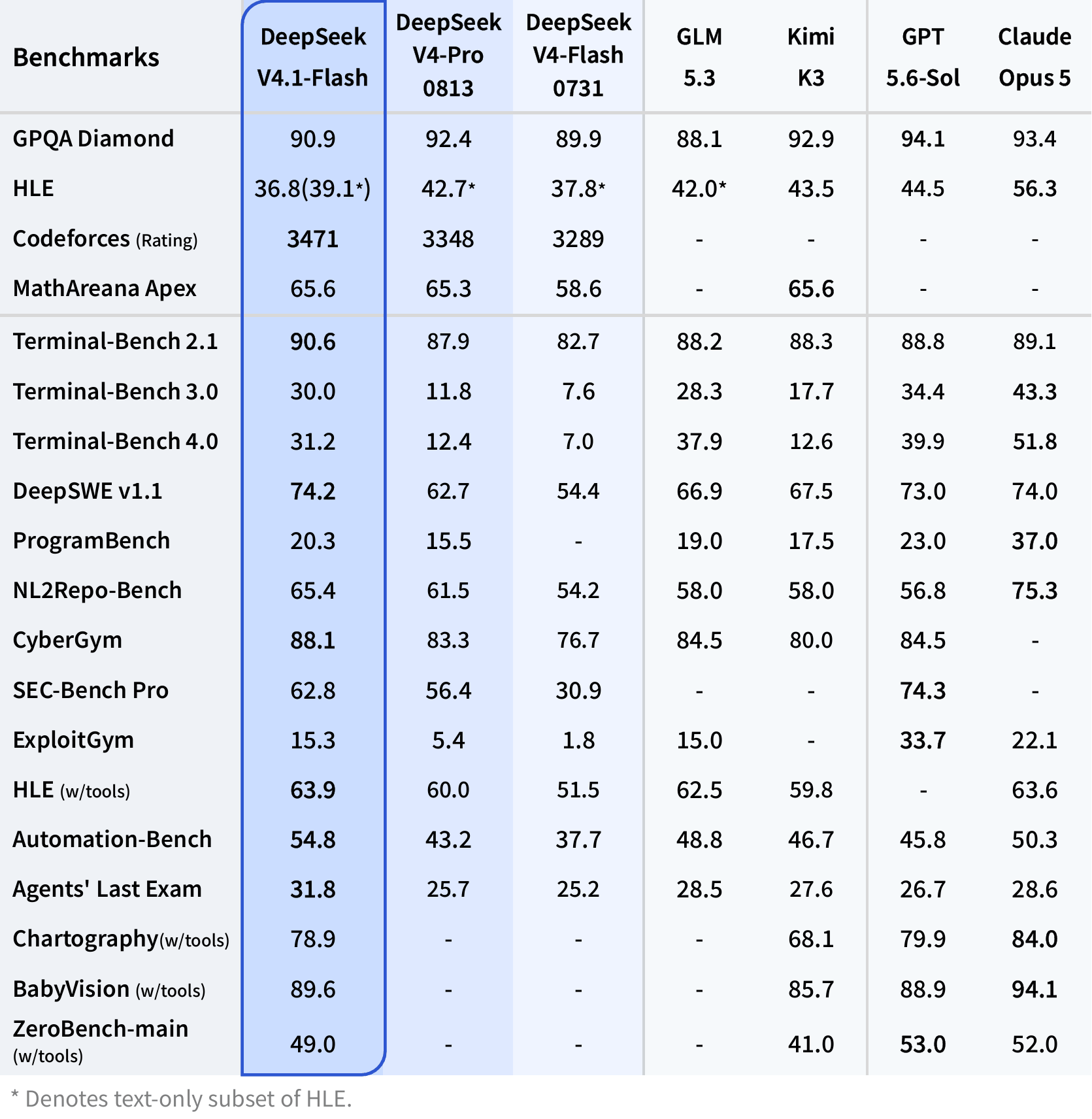
In DeepSeek’s published evaluations, using the stated benchmark configurations and agent scaffolds, V4.1-Flash reported the following results:
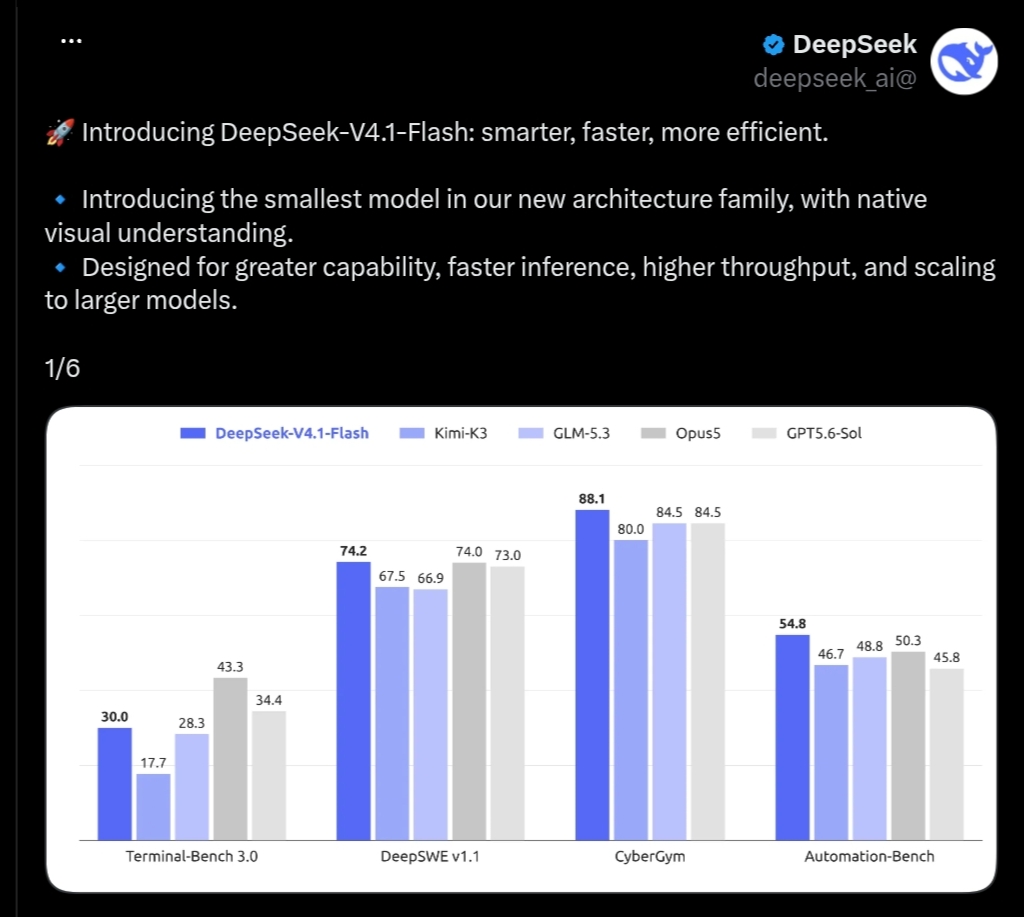
- DeepSWE v1.1: Scored 74.2% in real-world GitHub issue resolution, surpassing Anthropic’s Opus-5 (74.0%) and OpenAI’s GPT-5.6 Sol (73.0%), while marking a substantial leap over V4-Flash (54.4%).
- Terminal-Bench 2.1: Reached 90.6 in CLI workflow execution, outpacing Opus-5 (89.1), GPT-5.6 Sol (88.8), and V4-Flash (82.7).
- Automation-Bench: Surged from 37.7% in the previous generation to 54.8%, alongside a competitive programming rating of 3471 on Codeforces and 65.6 on MathArena Apex.
- CyberGym: Achieved 88.1% in cybersecurity vulnerability detection, outpacing the retired V4-Pro flagship (83.3%).
Nevertheless, a closer look at the data shows that V4.1-Flash does not sweep every domain. On the long-horizon Terminal-Bench 4.0 benchmark, the model scored 31.2%, trailing Opus-5 (51.8%) and GPT-5.6 Sol (39.9%).
Similarly, on ProgramBench, V4.1-Flash recorded 20.3%-improving on V4-Pro’s 15.5%, but lagging behind GPT-5.6 Sol (23.0%) and Opus-5 (37.0%).
These figures demonstrate that while V4.1-Flash may not dominate every specialized benchmark, it directly challenges top-tier proprietary models in core software engineering tasks at a fraction of the operating cost.
DeepSeek Harness Enhances Developer Tooling and Multi-Agent Workflows
Coinciding with the model release, DeepSeek upgraded its runtime agent framework, DeepSeek Harness (including the v0.1.5 development line), providing tailored training for Standard Execution, Programmatic Tool Calling (PTC), and Minimalist operational modes.
A standout feature of this update is the ability to modify system prompts dynamically without invalidating the precomputed KV cache, eliminating redundant processing overhead during multi-step agent interactions.
In multi-agent orchestration, the environment introduces an experimental Agent Teams feature. A lead agent can spawn sub-agents, delegate sub-tasks via a shared board, coordinate bidirectional messaging, and synthesize unified deliverables. The workspace interface also adds native file-tree navigation and rendering for Markdown, HTML, PDF, and code previews, supported by ecosystem integrations across Tencent WorkBuddy, CodeBuddy, and OpenCode.
API Cost Breakdown: Quantifying Real-World Developer Savings
DeepSeek translated these architectural gains directly into API price reductions, continuing its structured peak and off-peak pricing model to encourage workload scheduling during lower-demand windows.
Off-peak hours run outside the standard Beijing business windows (09:00-12:00 and 14:00-18:00, Monday through Friday), offering a flat 50% discount across all token categories.
Cache-hit input pricing dropped by 60% to ¥0.02 per million tokens during off-peak hours (¥0.04 during peak). Cache-miss input rates fell by 33.3% to ¥1.00 per million off-peak (¥2.00 peak), while output generation rates declined by 11.1% to ¥4.00 per million off-peak (¥8.00 peak).
For repetitive agent workflows, these price cuts yield immediate financial benefits. For example, a task requiring 1,000,000 cached input tokens, 100,000 uncached input tokens, and 10,000 generated output tokens drops from ¥0.245 to ¥0.160 during off-peak hours-a net cost reduction of 34.7% per run.
What Happens to V4-Pro Users After September 14?
In a decisive move, DeepSeek announced the phase-out of its previous top-tier model, DeepSeek-V4-Pro, after internal benchmarking confirmed that V4.1-Flash matches or exceeds it across overall throughput, response latency, and cost-efficiency.
Effective September 14, 2026, at 04:00 UTC (12:00 Beijing Time), all traffic sent to the deepseek-v4-pro endpoint will be automatically routed to V4.1-Flash and billed at Flash rates until the arrival of the upcoming V4.1-Pro model. Legacy endpoints have also been consolidated under standard, OpenAI- and Anthropic-compatible API routes.
DeepSeek Prepares for Domestic IPO Amid Surging Market Valuation
The release comes amid significant corporate milestones reported by Reuters, indicating that DeepSeek has engaged CITIC Securities to prepare for an initial public offering on the Shanghai Stock Exchange’s STAR Market.
Financial sources indicate that the company’s latest funding efforts could position its valuation near 500 billion RMB (~$75 billion USD), building on an earlier $7.4 billion capital round. The strong investor interest reflects market appetite for cost-effective, high-efficiency AI architectures capable of challenging established industry players.
Evaluating Strengths, Trade-Offs, and Performance Boundaries
An objective evaluation of DeepSeek-V4.1-Flash requires assessing its limitations alongside its strengths. While the model excels in memory compression and coding tasks, measurable performance gaps remain in highly abstract scientific reasoning.
On the demanding GPQA Diamond benchmark, V4.1-Flash achieved 90.9%, slightly trailing frontier closed models such as GPT-5.6 Sol (94.1%) and Opus-5 (93.4%).
Similarly, in vision evaluations, the model registered 89.6% on BabyVision and 78.9% on Chartography, indicating that while its integrated visual processing is robust for developer tooling, specialized commercial vision systems retain an edge in complex visual parsing.
Open Weights Under MIT License and Enterprise Deployment
Staying true to its open-source foundation, DeepSeek has published the model weights on Hugging Face under the permissive MIT License, granting developers full freedom for commercial deployment, local fine-tuning, and research.
The model provides out-of-the-box support for high-throughput inference runtimes, including vLLM, SGLang, and Transformers. For large-scale enterprise deployments, DeepSeek has outlined deployment blueprints tailored for clusters spanning up to 2,000 GPUs paired with high-performance storage fabrics.
Conclusion: Does DeepSeek-V4.1-Flash Represent a Genuine Breakthrough?
DeepSeek-V4.1-Flash stands out as one of the most consequential developer-focused AI releases of 2026. By combining a 60% reduction in cache pricing with an innovative Causal Encoder-Decoder architecture and open MIT weights, it delivers accessible, production-ready intelligence for autonomous coding agents.
While performance boundaries remain in specialized vision tasks and abstract scientific benchmarks, the model’s real-world efficiency shifts the broader AI paradigm. It proves that reducing KV cache footprints and optimizing post-training environments can bridge the gap with closed frontier models-offering an economically viable blueprint for the future of AI engineering.