DeepSeek-V4.1-Flash-1017: A New Update Boosting Coding Speed and Slashing Costs
DeepSeek released DeepSeek-V4.1-Flash-1017 on October 17, 2026, as an update to its existing DeepSeek V4.1 Flash model. The new version is designed to complete tasks faster and generate shorter outputs, with improvements reported across several benchmarks. DeepSeek says API pricing and the model’s API identifier remain unchanged, and the updated weights are available on Hugging Face under the MIT license.
🚀 DeepSeek-V4.1-Flash-1017 is here!
Stronger benchmark performance, faster task completion, and shorter outputs than the previous version-a Pareto improvement in performance and cost. Now live on our website, app, and API.
🛠️ Optimized for @DeepSeekHarness, Tencent CodeBuddy,… pic.twitter.com/MiqGbnCiVz
– DeepSeek (@deepseek_ai) October 17, 2026
This update directly targets developers and organizations building autonomous coding agents and multi-step automation workflows that cannot afford high latency or runaway token bills. By finding a sharper balance between execution speed and reasoning accuracy, DeepSeek continues to solidify its foothold in the low-cost, high-efficiency AI tier.
DeepSeek-V4.1-Flash-1017: What Does the New Update Bring?
The “1017” suffix denotes the release date-October 17, 2026-following DeepSeek’s established practice of versioning updates by timestamp rather than altering primary model families. With this iteration, the team aimed to move beyond theoretical question answering, optimizing the system for real-world software engineering, repository construction, and interactive debugging within live developer environments.
In practice, engineering efforts focused heavily on command-line interface (CLI) interactions, end-to-end repository scaffolding, and multi-step tool execution. DeepSeek showcased capabilities by generating self-contained projects from concise text prompts, including functional browser games and interactive 3D web scenes. While such demonstrations illustrate intended agent workflows, production environments still demand rigorous isolated testing inside target codebases to catch edge-case regressions.
Shorter Outputs and Faster Tasks: How Does the Update Cut Token Consumption?
The 1017 update is designed to complete tasks faster and generate shorter responses than the previous version. This matters in coding agents, where a single task may involve multiple model calls. Fewer output tokens can lower API costs, although the actual savings depend on the number of calls, the amount of reasoning required, and the final result.
The importance of this optimization becomes evident when running the model through iterative workflows such as authoring code, running automated test suites, and patching errors. The fewer tokens the engine generates to accomplish an objective, the lower the overall compute cost and the faster the feedback loop. Nonetheless, reducing output length alone is insufficient; genuine utility relies on the system completing each task with precision without sacrificing code quality or runtime stability.
Benchmark Results: How Has DeepSeek-V4.1-Flash-1017 Improved in Coding?
DeepSeek’s published Hugging Face model card reflects measurable score increases across every standard evaluation track, with notable gains in software development and terminal automation compared to the September release.
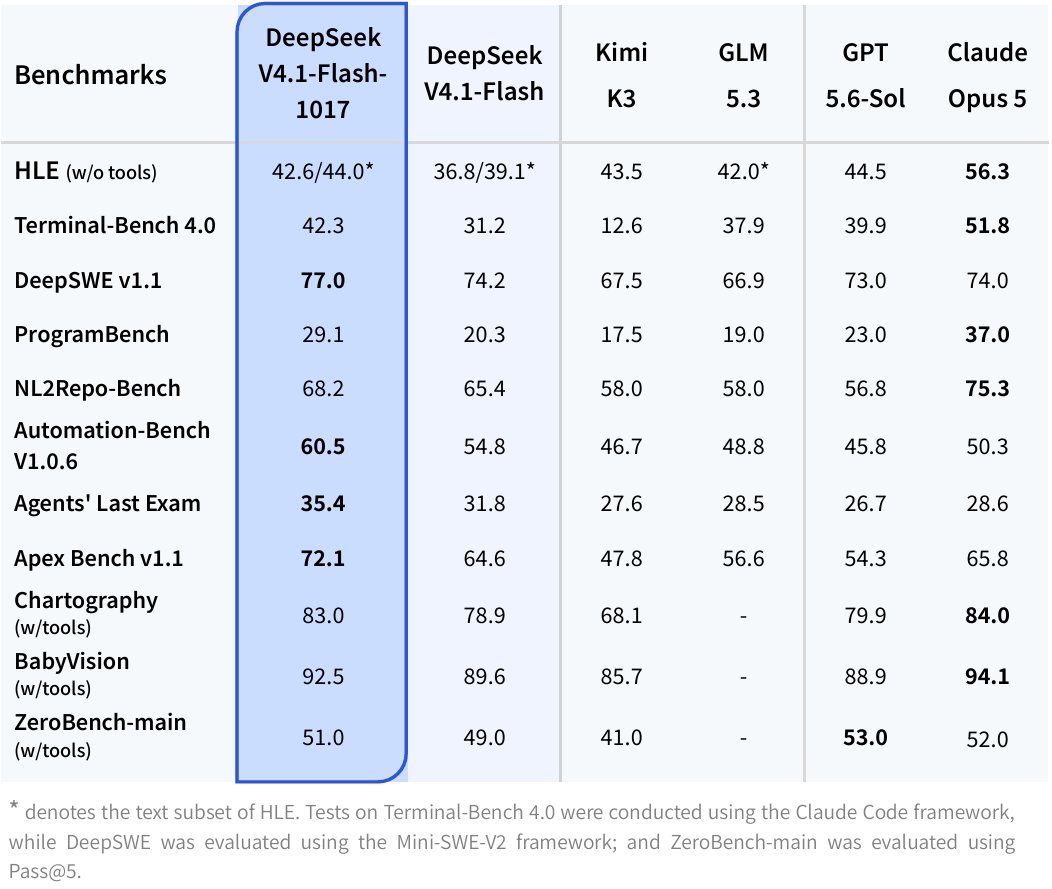
The most pronounced leap occurred on Terminal-Bench 4.0, an evaluation assessing how effectively AI agents navigate terminal shells, install dependencies, parse directory trees, and resolve command-line errors. The score surged by 11.1 points, climbing from 31.2 to 42.3. This evaluation was conducted using Anthropic’s Claude Code framework-a critical methodological detail, as the surrounding agent harness and tool execution format directly influence end results.
Software engineering benchmarks followed a similar trajectory. On DeepSWE v1.1, which evaluates solving real-world GitHub issues, the model rose to 77.0 from 74.2. ProgramBench saw an 8.8-point jump to reach 29.1, while natural-language repository generation (NL2Repo-Bench) climbed to 68.2. General automation also trended upward, with Automation-Bench reaching 60.5 and Apex Bench posting 72.1.
These gains also extended into vision tasks executed alongside tools. The model scored 83.0 on Chartography and 92.5 on BabyVision. These multimodal capabilities allow developer workflows to parse application UI mockups, analyze terminal error screenshots, and inspect complex engineering schematics without routing calls to a secondary vision model.
Performance Against Rivals: Agentic Automation vs. Theoretical Reasoning
An objective evaluation requires examining how the 1017 checkpoint fares against industry benchmarks, including frontier systems like Claude Opus 5 and GPT-5.6 Sol, alongside domestic alternatives such as GLM-5.3 and K3.
On specialized coding agent evaluations, Flash 1017 holds a notable lead on DeepSWE v1.1 at 77.0, edging past Claude Opus 5 (74.0) and GPT-5.6 Sol (73.0). It also secured top honors on Automation-Bench at 60.5, demonstrating exceptional readiness for day-to-day developer toolchains and rapid refactoring tasks.
However, Claude Opus 5 retains a commanding lead in raw conceptual reasoning and theoretical benchmarks. On Humanity’s Last Exam (HLE) without external tools, Opus 5 reached 56.3, whereas DeepSeek’s 1017 settled at 42.6 overall (and 44.0 on the text-only subset). Opus 5 also maintains the advantage on full repository generation (NL2Repo-Bench) at 75.3 versus DeepSeek’s 68.2, and leads BabyVision at 94.1. Meanwhile, GPT-5.6 Sol retains top ranking on ZeroBench-main at 53.0 versus DeepSeek’s 51.0.
These comparisons present a clear picture: Flash 1017 is an aggressive, cost-effective contender for procedural coding, script generation, and terminal loops, but larger frontier models still hold the edge in academic edge cases, deep logic proofs, and complex architectural design.
The Key Difference Compared to the Legacy V4 Pro
For engineering teams operating existing integrations on DeepSeek V4 Pro, the 1017 update provides a compelling incentive to migrate. Empirical tests covering parser generation, structured data extraction, and parallel tool calling reveal massive performance and economic gaps.
In complex code generation benchmarks, 1017 completed tasks in roughly 88 seconds that required upwards of 20 minutes on V4 Pro. Furthermore, 1017 features native multimodal vision-a feature entirely absent in V4 Pro, which remains text-only. The reported differences in task completion time and API cost may make Flash 1017 a more practical option for some software automation workflows. However, teams should test both models on representative tasks before migrating, taking accuracy, latency, infrastructure requirements, and total cost into account.
KV Cache Compression: How Does the Architecture Work?
DeepSeek titled its accompanying technical report “DeepSeek-V4.1-Flash: Pushing the Limits of KV Cache Compression.” Under the hood, the system uses a 552-billion parameter Mixture-of-Experts (MoE) architecture, activating just 8 billion parameters during prompt ingestion and 16 billion parameters during token generation.
The Key-Value (KV) cache stores past attention states to eliminate redundant recalculations across multi-turn generation. In long-context setups reaching 1 million tokens, uncompressed caches rapidly exhaust GPU High Bandwidth Memory (HBM). DeepSeek’s compression techniques keep this 1M-token window stable and responsive, paired with supported output limits spanning 256K to 384K tokens. This architectural focus allows agents to process comprehensive code repositories and sprawling execution traces without overwhelming server memory.
API Pricing and Search Tools: What Do Developers Need to Know?
DeepSeek made no changes to its published API rates with the 1017 release. The platform continues to separate billing into off-peak and peak intervals. Standard off-peak pricing stands at:
- $0.15 per million tokens: Cache-miss input.
- $0.003 per million tokens: Cache-hit input.
- $0.60 per million tokens: Generated output.
Rates double during weekday peak hours, scheduled between 01:00-04:00 UTC and 06:00-10:00 UTC. Scheduling non-urgent batch jobs, repository indexings, and offline sweeps outside these peak windows yields an immediate 50% discount on compute costs.
Alongside the model checkpoint, DeepSeek introduced two complementary tool APIs: the Search API for retrieving ranked web indexes, and the Fetch API for parsing web pages into clean Markdown. Both are billed at $0.75 per 1,000 successful queries, with free access granted through official developer harnesses until October 31, 2026.
Practical Implementation: API Calling and Local Deployment
Existing API integrations require zero code modifications; developers can continue targeting the established deepseek-flash model endpoint. Legacy identifiers automatically route to the 1017 checkpoint. The API natively supports both Thinking Mode (with configurable reasoning effort settings) and direct non-thinking mode for straightforward data parsing.
For teams seeking self-hosted infrastructure, DeepSeek published the weights across 48 safetensors files in native FP8 quantization on Hugging Face under the MIT license. While the license guarantees full freedom for commercial deployment and modification, hosting a 552B parameter MoE architecture still requires substantial enterprise multi-GPU hardware.
Notably, this release omits a standard Jinja chat template. In its place, DeepSeek provides a standalone Python reference encoder, alongside deepseek-recipe-a high-performance Rust library with Python bindings designed to handle prompt formatting, tool call serialization, and token decoding in production pipelines. Developers are also advised to update DeepSeek Harness to version v0.2.1-rc.1 or newer.
Best Practices for Safe Deployment and Model Routing
Deploying autonomous developer agents requires strict isolation safeguards. Always execute agent-generated shell commands inside isolated sandboxes or disposable containers to prevent accidental file deletion or API credential leakage. Similarly, teams should avoid prompt bloat by keeping long-context inputs strictly curated, providing clear task boundaries and verifiable unit tests.
From an architectural standpoint, adopting a model routing pattern offers the highest return on investment. Teams can position Flash 1017 as the high-speed, low-cost default “worker agent” responsible for handling 80% to 90% of code implementations, documentation parsing, and bug triage. When automated unit tests fail repeatedly or tasks demand complex abstract reasoning, the system can escalate the execution trace to a frontier model like Claude Opus 5.
DeepSeek-V4.1-Flash-1017: Is the Update Worth Adopting?
DeepSeek-V4.1-Flash-1017 reports improvements on several coding and agent benchmarks, alongside shorter outputs and faster task completion. API pricing remains unchanged, and the model weights are available under the MIT license.
For developers, the practical benefit will depend on the workload. Testing the model on real coding tasks can help determine whether its speed and token usage translate into lower costs without compromising accuracy.