Google Announces Gemini 4 Carbon With Advanced Cybersecurity and Coding Capabilities
Google has announced Gemini 4 Carbon, a new AI model designed to handle complex software engineering tasks and cybersecurity challenges. Google DeepMind describes Carbon as its strongest model to date, highlighting its ability to detect software vulnerabilities, assess whether they can be exploited, and develop fixes that address their underlying causes.
Announced on October 28, 2026, Gemini 4 Carbon follows the launch of Gemini 4 Argon two weeks earlier. Google plans to introduce the new model gradually, beginning with a limited group of cybersecurity professionals before expanding access to trusted partners. Developers, businesses, and consumers will receive access through Google’s products at a later stage.
Gemini 4 Carbon Targets Complex Coding Tasks
Gemini 4 Carbon is designed for long-running engineering work that requires multiple steps, sustained reasoning, and repeated attempts to solve difficult problems. Rather than focusing only on short code snippets or individual questions, the model aims to handle larger projects that require investigation, debugging, and implementation.
According to Google, its internal teams have tested Carbon on engineering tasks that continued for days. These included identifying the root causes of subtle bugs and developing fixes across large codebases and low-level systems, even when initial approaches failed.
The company has also worked to improve the model’s performance in agentic coding, scientific tasks, reasoning, full-stack web development, and multimodal understanding.
In WebDev Arena, Google reports that Carbon gained 89 Elo points to reach a score of 1,769, placing it fourth in the web development evaluation cited in the announcement. The result points to improvements in generating web development outputs, although performance on a single benchmark does not establish how a model will perform across every programming task.
Cybersecurity Benchmarks Highlight Vulnerability Detection and Repair
Cybersecurity is one of the main areas Google emphasizes in its announcement. Gemini 4 Carbon is designed to support several stages of defensive security work, from finding vulnerabilities to evaluating their practical risks and producing code fixes.
Google reported the following results across three cybersecurity benchmarks:
- SEC-bench Pro: 88.2%. Carbon achieved this score on a benchmark focused on identifying real-world software vulnerabilities, including complex flaws that can be difficult to detect.
- ExploitGym: 54.8%. This result measures the model’s performance in evaluating and exploiting vulnerabilities, helping security teams assess which weaknesses may pose a practical risk.
- CWE-bench: 71.0%. Carbon achieved this score on a benchmark focused on fixing vulnerabilities by addressing their underlying causes.
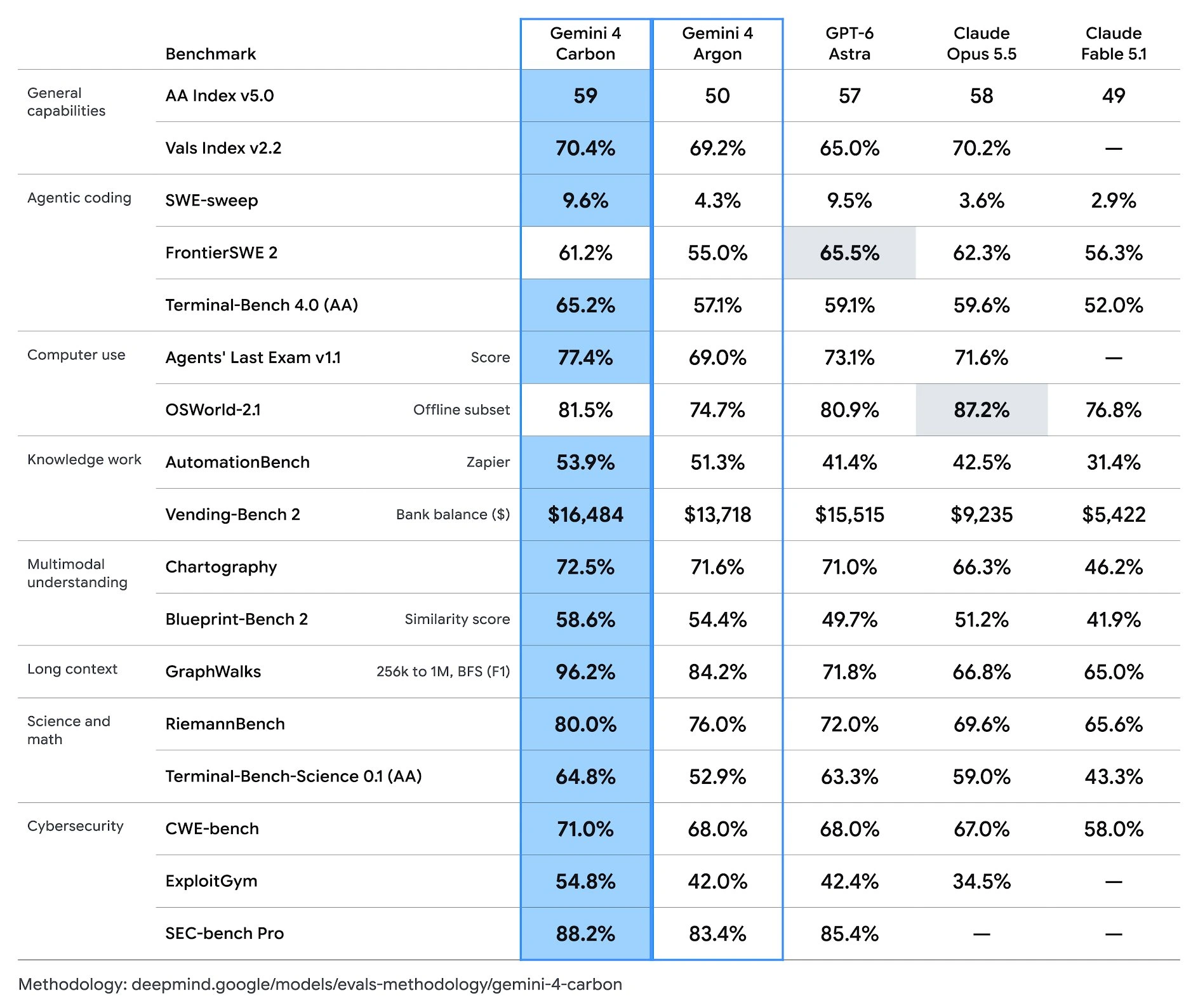
These tasks serve different purposes in a security workflow. Finding a flaw does not automatically establish that it can be exploited, while identifying a potential attack does not guarantee that a proposed fix will resolve the problem. Combining these capabilities could help security teams investigate vulnerabilities and develop more effective patches.
Google also reported that Carbon achieved more than twice the success rate of Gemini 4 Argon in generating secure code during internal evaluations.
The Chrome team reportedly found that Carbon performed more than ten times better than another leading AI model from a competing lab when generating high-quality patches. Google did not identify the competing model or provide enough detail in the announcement to independently assess the comparison, so the result should be understood as a company-reported internal evaluation.
Improved Reliability and Resistance to Prompt Injection
Google says Gemini 4 Carbon builds on the layered safety and security system used in Argon. The approach combines model training, real-time misuse defenses, prompt-injection resistance, and monitoring intended to detect potentially problematic behavior.
The company reported several improvements in its internal tests. On Terminal-Bench 4.0, successful cheating attempts fell to 0%, while the rate of attempted cheating dropped to 0.4%. Google also observed an almost 80% reduction in high-severity misalignment alerts during live coding work with its internal teams.
Carbon reportedly makes approximately half as many unsupported claims as Argon. Rather than presenting uncertain information as fact, the model is designed to identify missing evidence, explain methodological limitations, and indicate when additional information is needed.
Google also reported a 26% reduction in overreach, in which a model goes beyond the intended scope of a task, and a 29% reduction in under-service, in which it fails to complete required work.
Prompt-injection resistance was another focus. On Gray Swan’s Indirect Prompt Injection benchmark, Google reported a 0% attack success rate for Carbon, compared with 0.7% for Argon. These results reflect the attacks evaluated in that test and do not establish that the model is immune to every possible attack.
Gemini 4 Carbon Pricing and Availability
Google plans to roll out Carbon cautiously because of its advanced cybersecurity capabilities. Initial access will go to a selected group of cyber defenders, followed by additional trusted partners through the company’s Fairwind Program.
This staged approach will allow Google to gather feedback and refine safeguards before making the model more widely available to developers, businesses, and consumers.
The announced introductory API pricing is $2 per million input tokens and $10 per million output tokens. Cached input tokens receive a 95% discount against the standard input-token price.
Google has not announced a specific date for general availability. Wider access is expected to follow further testing and refinement of the model’s safety controls.
What Gemini 4 Carbon Means for AI-Assisted Development
Gemini 4 Carbon reflects Google’s focus on AI systems that can handle more demanding engineering work while following task requirements and security safeguards. Its reported benchmark results, long-running coding capabilities, and emphasis on vulnerability remediation make it a model to watch in software development and defensive cybersecurity.
However, independent testing will be important in determining how well Carbon performs outside Google’s own evaluation environments and how it compares with competing models in practical use.
For now, its gradual rollout means that most developers and businesses will have to wait for broader access. Real-world feedback and independent evaluations should provide a clearer picture of whether its reported improvements translate into more reliable software engineering and cybersecurity work.