Google Launches Nano Banana 2.1: Features & Improvements
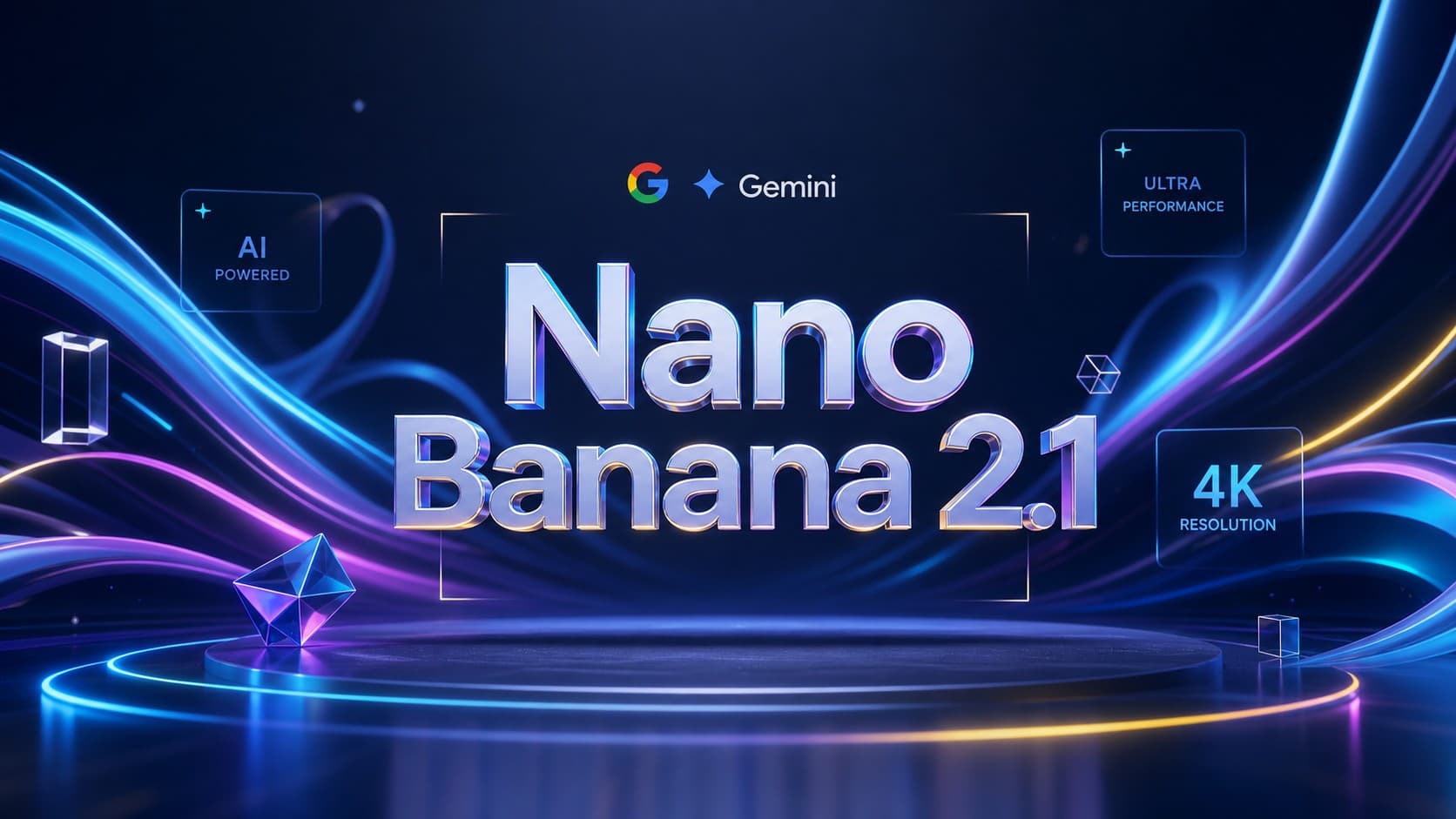
Google has officially announced Nano Banana 2.1, its latest AI model for image generation and editing, entering General Availability (GA) under the stable API identifier gemini-nano-banana-2.1. Arriving as an upgrade to Nano Banana 2, the model delivers noticeable gains in visual quality, prompt adherence, and subject consistency across complex multi-turn editing workflows.
Nano Banana 2.1 is here!
This upgraded version outperforms our previous models across the board, with notable leaps in:
– visual design
– mask-based editing
– subject consistency
– more natural-looking imageryTry it now in @GeminiApp, @GoogleAIStudio, and more. pic.twitter.com/2BuwyVfKmS
– Nano Banana 2.1 (@NanoBanana) October 6, 2026
Nano Banana 2.1 supports high-resolution outputs up to 4K, multi-image fusion with up to 14 reference images, enhanced text rendering in infographics and posters, and seamless handling of ultra-wide panoramic aspect ratios. Grounded with Google Web and Image Search, the model is rolling out across the Gemini app, AI Mode in Search, Google AI Studio, the Gemini API, and Google Cloud.
What is Nano Banana 2.1 and How Does It Connect to Gemini 3.6 Flash?
Google developed Nano Banana 2.1 as a direct successor to Nano Banana 2 (known in API documentation as gemini-3.1-flash-image). According to Google DeepMind, the model is built on top of the advanced Gemini 3.6 Flash architecture, specifically optimized for static image generation and conversational photo editing.
While the model does not produce animated video as an output format, it natively supports video files as multimodal inputs via the Gemini API, allowing developers to extract frames and reference video content for image generation and editing workflows.
This architecture is paired with extensive operational specifications: a context window of approximately 131,000 tokens (131,072) in the Gemini API (scaling up to 1 million tokens in the core model specifications), a 32,768-token output window, and the capacity to handle up to 14 reference images while preserving identity across 4 distinct characters and 10 simultaneous objects. To ensure transparency, all outputs are watermarked with Google’s invisible SynthID digital verification technology.
What’s New in Nano Banana 2.1?
The update introduces a comprehensive suite of engineering enhancements designed for real-world creative and developer workflows:
- Multi-Resolution Visual Fidelity: Supports 1K (default), 2K, and 4K outputs with refined lighting distribution, realistic skin textures, and natural shadows.
- Advanced Prompt Adherence: Significantly improved comprehension of complex prompt instructions, spatial layouts, and specific artistic constraints.
- Conversational Multi-Turn Editing: Allows users to iteratively refine, add, or modify visual elements over consecutive conversational messages without rewriting the entire prompt.
- Enhanced Typography & Infographic Layouts: Substantially better rendering of legible text, lettering, and structured diagrams within social media graphics, posters, and marketing assets.
- Panoramic & Wide-Aspect Artifact Fixes: Resolves previously problematic tiling artifacts across extreme aspect ratios (1:4, 4:1, 1:8, and 8:1) at 2K and 4K across 14 supported ratios.
- Google Web and Image Search Grounding: Integrates live search context for factual accuracy and authentic visual references, with strict safety filters preventing the use of real-world web photos of individuals.
- Configurable Thinking Levels: Offers adjustable reasoning depth-Minimal, Medium (default), and High-allowing users to tailor spatial logic and generation fidelity.
Official Google DeepMind Benchmark Results
Internal evaluations published in Google DeepMind’s official Model Card reveal that Nano Banana 2.1 excels when creative tasks become structurally complex. As the number of characters, reference assets, and interdependent objects increases, the performance gap between Nano Banana 2.1 and earlier generations widens significantly.
In the Multi-Character Consistency benchmark, Nano Banana 2.1 scored 1,106 Elo points in Thinking mode, outperforming Nano Banana 2 (978 points) and Nano Banana Pro (1,011 points). This consistency extends to Multi-Reference Editing, where the model reached 1,066 points, alongside 1,062 points in artistic Stylization. Regional editing also saw major gains, scoring 1,049 points in Mask/Ink Editing compared to 965 for Nano Banana 2 and 927 for Pro.
The most striking divergence appears in structured design: beyond scoring 1,048 points in Infographic Design, Nano Banana 2.1 achieved an Infographic Factuality score of 0.521, vastly exceeding Nano Banana 2 (0.179) and Nano Banana Pro (0.265). In overall user preference, the model maintained top ranking with 1,050 Elo points, underscoring that DeepMind’s improvements focus heavily on multi-element coherence, factual precision, and complex composite editing.
Nano Banana 2.1 vs. Nano Banana 2 and Pro: What’s the Difference?
These engineering updates shift the balance across Google’s imaging lineup. Compared to Nano Banana 2, the 2.1 release delivers dramatically better character continuity across multi-turn sessions rather than just single-image generation, adds native 4K support, and fixes wide-aspect tiling while retaining the rapid inference and cost efficiency of the Flash tier. When measured against Nano Banana Pro, internal DeepMind benchmarks show that Nano Banana 2.1 actually matches or surpasses Pro in multi-character consistency, mask editing, and infographic factuality, offering creative teams a faster and more versatile multimodal tool for production pipelines.
Where Can You Use Nano Banana 2.1?
Access to Nano Banana 2.1 is available across consumer and enterprise Google ecosystems:
- For End Users: Accessible directly within the Gemini app on mobile and desktop, AI Mode in Google Search, Google Flow, Stitch, and Google Ads.
- For Developers & Enterprises: Callable under the stable model ID
gemini-nano-banana-2.1via Google AI Studio and the Gemini API, with enterprise-grade deployment on Google Cloud Vertex AI.
How to Get the Best Results from Nano Banana 2.1?
To maximize the capabilities of Nano Banana 2.1, consider the following best practices:
- Be Specific with Typography: Clearly describe the scene, lighting, and camera perspective, and place any text that must appear in the image inside quotation marks (e.g.,
"SUMMER SALE"). - Utilize Mask-Based Editing: Upload your base image and select only the region you wish to alter, explicitly prompting the model to preserve ambient lighting, camera angles, and background geometry.
- Leverage Multi-Image References: Provide up to 14 reference images and refer to them sequentially (e.g., “place the subject from Image 1 into the environment of Image 2”).
- Tune Thinking Levels: Enable Medium or High thinking modes when generating complex infographics, dense diagrams, or multi-subject compositions.
Frequently Asked Questions About Nano Banana 2.1
Can Nano Banana 2.1 render legible text and typography inside images?
Yes. Nano Banana 2.1 features substantial improvements in font rendering, signage layout, and infographic text, producing sharp, correctly spelled typography across posters, logos, and digital banners.
Is Nano Banana 2.1 free to use?
End users can access Nano Banana 2.1 within standard usage limits in the Gemini app and Google Search. For developers building on the Gemini API or Google Cloud, usage is billed per token according to standard platform pricing tiers.
Is Nano Banana 2.1 better than Nano Banana 2?
Yes. Official Google DeepMind benchmarks demonstrate that Nano Banana 2.1 outperforms Nano Banana 2 across all key metrics, including multi-character consistency, mask-based editing precision, factual accuracy in infographics, and native 4K resolution support.