ChatGPT’s Latest Updates: Google Drive, Quizzes, Reservations and Ultrafast
OpenAI has introduced a series of updates that expand ChatGPT’s role across work, learning, and everyday tasks. The latest changes include deeper Google Drive integration, interactive quizzes, natural-language restaurant reservation searches, personalized suggestions for paid users, and a new Ultrafast service designed to deliver GPT-5.6 Sol output at significantly higher speeds.
These developments were introduced across several updates released between August 10 and August 14, 2026. While some focus directly on the ChatGPT consumer experience, others address infrastructure, developer access, and the company’s expanding advertising program.
A New Feature Drop for ChatGPT
On August 14, 2026, Adam Fry, ChatGPT’s Consumer Product Lead, highlighted the latest feature drop on X. The update covered four areas: interactive quizzes, natural-language reservation searches, Google Drive integration with the ChatGPT Library for eligible paid users, and new suggestions designed to help paid users discover useful ways to use ChatGPT.
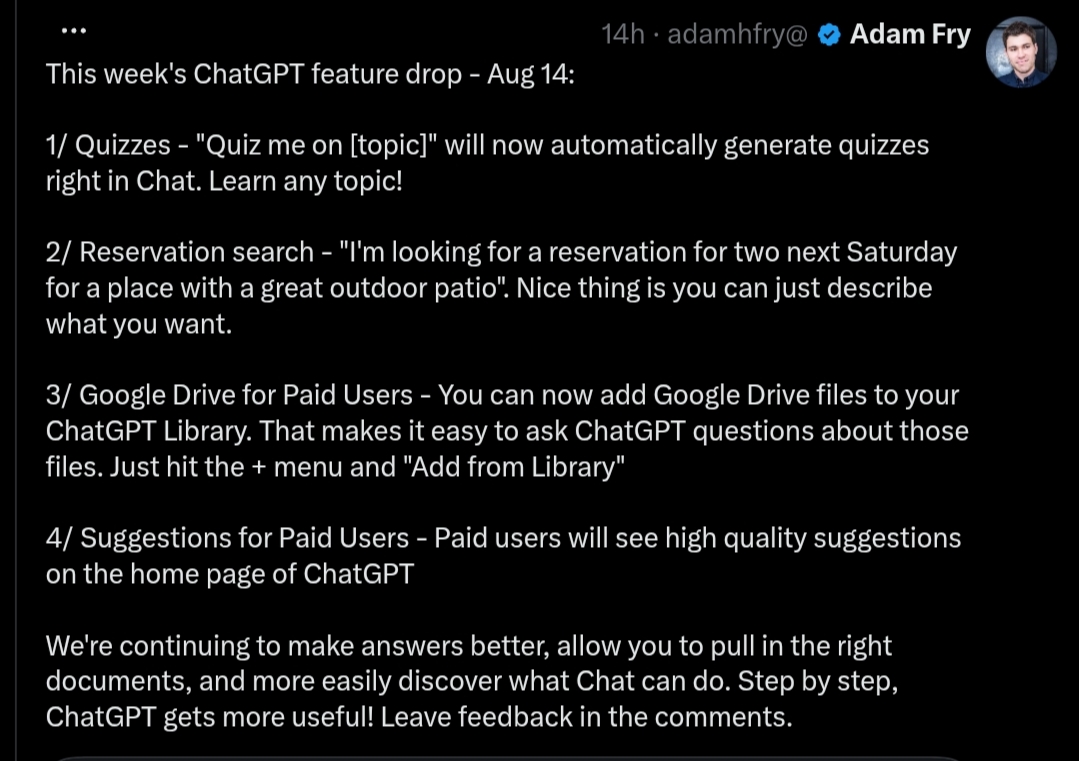
OpenAI’s official release notes also document the rollout of several of these capabilities, with availability expanding gradually depending on account type and region.
Google Drive Integration Comes to the ChatGPT Library
OpenAI has expanded the way users can work with Google Drive files inside ChatGPT. Eligible users who connect their Google account can access supported Drive content through the ChatGPT Library, making it easier to reference documents without repeatedly uploading them.
- File Access: Users can retrieve and reference supported Drive files from ChatGPT rather than uploading the same documents repeatedly.
- Work With Google Files: ChatGPT can work with supported Google Docs, Sheets, Slides, and other compatible files as part of a conversation.
- Connected Workflows: Depending on the account, permissions, and supported functionality, ChatGPT can work with connected cloud content as part of a broader workflow rather than treating each upload as an isolated file.
The integration makes Google Drive more useful as a source of information inside ChatGPT and reduces the friction involved in moving documents between cloud storage and an AI assistant.
Interactive Quizzes for Learning
OpenAI has also introduced interactive quizzes that allow users to turn a conversation into a structured learning session. A simple request such as “Quiz me on [topic]” can generate an interactive quiz directly in ChatGPT.
Rather than simply explaining a subject, ChatGPT can use questions and feedback to help users actively test their understanding. This makes the feature particularly useful for studying, revision, and learning new subjects.
Personalized Suggestions for Paid Users
Paid ChatGPT users are also beginning to see new suggestions on the ChatGPT home page. These recommendations are designed to highlight useful capabilities and potential ways to use the service without requiring users to already know which features are available.
The change is part of a broader effort to make ChatGPT’s growing set of capabilities easier to discover from the main interface.
Natural-Language Restaurant Reservations
On August 10, OpenAI introduced improvements to restaurant reservation searches within ChatGPT. Instead of beginning with the name of a specific restaurant, users can describe what they want in natural language.
For example, a user could ask for a table for two next Saturday at a restaurant with a comfortable outdoor patio. ChatGPT can use details such as the location, date, party size, and preferences to help find suitable reservation options.
The experience incorporates reservation and restaurant services including OpenTable, Resy, and Yelp, with availability depending on the service, location, restaurant, and requested time.
This represents a shift from simply answering questions about restaurants toward helping users complete real-world tasks through conversational requests.
ChatGPT Ads Expand to Additional Markets
Alongside its consumer product updates, OpenAI is expanding its advertising test to additional markets. According to the company’s August 11 update, ChatGPT Ads are being introduced for eligible users on Free and Go plans in the United Kingdom, Mexico, Brazil, Japan, and South Korea, with further expansion planned.
Under the current framework, users on Plus, Pro, Business, Enterprise, and Education plans do not receive ads. OpenAI says sponsored content is clearly labeled and kept separate from ChatGPT’s normal responses.
The company has also stated that advertisers cannot influence the answers generated by ChatGPT, maintaining a separation between advertising and the assistant’s responses.
The Speed Revolution: Ultrafast for GPT-5.6 Sol
On August 13, OpenAI previewed Ultrafast, a new high-speed service for GPT-5.6 Sol focused on reducing latency and increasing output throughput.
- Up to 750 Tokens per Second: OpenAI says Ultrafast can deliver output at speeds of up to 750 tokens per second.
- Up to 14× Faster: The company describes this as up to a 14× increase compared with standard processing rates.
- Cerebras Infrastructure: The service uses Cerebras hardware and is being offered as a limited preview through the OpenAI API rather than as a general ChatGPT feature.
The Ultrafast preview is aimed at applications where response speed and throughput are particularly important. It is currently available to a limited group of developers and customers while OpenAI expands capacity.
Where Ultra-Low Latency Can Make a Difference
OpenAI has highlighted several areas where faster model output could be particularly useful.
- Incident Response: Engineering teams can use AI to analyze logs, error traces, and code changes while investigating incidents, potentially shortening the time required to identify and test solutions.
- Financial Research and Security: Faster processing can help applications analyze large amounts of changing information and respond more quickly in environments where timing matters.
- E-Commerce and Customer Support: Low-latency AI can make conversational systems more responsive when handling complex requests, product questions, recommendations, or multi-step support tasks.
- Voice Applications: Faster output can also improve interactive voice experiences, where long pauses can make conversations feel unnatural.
Early Testing With Jane Street and Podium
OpenAI has begun testing Ultrafast with organizations working across different areas. Jane Street has discussed how faster model responses can change the way developers interact with AI systems, while Podium has explored the technology for highly interactive voice applications where response speed is important.
OpenAI is also using the technology internally in areas such as research and incident response. According to the company, faster model output can allow teams to run more iterations during the working day instead of waiting for longer-running experiments to complete.
GPT-5.6 Sol Continues to Evolve
Ultrafast is part of a broader series of developments surrounding GPT-5.6 Sol. Earlier updates focused on the model’s capabilities and everyday usability, while the latest preview places greater emphasis on how quickly those capabilities can be delivered.
The new Ultrafast service adds a different dimension to the evolution of the model: rather than introducing another consumer-facing ChatGPT mode, it focuses on making advanced AI output significantly faster for applications and developers that require low latency.
From AI Assistant to Connected Daily Workspace
Taken together, these updates point to a broader shift in how OpenAI is positioning ChatGPT. Google Drive integration reduces the friction between cloud documents and AI, interactive quizzes turn the assistant into a more active learning partner, and natural-language reservation searches extend ChatGPT into real-world tasks.
On the developer side, Ultrafast addresses a different challenge: delivering advanced model capabilities quickly enough for applications where latency matters.
Some of these features are still rolling out gradually, while Ultrafast remains a limited preview. Nevertheless, the direction is becoming increasingly clear: ChatGPT is evolving beyond a simple question-and-answer interface toward a more connected platform for work, learning, and everyday tasks.