
OpenAI Updates GPT-5.6 and Expands Unlimited Free Chats to All Users
OpenAI has announced substantial updates to ChatGPT, enhancing accuracy for paid tiers and opening unlimited text-based conversations for free users.
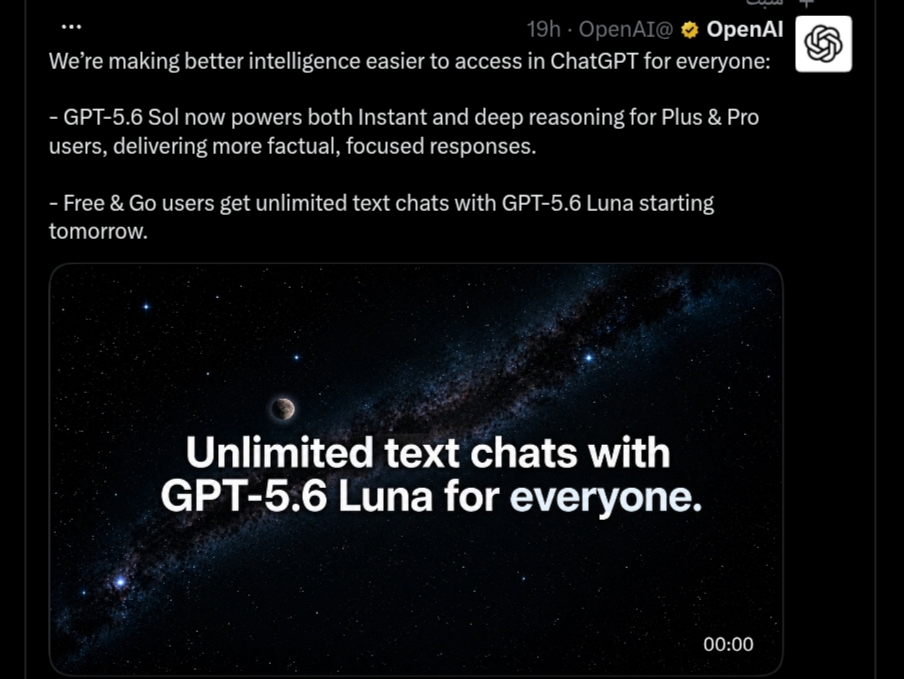
According to official announcements, free subscribers have gained unrestricted access to the GPT-5.6 Luna model without usage caps, a strategic move that reshapes daily artificial intelligence usage amid intense competition in the tech industry.
These updates target a massive user base, especially as the platform surpasses 1 billion weekly active users. In an official release, OpenAI announced that the default model for both free users and the “Go” subscription plan has been upgraded to GPT-5.6 Luna. The rollout is occurring in phases, granting users unlimited text conversations without a usage ceiling.
Deep Reasoning with the New “Think” Button
To handle more complex user queries, OpenAI has integrated new capabilities into the free tier:
- The “Think” Button: A new option that processes complex prompts with deeper, more analytical reasoning when clicked.
- Paid Tier Exclusives: Strict boundaries remain for file uploads, image generation/analysis, and advanced voice mode, which remain exclusive to paid subscription tiers.
Providing unlimited text generation reflects a significant reduction in the computational costs of processing text. In contrast, complex operations like image generation or massive data parsing require substantially more compute power, explaining why they remain behind subscription paywalls.
GPT-5.6 Sol: Enhanced Accuracy for Plus and Pro Tiers
The updates also target ChatGPT Plus and Pro subscribers. OpenAI has fine-tuned the GPT-5.6 Sol model to better suit daily professional tasks. Internal evaluations show a remarkable 68% decrease in factual errors compared to previous versions. Similarly, factual errors in the Luna model dropped by 62%, particularly in legal, medical, and financial queries. This reduction in “hallucinations” represents a major leap in reliability, resolving a long-standing challenge with dates, numbers, and citations.
Practical Case Study: Context-Aware Responses
To demonstrate the practical differences, OpenAI shared a comparison of how the old and new models handle a weather query. A user asked if they could ride a bicycle to Ocean Beach after work without getting rained on. While older models delivered verbose paragraphs detailing temperature and wind speeds before reaching a conclusion, GPT-5.6 Sol provided a concise, direct response.
The system confirmed that no rain was expected and immediately highlighted the actual obstacle-a strong headwind-advising the user to wear a light windbreaker. This illustrates the model’s ability to grasp the intent of a query and eliminate unnecessary fluff.
Granular Control via the Reasoning Slider
To customize response depth, OpenAI has introduced a new “Reasoning Slider.” Users can manually adjust this slider to determine the cognitive effort the model applies-whether they need a rapid response or a highly complex, step-by-step action plan.
This unified interface bridges the gap between quick chats and deep-thinking sessions. Writers can brainstorm ideas instantly, while programmers can allot more compute time to debug complex code blocks, reducing the need to constantly switch between different models.
Market Strategy: Retaining Dominance in a Competitive Landscape
Expanding free services is a proactive measure to protect OpenAI’s market share. With tech giants expected to integrate highly capable, free AI chat features directly into mobile operating systems, locking advanced models solely behind paywalls would risk losing user loyalty.
Furthermore, this strategy is fueled by user data. Having 1 billion weekly active users generates massive volumes of real-world interactions. These inputs are vital for Reinforcement Learning from Human Feedback (RLHF), turning cheap computational text processing into a highly valuable asset. Analyzing user patterns and complex queries helps train future models far more effectively than synthetic datasets ever could.
The Shifting Cost Equation in the AI Sector
This move highlights a clear dichotomy in the AI market. While OpenAI expands its free offerings, some competitors are raising subscription costs to cover heavy infrastructure expenses. When text processing costs drop toward zero, free conversations become a powerful customer-acquisition tool rather than a financial burden.
Companies relying on less efficient server architectures are forced to raise prices, a situation OpenAI avoids by developing highly efficient models and reducing API costs by up to 80%.
Safety Guardrails and Teen Protections
On the safety front, OpenAI has implemented strict protective measures. Both models are trained to avoid romantic roleplays or age-inappropriate challenges with users under the age of 18. Additionally, the system features precise guardrails surrounding eating disorders, body image, and sensitive sexual content.
Beyond direct training, OpenAI introduced safety evaluations tailored to younger demographics. The system is programmed to gently guide teenagers to contact trusted adults or seek professional support when expressing psychological distress, ensuring that AI remains a supportive tool rather than a replacement for human connection.
Conclusion: A New Era of Accessible AI
Ultimately, these updates mark a new phase in AI accessibility. Basic text conversations have become a commodity available to everyone, while advanced multi-modal productivity tools remain premium features. This clear division between free and paid capabilities reflects a maturing industry seeking sustainable financial models, with the everyday user benefiting from stronger, more intelligent tools at no additional cost.