Between Image Generation and Design Engineering: What Sets Grok Imagine 2.0 Apart?
SpaceXAI (formerly xAI) has launched the second generation of its image model, Grok Imagine 2.0 (officially announced as Imagine Image 2.0), currently available in Quality Mode on the official web platform and mobile apps. The new model introduces a comprehensive ecosystem focused on precision editing, crisp typography, and iterative refinement without losing base image details. This shift places the model firmly in the category of professional design applications, rather than a mere casual image generator.
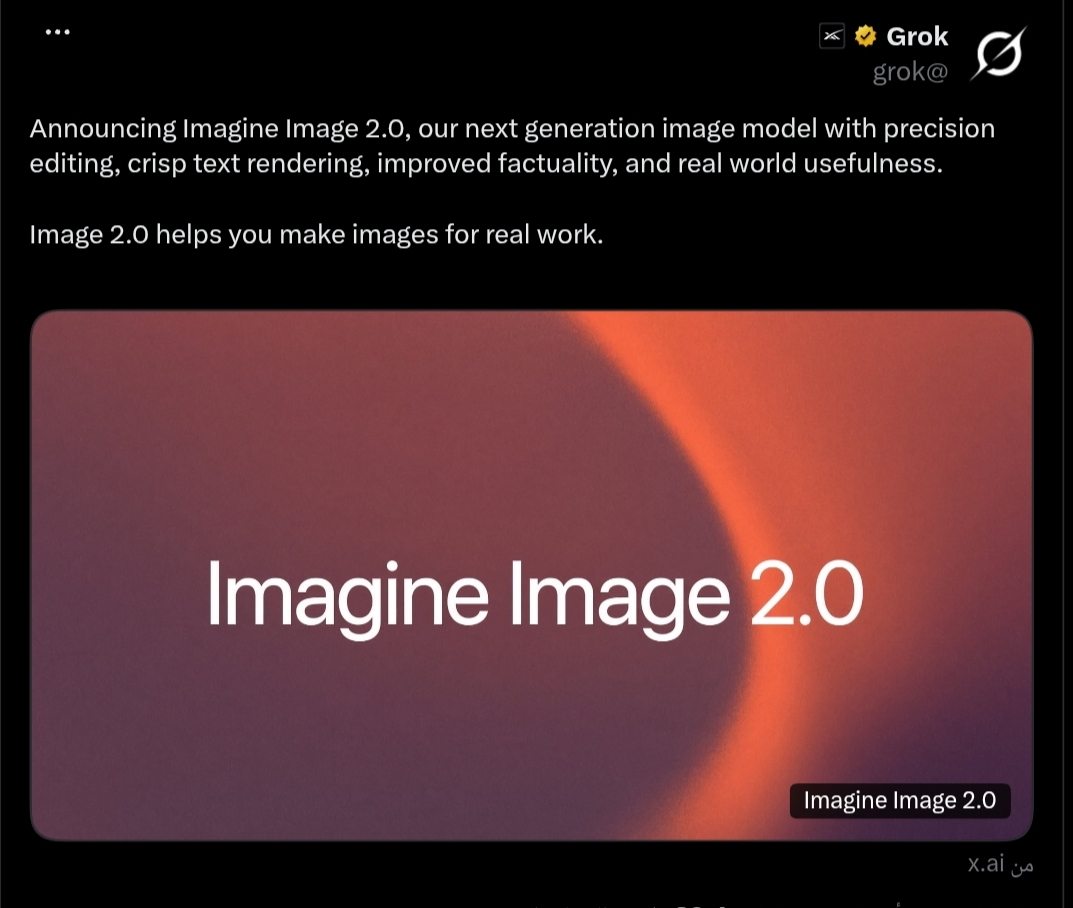
According to SpaceXAI’s official release, the model was built with a practical goal: creating assets ready for real-world usefulness in professional environments. To achieve this, developers focused on solving the challenge of precise local editing-historically one of the greatest friction points for designers utilizing AI algorithms.
Typography and Professional Layouts: Ending the Era of Scrambled Text
One of the most persistent bottlenecks in generative AI tools is the random nature of rendering text within a scene. Letters often appear reversed, distorted, or scrambled, particularly in complex designs with multiple text areas.
The development team noted that Grok Imagine 2.0 plans typography and layout similarly to a human designer. As a result, the tool can produce text-dense designs with clean formatting, ensuring small fonts remain legible. This capability transitions the model from an experimental toy to a viable asset for creating promotional posters, flyers, and marketing materials, where attention to detail is a critical factor for success.
Precision Local Editing: A Practical Alternative to Complex Software
Creative work rarely ends with the first generation; initial images often require a series of iterative refinements. Grok Imagine 2.0 addresses this with a suite of tools designed to simplify the editing loop:
- Magic Wand: This tool allows users to select and edit a highly specific area of the image while keeping the rest of the scene intact. For instance, if a designer has a well-composed image of a living room but wants to change the color of a throw pillow, they can simply paint over the pillow. The AI adjusts its color while preserving natural lighting shadows and the original fabric texture.
- Segmentation Tool: Offers precise control over isolating specific element borders within the scene.
- Background Removal: Easily cuts out a subject or product, exporting it as a transparent PNG ready to be copied and pasted into other design software, saving valuable time for designers running large-scale ad campaigns.
Multi-Reference Image Composition: Merging Five Elements into One Scene
Composition is a major hurdle in AI design. Merging a character from one image, a background from another, and a product from a third traditionally required exporting the elements and manually compositing them in external software.
The model introduces a “multi-reference editing” feature that accepts up to five different input images. The model analyzes these elements and merges them into a single, cohesive scene with matching perspective and lighting. This bypasses a major step in post-production, offering immense value to content managers who need to produce complex promotional posts rapidly.
Flexible Digital Publishing: How the Model Reimagines Image Resizing for Multiple Platforms
Managing digital media channels requires handling different aspect ratio requirements for each platform. An article header image requires a different ratio than the same image uploaded as an Instagram Story or a Facebook ad.
SpaceXAI integrated a smart resizing feature supporting nine distinct aspect ratios (ranging from 1:2 to 2:1). Instead of cropping the edges of an image when a new dimension is selected, the model imagines and draws the missing extensions to match the original style (Outpainting). Conversely, if the image is scaled down, the model intelligently reorganizes the scene to keep the primary subject centered in the frame, making it easier for marketing teams to maintain visual consistency across channels.
Ready-Made Templates: Bridging the Gap Between Artistic Concepts and Commercial Deliverables
Innovation is not just about raw computational power; it also lies in the user experience. The platform introduces pre-configured “Templates” that act as pre-set workflows for repetitive tasks, serving as bridges between complex technology and daily design needs.
The available templates are split into practical categories:
- Photography Tools: For image editing and creative reimagining.
- Product Tools: For changing product colors and generating e-commerce storefront imagery.
- Marketing Tools: For clean ad posters and realistic user-generated-content-style photos.
- Design Tools: Such as custom icon makers and avatar generators.
This helps close the gap between casual users and professionals. Instead of writing complex prompt strings to isolate a product background, a user selects the “e-commerce product” template, and the system automatically configures the environment. Professionals retain the flexibility to tweak the results, ensuring a balanced workflow between speed and precision.
Consistent Visual Identity: Establishing Unified Worlds and Characters for Animation and Video
While primarily an image-focused tool, the model is integrated into a broader video production ecosystem. SpaceXAI introduced a “world-building” feature that allows designers to generate a main character and then place them across different geographical locations within the same visual universe while keeping their accessories and features intact.
Most notably, this feature does not stop at static images. It serves as a direct bridge to the platform’s video generation models (such as Grok Imagine Video), allowing creators to transform these consistent characters and environments into short animated clips with synchronized audio and natural camera motion within a single workspace. For independent game developers and animators, this serves as an efficient way to establish a visual design document in minutes before moving to full-scale animation.
The Competitive Landscape: What Does Ranking Second Globally Really Mean?
When evaluating a creative tool, the ultimate question is how it translates to real-world performance.
According to the independent LMSYS Arena leaderboard-which relies on blind community preferences to rank models-the low-power version of Grok Imagine 2.0 (listed under its parent company SpaceXAI) holds the second place globally across two major categories.
In the “Image Editing” category, the model scored 1439 points, trailing OpenAI’s GPT-Image-2 by approximately 24 points. In the “Text-to-Image” category, the model secured 1320 points.
While not holding the top spot, these benchmarks put the tool in a highly competitive bracket, outperforming major models from Meta (Muse-Image), Google (Gemini), and ByteDance (SeedDream). These results demonstrate the model’s ability to satisfy actual user expectations beyond theoretical metrics, highlighting SpaceXAI’s rapid growth in the visual content space.
Access Channels and Trials: From Consumer Platforms to Developer Gateways
Grok Imagine 2.0 is currently accessible to users via Grok.com/imagine or through updated mobile apps with Quality Mode enabled.
For developers and enterprises wanting to integrate these image-generation capabilities into their own software, full and direct API access is planned for an upcoming release. However, developers do not have to wait entirely; preview integrations of the model have already begun appearing on prominent developer gateways like Vercel AI Gateway and fal.ai. This rolling release allows teams to experiment and build initial workflows alongside the maturing consumer product.
Conclusion: Is Grok Imagine 2.0 the Right Tool for Your Next Project?
Grok Imagine 2.0 is not meant for casual users seeking abstract art to copy and paste into group chats. It is designed for professional creators, graphic designers aiming to optimize their workflows, and e-commerce managers who need precise, editable product visuals.
The combination of precise local editing, smart resizing, and 5-image multi-reference compositing builds an environment that significantly reduces reliance on external image editors. Through this launch, SpaceXAI demonstrates that the future of generative AI lies not just in creating more beautiful images, but in building highly adaptable, practical assets tailored for the demands of the real market.