Gemini 4 Hydrogen: Google’s Faster AI for Coding & Agents
Google announced Gemini 4 Hydrogen on November 12, 2026, introducing a new AI model focused on faster task execution, software development, and AI agent workflows. According to the company, Hydrogen completes tasks up to 2.5 times faster than Gemini 3.8 Flash, while delivering improved coding benchmark results and a significant reduction in fabricated claims.
Meet Gemini 4 Hydrogen.
It brings cutting-edge intelligence to everyone, with speed and efficiency for everyday coding and agentic work.
Across 4 thinking levels, it stands on its own or teams up with Carbon and Argon – 2.5X faster than 3.8 Flash, outpacing competing models in… pic.twitter.com/QTRwACdxU2
– Google (@Google) November 12, 2026
Hydrogen joins the Gemini 4 family alongside Gemini 4 Carbon and Gemini 4 Argon, with each model serving a different purpose. Carbon focuses on complex, long-running tasks, while Argon targets advanced reasoning. Hydrogen, meanwhile, is designed for fast, repeated execution, including writing code, running tests, fixing bugs, and analyzing files.
The launch extends beyond developers. Google has begun bringing the model to the Gemini app and Google Search, alongside developer APIs and business products.
What Is Gemini 4 Hydrogen?
Gemini 4 Hydrogen is a reasoning model from Google DeepMind, built on a modified version of Gemini 4 Carbon, according to its official model card. Rather than focusing solely on lightweight conversations, Hydrogen combines reasoning capabilities with multi-step task execution, placing particular emphasis on response speed and token efficiency.
The model targets workflows that involve several connected steps. For example, it can inspect a large software repository, locate a bug, suggest a code change, run tests, and verify the result. Its capabilities also cover research, data analysis, and working with documents and visual files.
Hydrogen complements the other Gemini 4 models rather than replacing them. Tasks requiring deep architectural planning or extended research belong to Carbon or Argon, while Hydrogen is designed for faster execution, code reviews, and repeated testing.
Faster Performance and Improved Coding Benchmarks
Speed is one of the main selling points of Gemini 4 Hydrogen. According to Google’s tests, the model completes tasks up to 2.5 times faster than Gemini 3.8 Flash when using the High thinking level, which is Hydrogen’s default setting.
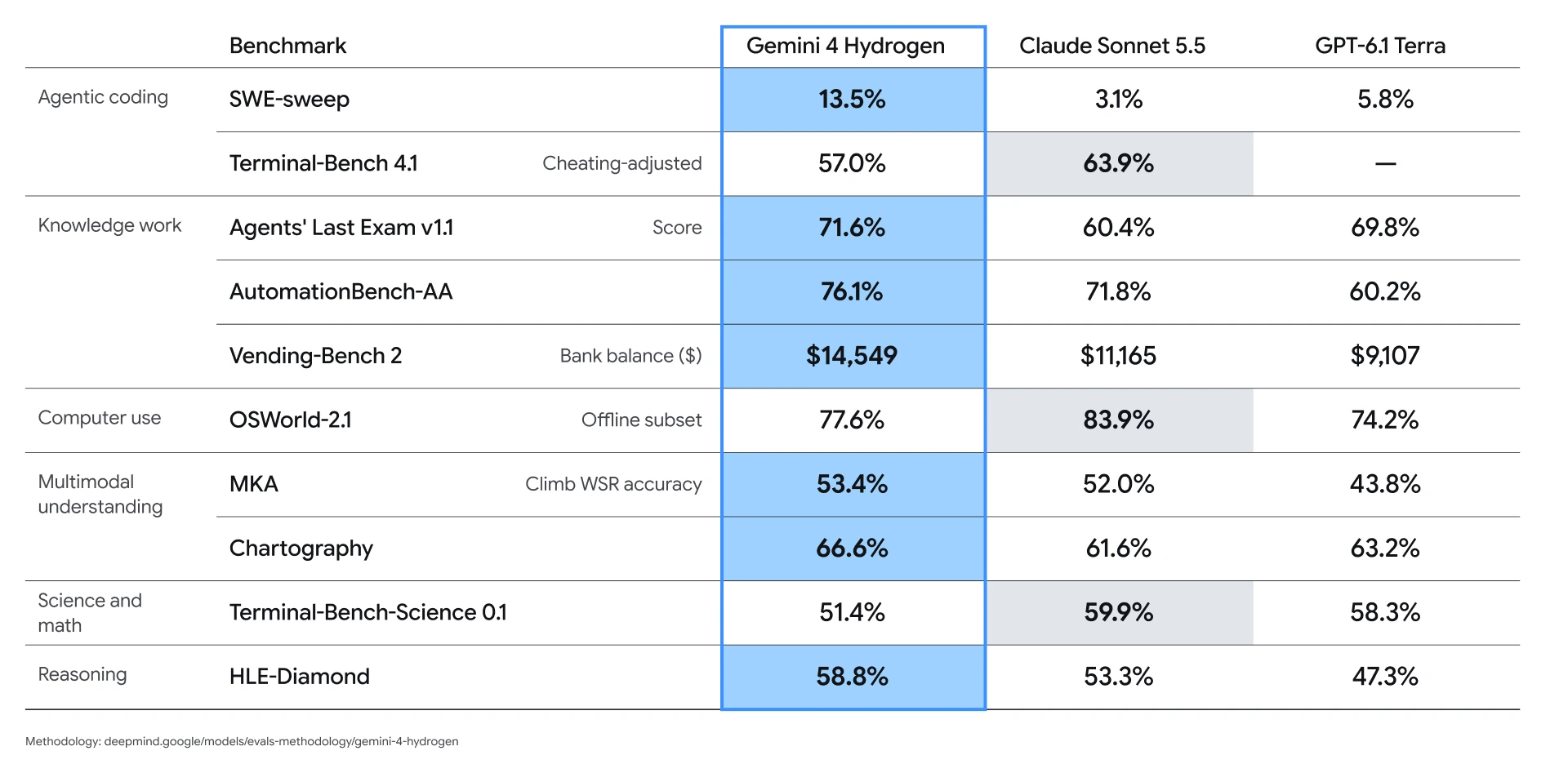
The model also scored 57% on Terminal-Bench 4.1, compared with 18.2% for its predecessor. The benchmark evaluates how well AI models complete software engineering tasks in a terminal environment, including using tools, executing commands, and working with project files. Google also reports that Hydrogen reduces fabricated claims by more than five times compared with Gemini 3.8 Flash.
These improvements are particularly relevant to everyday software development. Instead of simply suggesting a code snippet, Hydrogen can work with project files, search across different parts of a repository, make targeted changes, and continue through testing and debugging. It also supports parallel file-reading and search operations, significantly cutting navigation time across large codebases.
In partner evaluations, the model recorded speeds between 2 and 2.8 times higher on complex tasks involving databases, spreadsheets, and enterprise data. Token consumption also decreased by 12% to 23% compared with Gemini 3.8 Flash. Because these benchmarks reflect controlled partner environments, actual speedups in production will depend on codebase complexity and workflow structure.
How Does Gemini 4 Hydrogen Perform in Independent Benchmarks?
Independent evaluations provide a more varied picture than Google’s published figures. In the Vals AI evaluation, Gemini 4 Hydrogen scored 68.49% on the Vals Index, ranking sixth among the 37 models included in the assessment.
The model achieved 52.30% on Tax Agent Bench, placing first among 85 models in this specialized tax-related evaluation. It also ranked second on the Vals Finance Index with a score of 66.14%, and recorded 53.85% on Legal Research Bench.
Its coding results, however, were less dominant. Hydrogen ranked 11th among 64 models on Terminal-Bench 4.0, with a score of 54.04%, and 13th among 128 models on Vibe Code Bench.
It is important to distinguish between the different benchmark versions. Google’s 57% result refers to Terminal-Bench 4.1, while Vals AI’s 54.04% score comes from Terminal-Bench 4.0. These results are not directly comparable because they use different benchmark versions and evaluation settings. Google reported its result at the High thinking level, whereas Vals AI evaluated Hydrogen using the maximum XHigh setting.
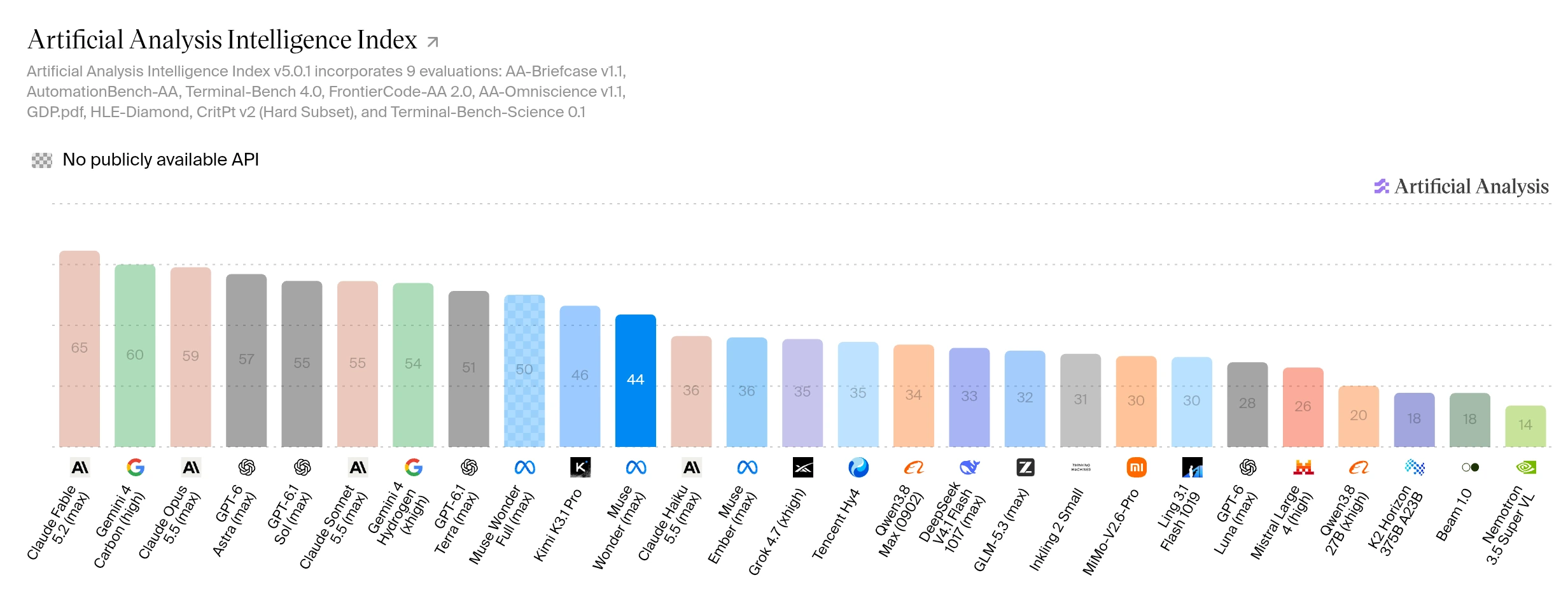
On the Artificial Analysis Intelligence Index, Hydrogen recorded approximately 51 points at the High level, compared with 50 points for Gemini 4 Argon. Its score increased to 54 points at XHigh. These results indicate that Hydrogen’s strengths are concentrated in execution speed and efficiency on repeated tasks, while other models can perform better on problems requiring more complex reasoning.
A Context Window of Up to 1 Million Tokens
Gemini 4 Hydrogen supports a unified context window of 1,048,576 tokens, giving it substantial capacity for processing long documents, large files, and multi-step conversations.
Supported inputs include text, images, audio, and video, as well as PDF files and Microsoft Office documents such as Word, PowerPoint, and Excel. The model also supports OpenDocument files. This multimodal support allows it to analyze different types of material within a single workflow, such as reviewing a lengthy report containing tables, charts, audio recordings, or video clips.
There is an important technical distinction behind the one-million-token limit. The context window represents a shared total limit for input and output, rather than one million tokens for input and another million for output. The total also includes thinking tokens, tool calls, and the final response.
Output is limited by default to 65,536 tokens per request, with the possibility of extending it through the continuation mechanism supported by Google’s APIs.
Four Thinking Levels for Different Tasks
Gemini 4 Hydrogen offers four thinking levels designed to balance reasoning depth, execution speed, and resource consumption:
- Low: Suitable for classification, summarization, data extraction, and quick tasks.
- Medium: Designed for general work, routine coding, and document analysis.
- High: The default level, intended for multi-step programming, tool use, and complex file analysis.
- XHigh: Designed for tasks requiring deeper reasoning, including scientific and mathematical problems and large software projects.
These options give developers more control over how the model handles different workloads. Simple tasks run efficiently on Low without wasting compute, whereas complex research and large codebases demand XHigh, even if it increases execution time and token consumption.
Orchestrator Combines Hydrogen and Carbon in Antigravity
One of the key announcements accompanying Gemini 4 Hydrogen is Orchestrator, a coordination feature within Google Antigravity that allows different models to work together during the same session.
The approach distributes responsibilities instead of assigning an entire project to a single model. Carbon can handle planning, coordination, and tasks requiring deeper reasoning, while Hydrogen takes care of execution, code writing, testing, and reviewing results.
On Terminal-Bench 4.0, Google reports that Orchestrator achieved a success rate close to Carbon while using 24% less quota and completing tasks 19% faster on average.
The system also supports parallel agents working in isolated workspaces. Hydrogen can execute changes and verify them simultaneously rather than waiting for each step to finish before starting the next. This extends the model’s role beyond answering developer questions, allowing it to participate throughout the software development and testing process.
Gemini 4 Hydrogen Pricing and Availability
Google has set the following Gemini 4 Hydrogen API prices:
| Usage | Price per 1 million tokens |
|---|---|
| Input tokens | $1.50 |
| Output tokens | $7.50 |
These rates make output tokens more expensive than input tokens, an important consideration for applications that generate lengthy responses or rely on repeated reasoning operations.
The model began rolling out across several Google products on November 12, 2026:
- Gemini app: Users can access Hydrogen through the model selector, while free users may receive it through automatic model selection when it is suitable for their requests.
- Google Search: Hydrogen is being integrated globally to improve the handling of complex questions and deliver more visual answers and relevant links.
- Google AI Studio and Gemini API: Developers can use the model to build AI-powered applications and systems.
- Android Studio: Hydrogen is supported among the paid developer options.
- Google Antigravity: Access is available to Google AI Pro and Ultra subscribers.
- Gemini for Business and Google Sheets: The model is available to eligible business plans and Google AI Pro and Ultra subscribers using Sheets.
Gemini 4 Hydrogen Limitations and Safety Considerations
Despite its performance improvements, Gemini 4 Hydrogen has several limitations. Its official model card lists March 2026 as its knowledge cutoff and highlights technical problems when running long tasks or using higher thinking levels. These include increased response times, repeated timeout errors, and the generation of inaccurate outputs.
The model card also reports a 5.57-percentage-point increase in the false refusal evaluation compared with Gemini 3.8 Flash. In practice, this higher refusal rate means users will encounter more false blocks on benign prompts. On the other hand, it recorded improvements in multimodal and multilingual safety assessments.
The safety results in the model card are based on automated evaluations. Google says a full safety and security report will follow.
Is Gemini 4 Hydrogen Worth Using?
Gemini 4 Hydrogen is a significant addition to the Gemini 4 family, particularly for developers and businesses that need fast software execution, file analysis, and AI agent workflows. Its main strengths lie in combining faster performance with multiple thinking levels, a large context window, and the ability to work alongside Carbon through Orchestrator.
However, Vals AI’s results show that its performance is not equally strong across every field. It achieved strong results in financial, tax, and legal evaluations, while placing in the middle of the rankings on some coding benchmarks. Hydrogen is therefore not the strongest model for every workload. It is better suited to fast development teams and repetitive execution tasks, while Carbon remains the clear choice for large projects where deeper reasoning is essential.
For everyday users, Hydrogen’s arrival in Gemini and Google Search is also relevant. Everyday users immediately get sharper instruction following and richer answers on complex queries, without requiring them to select a specialized model for every request.