Gemini Decision 1: Dedicated AI Model for Fast Decisions and Low-Cost Agent
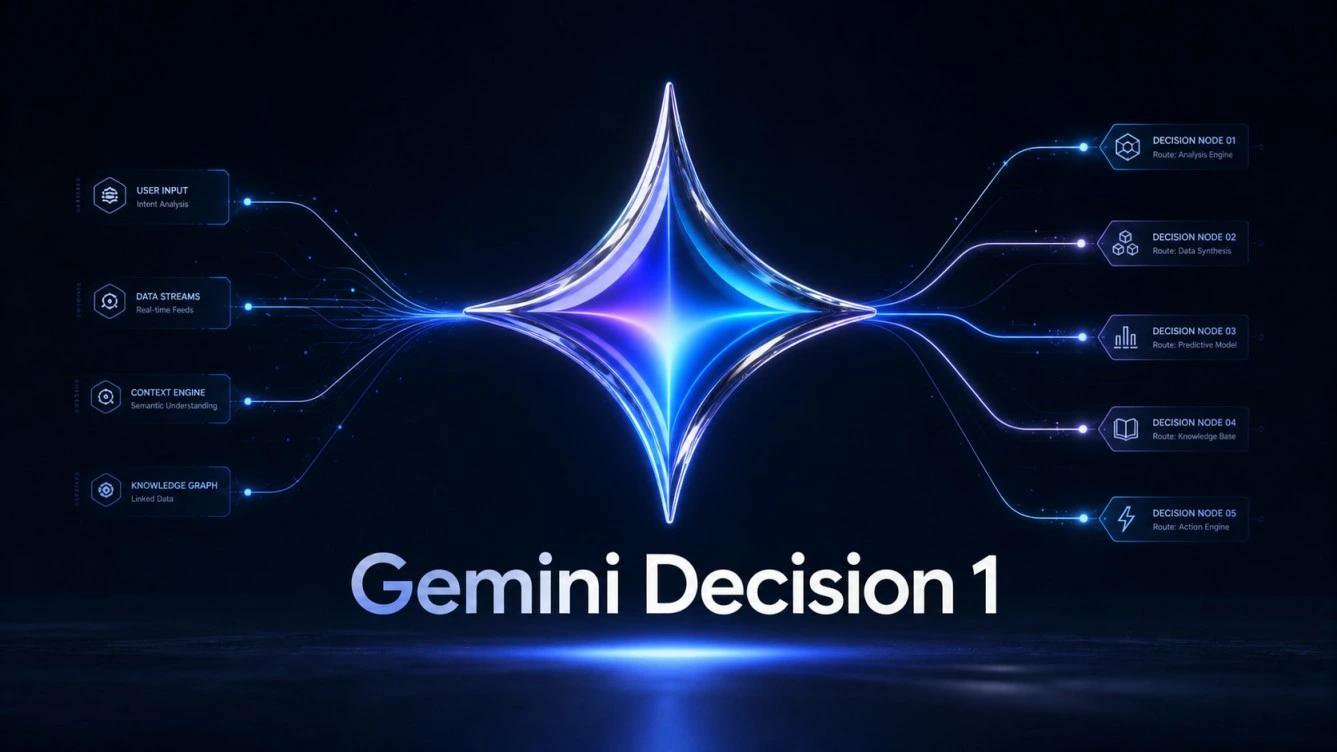
Google has launched Gemini Decision 1, an AI model designed to evaluate options, classify data, and return specific decisions at high speed through a dedicated API called Gemini Decisions API. Unlike conversational AI models that generate lengthy text responses, Gemini Decision 1 focuses on carrying out evaluation and selection tasks directly, without producing unnecessary conversational filler.
introducing the Gemini Decisions API
powered by Gemini Decision 1, our new multimodal decision model
get fast, calibrated decisions on up to 1000 questions at once across text, images, audio, video, and PDFs
try it today in AI Studio and via the Gemini API… pic.twitter.com/LYZSfzJeSL
– Google AI Studio (@GoogleAIStudio) November 11, 2026
Announced on November 11, 2026, the model targets software developers, engineers, and teams building AI agents that need to process large numbers of decisions quickly and at a fraction of standard API costs.
Gemini Decision 1 can analyze different types of input, including text, images, audio recordings, videos, and PDF files. It then answers predefined questions about that content. This approach is particularly useful for applications that need to process large amounts of information or make repeated decisions, such as classifying messages, reviewing documents, or determining the appropriate action in a specific situation, without calling a conversational model for every task.
What Is Gemini Decision 1? A Model Built for Decisions, Not Text Generation
Identified by the model name gemini-decision-1, Google’s new system analyzes input and compares it against a set of conditions or options defined by the developer. It then returns the appropriate result in a structured format.
Rather than generating several paragraphs of text, the model provides a direct answer in the form of a selection, classification, or score. This makes it suitable for tasks where the application needs a clear result that can be processed immediately.
Gemini Decision 1 is not intended to replace Google’s general-purpose Gemini models, including the Pro and Flash versions. Instead, it is designed to work alongside them. Generative models can handle tasks that require writing, explanations, or extended analysis, while Decision 1 handles specific decisions that can be evaluated against clearly defined criteria.
For example, a customer support system could use the model to determine whether an incoming message requires urgent attention. An application could also submit a document and ask whether it meets a particular set of requirements. In both cases, the application receives a result it can use directly instead of having to extract a decision from a lengthy AI-generated response.
The model also supports a context window of up to 256,000 tokens. This allows developers to submit large documents or multimodal inputs and ask multiple questions about their contents.
Three Evaluation Modes in the Gemini Decisions API
The Gemini Decisions API provides three main evaluation modes, allowing developers to select the approach that best fits their application and the type of result they need.
1. Yes/No Decisions
This mode is designed to verify whether a specific condition is met and return a binary result.
For example, an application could analyze an image to determine whether there is a liquid spill on a desk. It could also review an incoming message to check whether it contains a refund request.
This approach is useful for repetitive verification tasks, particularly when the required answer is straightforward and does not need a detailed explanation.
2. Multiple-Choice Selection
The multiple-choice mode allows developers to provide a list of alternatives and ask the model to select the most appropriate one. It supports lists containing between two and 255 options.
A maintenance management system, for instance, could analyze a report about a technical failure and choose the appropriate response from several possibilities: dispatching a maintenance team, escalating the issue to an emergency department, or recording the report without immediate action.
The model can also return probability scores indicating how suitable each option is, giving applications additional information when handling the result.
3. Rubric Scoring
The Rubric Scoring mode evaluates input against a predefined scoring scale and a set of criteria supplied by the developer.
Instead of selecting a single answer, the model assigns a score that reflects how closely the submitted content matches the specified requirements.
Potential applications include evaluating text quality, checking whether documents comply with specific policies, and assessing the risk level of a financial transaction.
Across all three modes, the model provides a numerical confidence score ranging from zero to one. Applications can use this score to identify results that require additional review. If a decision is uncertain or its confidence falls below a threshold set by the developer, the application can route the case to a human reviewer rather than acting on it automatically.
Processing Hundreds of Questions From a Single Input
Google highlights response speed as one of the main advantages of Gemini Decision 1. According to the company’s figures, total response latency ranges from 150 to 250 milliseconds, while the model’s internal processing time is between 50 and 100 milliseconds.
However, the more notable capability is not simply answering an individual question quickly. The API can also handle a large number of questions related to the same input. Developers can submit up to 1,000 questions about a shared file or piece of content, while paying for the input only once rather than resubmitting it with every question.
For example, a developer could upload a ten-minute video or a large PDF document and then ask hundreds of separate questions about its contents. These questions might involve identifying people or objects, extracting specific information, or checking whether particular events or conditions appear in the material.
This approach eliminates redundant data processing, directly cutting operating costs and significantly boosting execution speed, especially in applications that handle large volumes of files and queries.
Google also reports that Gemini Decision 1 has achieved results in tests covering task classification, agent routing, and multimodal understanding. The company says that using the model reduced costs by approximately five times compared with using Gemini 3.5 Flash-Lite through the previous interaction API.
These figures are based on Google’s internal evaluations. Their performance in real-world production environments will depend on how developers test and deploy the model in their own applications.
How Google Uses Gemini Decision 1 Across Its Products
Google has outlined several practical applications of the model within its products and projects. These examples show how a dedicated decision-making system can take over tasks that would otherwise require a full generative model.
Some of the highlighted uses include:
- Gemini Notebook: The model acts as an inquiry coordinator, helping identify the nature of a question and route it to the most suitable tool or processing method. Google says this approach reduced waiting times by 40% in some operations.
- Stitch: Google’s design platform uses rapid evaluation capabilities to speed up prototype creation and handle changes requested through voice input.
- CC, a Google Labs project: The model helps select the most appropriate response emoji from a list of more than 200 options, without generating a complete text response.
- Google Search: Google says the API is used to inspect suspicious behavior and address manipulation attempts associated with AI agent protocols such as MCP.
These examples demonstrate that the model’s role extends beyond basic data classification. It can also coordinate operations within software systems, determine the next step in an agent workflow, and inspect incoming data before it moves to more complex processing stages.
Developers can readily apply the same approach to sorting customer support messages, reviewing documents, classifying digital content, validating requests, and identifying cases that require human intervention.
Gemini Decisions API Pricing and Availability
Google has set the Gemini Decisions API input price at $0.10 per million tokens, with no charges for model outputs.
This pricing structure reflects the type of results the model produces. Its responses primarily consist of selections, classifications, and numerical scores rather than lengthy generated text.
Another important aspect of the pricing model is the ability to reuse a shared input across multiple questions. Developers do not need to pay to process the same file again for every new query. This can make the API particularly useful for applications that inspect large documents or perform repeated evaluation tasks.
Google has also made the model available for experimentation and prototyping through Google AI Studio. The company has indicated support for integration with development tools and platforms such as LangChain, OpenRouter, and Vercel, allowing developers to incorporate the model into existing applications and workflows.
Will Gemini Decision 1 Change How Developers Build AI Agents?
The launch of Gemini Decision 1 reflects a broader move toward specialized AI models designed for tasks that do not require text generation, but instead need information evaluated and an appropriate action selected quickly.
This specialization enables developers to decisively cut reliance on large generative models for simple, repetitive operations, while keeping those models available for tasks that require extended reasoning, explanations, or content generation.
The approach is particularly relevant to AI agent architectures. An agent can use Gemini Decision 1 to make quick decisions between execution steps, such as choosing the appropriate tool, classifying a request, or determining whether a task needs to be escalated.
However, the quality of its results depends heavily on how clearly developers define the evaluation criteria and available options. The model operates as a structured evaluation tool rather than an unrestricted generative system, so its accuracy is closely tied to the clarity of the rules and conditions provided to it.
Developers therefore need to define evaluation criteria carefully, test the resulting decisions, and establish clear conditions for human review before deploying the model in production applications.
With Gemini Decisions API, Google is giving developers a dedicated way to add a fast decision-making layer to their applications, instead of relying on a full conversational model for every classification or selection task.