Gemini 3.8 Flash from Google: What’s New and How Far Does Flash Cyber Go?
On September 2, 2026, Google DeepMind announced the official release of two new artificial intelligence models: Gemini 3.8 Flash and a specialized defensive variant, Gemini 3.8 Flash Cyber. Coming just three weeks after the arrival of Gemini 3.7 Flash, the dual launch marks Google’s third Flash-tier release in six weeks. Rather than introducing distinct architectures for different markets, Google engineered both variants upon a single, shared intelligence core refined through recursive agentic training loops. The defining distinction between the two models lies not in parameter scale, but in their safety boundaries and authorized deployment environments.
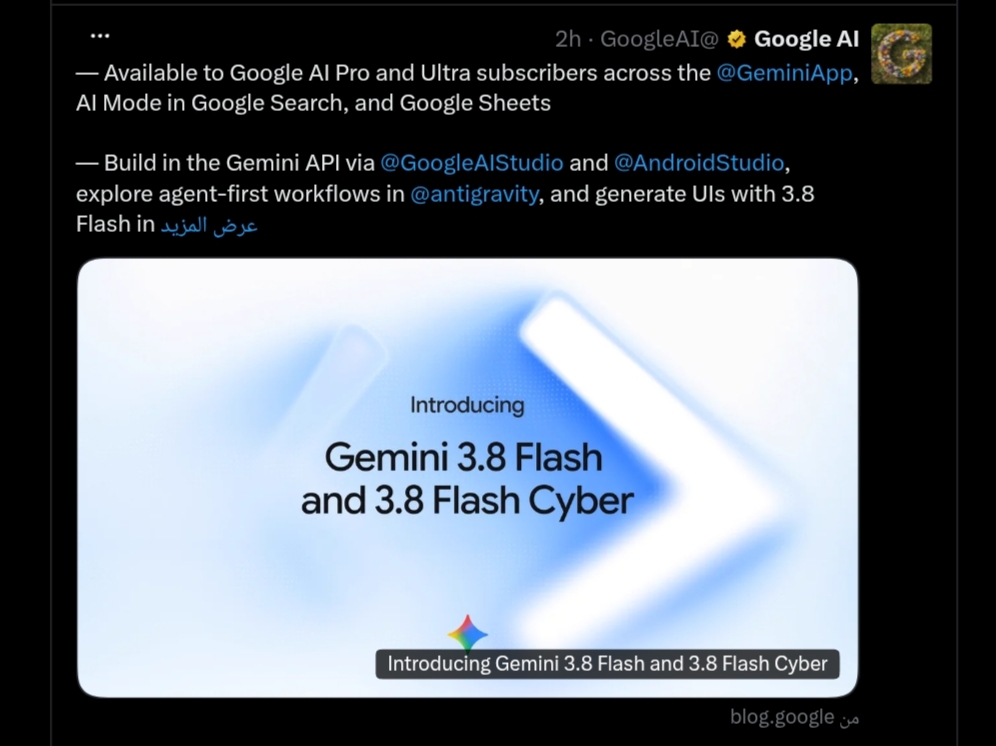
Gemini 3.8 Flash is available immediately across Google’s developer and enterprise ecosystems, including the Gemini API, Google AI Studio, Google Antigravity, Android Studio, and Gemini Enterprise. Model weights remain closed, ruling out on-premises or self-hosted deployments. In contrast, Gemini 3.8 Flash Cyber is subject to strict access controls under Google’s newly established Fairwind Program, which limits distribution to vetted defenders, government authorities, critical infrastructure operators, and open-source software maintainers.
Gemini 3.8 Flash and Flash Cyber: What Unites the Two Models and What Sets Them Apart?
Google DeepMind confirmed that both newly launched variants share the exact same technical baseline. This shared core underwent extensive optimization via recursive agentic feedback loops, where autonomous systems evaluated reasoning paths and improved performance dynamically without continuous human intervention. The engineering team noted that the significant gains in coding synthesis and logical problem-solving were a direct consequence of integrating rigorous training routines sourced from the demanding domain of digital security.
The divergence between the models reflects operational intent and deployment boundaries rather than architectural differences:
- Gemini 3.8 Flash (General Workhorse): Operates under standard commercial safeguards designed to limit assistance in cyber offensive tactics and hazards related to chemical, biological, radiological, and nuclear materials, targeting global developers, enterprises, and everyday consumers.
- Gemini 3.8 Flash Cyber (Defensive Specialist): Operates with a calibrated, permissive mitigation envelope that provides security practitioners with broad latitude to deconstruct complex software vulnerabilities and engineer patches, with distribution restricted exclusively to verified defenders to prevent malicious misuse.
How Does the Next-Gen Model Think? Deeper Reasoning and Iterative Tool Usage
Google described the behavioral shift of Gemini 3.8 Flash candidly: on demanding workflows, the system works noticeably harder. It executes additional internal reasoning steps and calls external tools iteratively to verify hypotheses before synthesizing a final response. This approach grants the model enhanced self-correction and execution rigor on long-horizon objectives.
This operational design introduces a calculated trade-off between absolute accuracy and resource expenditure. Higher reasoning levels consume a greater volume of tokens per task to achieve maximum precision. Consequently, Google’s official developer guide explicitly advises engineering teams to remain on Gemini 3.7 Flash for workflows where compute efficiency and token overhead represent primary constraints, recognizing that the newest model may not serve as the optimal default for cost-sensitive, low-complexity tasks.
Technical Specifications: Context Exceeding One Million Tokens and Flexible Reasoning Modes
Gemini 3.8 Flash builds directly upon the hardware-efficient foundation of Gemini 3.7 Flash without altering core capacity figures:
- Context Processing Window: Supports up to 1,048,576 tokens (~1M tokens) of comprehensive input data.
- Maximum Generation Capacity: Generates up to 65,536 tokens (~64K tokens) in a single response.
- Multimodal Ingestion: Ingests diverse input formats across text strings, high-resolution imagery, audio files, and video streams.
- Supported Reasoning Levels: Retains Low, Medium (the platform default), and High thinking modes.
- Configuration Deprecation: Completely removes the Minimal thinking mode; selecting Minimal now generates an immediate API validation error.
- Knowledge Cutoff Date: March 2026 for most knowledge domains, while select baseline fields align with January 2025 in accordance with the broader Gemini 3 family.
In Coding and Reasoning: How Does Gemini 3.8 Flash Compare to Competitors?
- Decisive Lead in Long-Horizon Software Engineering: On the DeepSWE v1.1 benchmark for autonomous software engineering, Gemini 3.8 Flash scored 73.7%, closing in on Anthropic’s flagship Claude Opus 5 (74.0%) while outperforming OpenAI’s GPT-5.6 Sol (72.7%), Claude Sonnet 5 (53.8%), and its predecessor Gemini 3.7 Flash (65.3%).
- Advanced Multi-Disciplinary Logic: The model attained 54.9% on the verified HLE benchmark, proving its ability to resolve complex multi-step reasoning across STEM disciplines, professional legal analysis, and humanities.
- Specialized Enterprise Agent Performance: In vertical agent testing, the model registered measurable advancements over 3.7 Flash and larger frontier models on both the Vals Finance Agent V2 benchmark and the Harvey Legal Agent Benchmark.
- Interactive 3D and Spatial Generation: Inside Google Antigravity, the model generated a fully interactive 3D wizard-castle game in a single prompt utilizing textures synthesized by Nano Banana. It also built a functional DOS-styled Google Maps interface with navigation, interactive Three.js exploded hardware visualizers, and real-time 3D topographic terrain maps integrated with U.S. Geological Survey data.
Flash Cyber: Why Did Google Launch a Dedicated Cybersecurity Model?
Google engineered Gemini 3.8 Flash Cyber to tackle structural imbalances across the digital security ecosystem, prioritizing automated vulnerability discovery and defensive patch generation over offensive exploitation. The strategic objective is to equip verified defenders with asymmetric speed and analytical depth against sophisticated threat actors.
Defensive practitioners require deep code examination capabilities to locate critical flaws and simulate attack vectors for remediation-tasks that conventional commercial safety filters often misinterpret and block. To overcome this limitation, Google DeepMind calibrated Flash Cyber with tailored safety mitigations that allow frictionless deep-code analysis, backed by rigorous vetting through the Fairwind Program to ensure access remains confined to authorized entities.
Cybersecurity Benchmarks: How Effectively Does the Model Discover and Patch Vulnerabilities?
- Industry-Leading Vulnerability Detection: On CyberGym, the standard benchmark for identifying flaws in C and C++ environments, Gemini 3.8 Flash Cyber scored 86.2% in this specific test, outperforming Gemini 3.5 Flash Cyber (77.5%), GPT-5.6 Sol (83.6%), and GPT-5.5-Cyber (85.6%).
- Comprehensive Polyglot Evaluation: In internal testing across 20 distinct programming languages, the model attained a vulnerability discovery success rate exceeding 70% across large, complex code repositories.
- Automated Code Remediation: On CWE-Bench, administered independently by Collinear, the model recorded a 47.2% Pass@1 rate for automated security patches, matching the performance of top-tier commercial frontier models (47.8%) at substantially lower cost.
- Empirical Production Success: Google Chrome’s security team reported that Flash Cyber generated 2.6 times more correct security patches than significantly larger commercial alternatives. Cloud security firm Wiz measured a 7.5 to 9.7 percentage point increase in penetration test recall with a 2.3x to 5.2x cost reduction, while Google Cloud researchers isolated a critical foundational vulnerability in under two hours compared to months of manual effort.
Does a Lower Token Price Mean Lower Total Cost? Per-Token Rates vs. Task Cost
Google launched Gemini 3.8 Flash with an introductory price matching Gemini 3.7 Flash at $0.75 per million input tokens and $3.75 per million output tokens, valid through December 31, 2026. On January 1, 2027, pricing will transition to standard rates of $1.50 for input and $7.50 for output per million tokens. Despite this scheduled increase, the model remains substantially more affordable than competing frontier alternatives; Claude Opus 5 costs $5.00 input and $25.00 output, while GPT-5.6 Sol sits at $4.00 input and $20.00 output per million tokens.
Independent analysis from Artificial Analysis highlights critical economic nuances:
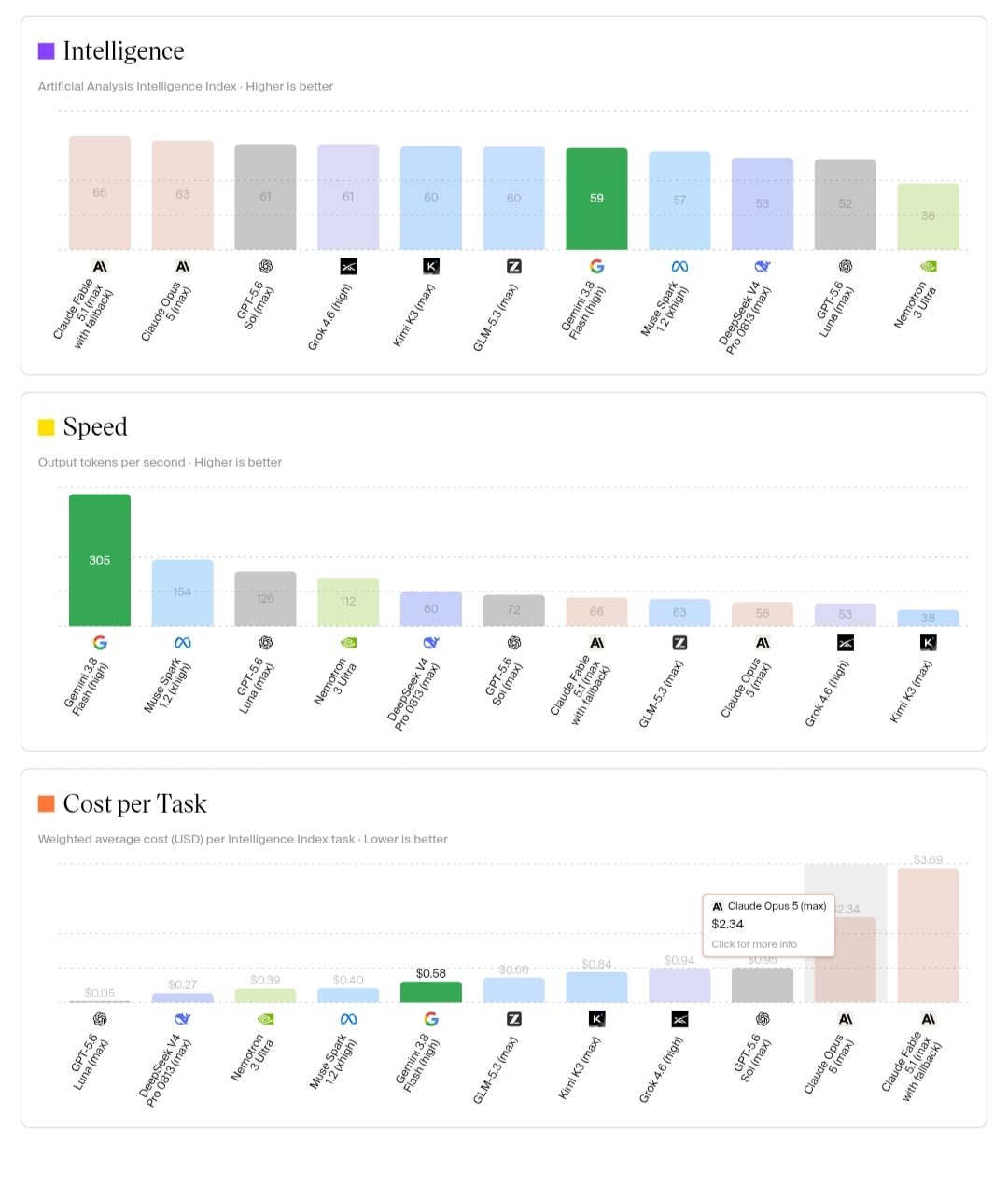
- Intelligence Index Score: Gemini 3.8 Flash scored 59 points, gaining three points over 3.7 Flash (56) and matching GPT-5.6 Sol at maximum reasoning and Grok 4.6 at medium reasoning.
- Effective Cost Per Task: Sits on the Pareto efficiency frontier at $0.58 per completed task, offering the lowest cost in its intelligence tier. However, this represents a 40% cost increase compared to 3.7 Flash ($0.40 per task) because the model consumes more tokens through deeper reasoning loops.
- Throughput and Execution Latency: Generates approximately 300 output tokens per second at high reasoning effort with an average task turnaround time of 2.5 minutes, outperforming GPT-5.6 Terra (3.3 min) and GPT-5.6 Luna (2.6 min), while trailing Claude Fable 5.1 (2.1 min) and 3.7 Flash (2.2 min). Lowering reasoning effort reduces turnaround time to roughly 48 seconds.
Safety and Protection: What Has Changed in the New Version?
Gemini 3.8 Flash demonstrated strong resistance against adversarial manipulation. On the independent Gray Swan Indirect Prompt Injection (IPI) benchmark, the model registered an attack success rate of just 5.5%, outperforming DeepSeek V4 Pro (60.1%), Kimi K3 (52.7%), and Grok 4.6 (51.8%), while closely tracking Claude Opus 5 (4.8%).
Under the Frontier Safety Framework evaluated in April 2026, the model remained within safe operational thresholds, without crossing any Tracked or Critical Capability Levels across CBRN risks. Internal Model Card evaluations revealed balanced safety metrics:
- Text Policy Violations: Decreased by 0.4 percentage points relative to 3.7 Flash.
- Objective Tone Alignment: Improved by +0.2 percentage points on sensitive topics.
- Unjustified Refusals: Dropped by 1.1 percentage points, improving compliance on benign edge cases.
- Multilingual Safety Adherence: Showed a 5.4 percentage point regression in non-English policies, with manual audits confirming that flagged content consisted predominantly of harmless false positives.
Where Is Gemini 3.8 Flash Available and Who Can Use Flash Cyber?
Google established structured deployment pathways to deliver Gemini 3.8 Flash across multiple sectors:
- For Developers and Engineers: Accessible via the Gemini API in Google AI Studio, Google Antigravity, Android Studio, and the Stitch interface design tool.
- For Enterprise Organizations: Integrated within the Gemini Enterprise platform for managing complex business workflows.
- For End Consumers: Integrated within the Gemini consumer app, Google Search AI Mode, and Google Sheets for Google AI Pro and Ultra subscribers.
Access to Gemini 3.8 Flash Cyber remains gated exclusively through the Fairwind Program. Eligibility is confined to verified government agencies, critical infrastructure operators, and open-source maintainers who pass security vetting. Google maintains a closed-weights policy across both models, excluding self-hosted or local infrastructure deployments.
What Does the Launch Reveal About Google’s Strategy in the AI Race?
Releasing three Flash-tier models in six weeks highlights Google’s accelerating pace of engineering and reflects an expanding strategic focus on cost-efficient reasoning models and autonomous agent architectures that combine rapid execution with fiscal viability, rather than competing solely on massive, high-cost models.
Addressing questions regarding the timing of flagship frontier models such as Gemini 3.5 Pro and Gemini 4, Koray Kavukcuoglu, the head of Google DeepMind, affirmed that Google remains dedicated to leading on raw frontier capabilities while concurrently driving price-performance boundaries. This confirms that DeepMind operates along parallel tracks: developing agile, low-cost models for daily production workloads alongside massive foundational models engineered for scientific research and advanced computation.
Gemini 3.8 Flash arrives at the core of this transition, with an explicit emphasis on enabling developers to build autonomous software agents capable of deep reasoning, iterative tool execution, and complex task resolution, while keeping token consumption and operational expenditures within practical parameters.