Anthropic Launches Claude Fable 5.2 and Mythos 5.2 With Major AI Advances
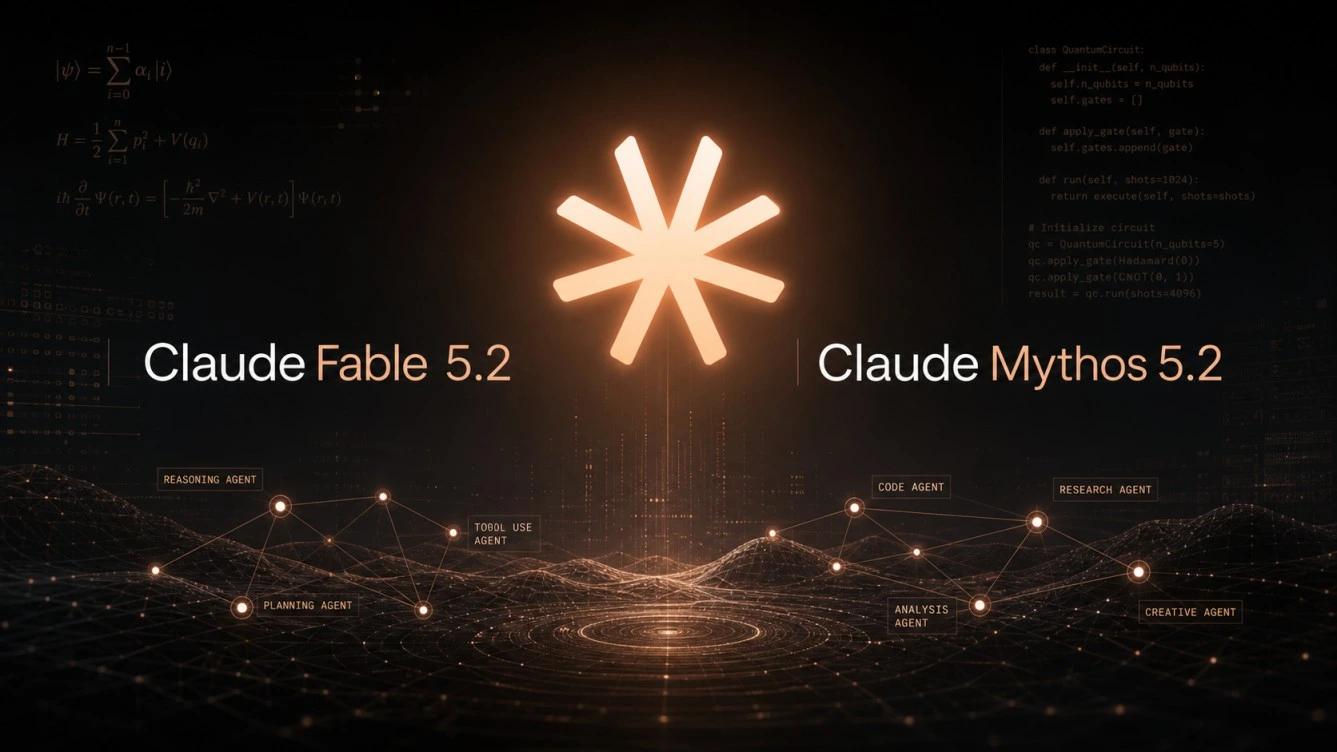
Anthropic announced the launch of Claude Fable 5.2 and Claude Mythos 5.2 on November 9, 2026, introducing major improvements in coding, reasoning, image understanding, and response speed. The company highlighted the new models’ ability to manage long-running engineering projects by coordinating thousands of AI agents. Their reported achievements also extend to theoretical physics, formal mathematical proofs, and the design of working electronic devices.
Introducing Claude Fable 5.2 and Claude Mythos 5.2, designed to tackle the most daunting technical challenges.
They’re capable collaborators on ambitious projects in many fields, and show improvements in areas like coding, reasoning, and vision. pic.twitter.com/jP0AutLxXb
– Claude (@claudeai) November 9, 2026
The release follows Fable 5.1 and Mythos 5.1, which appeared in September. Anthropic has taken two different approaches to distributing the new models: Fable 5.2 is available to users and developers, while Mythos 5.2 is restricted to organizations that pass the company’s security approval process, reflecting its advanced capabilities in vulnerability discovery and sensitive tasks.
Claude Fable 5.2 and Mythos 5.2: Key Improvements
Anthropic focused on four main areas in this release: software engineering, reasoning, image processing, and generation speed. One of the most significant developments is the models’ ability to handle long-horizon agentic tasks. These are projects involving hundreds of interconnected steps that may take hours or even days to complete.
This approach involves breaking a large project into smaller tasks, assigning them to multiple AI agents, and coordinating their execution while connecting the results of different workstreams. This gives Fable 5.2 a role that extends beyond writing code or fixing bugs. The emphasis is now on managing entire project stages and coordinating work across multiple agents.
Safety evaluations also showed a substantial reduction in false refusals, down approximately 55% compared with Fable 5.1. This allows greater flexibility in cybersecurity testing and biological research while maintaining strict safeguards for sensitive tasks.
Building an Operating System With More Than 1,000 AI Agents
One of the most notable experiments disclosed by Anthropic involved building an operating system from an empty directory, using more than 1,000 AI agents working in parallel over eight days.
The resulting system included a kernel, device drivers, persistent storage, a windowing interface, a login screen, and an installer. The project progressed to the point where the operating system could run on an actual laptop.
The significance of this experiment lies in the scale of coordination required. Building an operating system is not simply a matter of writing code. It requires multiple components to work together, from memory and storage management to hardware interaction and the user interface.
In another engineering experiment, the team used an early version of Fable 5.2 to migrate a complex production service from Python to Rust. Real-world performance measurements showed that the service started approximately 26 times faster after the migration. This demonstrates the practical potential of automated modernization for existing systems, a task that typically demands considerable time and effort from software engineering teams.
Claude Fable 5.2 and Mythos 5.2 Benchmark Results
Anthropic presented a comprehensive set of benchmark results, alongside evaluations from independent assessment organizations, to measure the models’ capabilities across coding, scientific research, cybersecurity, system control, and robotics.
| Benchmark / Metric | Area of Evaluation | Result | Significance and Comparison |
|---|---|---|---|
| Artificial Analysis (Intelligence Index) | Independent general intelligence index | 65 points | Ranked first globally, compared with 60 for Gemini and 57 for GPT-6 Astra |
| FrontierCode 2.0 (Xhigh) | Complex agentic coding | 49.1% | Highest reported score on the benchmark |
| FrontierSWE v2 | Real-world software engineering and bug fixing | 69.9% | Significant improvement over the previous version’s 56.3% |
| Terminal-Bench-Science 0.1 | Scientific research and reasoning through the terminal | 75.3% Mythos (74.6% Fable) | Mythos outperformed GPT-6 Astra (64.6%) |
| CyScenarioBench | Advanced cybersecurity defense scenarios | 76.3% Mythos | Strong performance in identifying and containing attacks |
| CVE Rediscovery | Rediscovery of known security vulnerabilities | 89.6% Mythos | Near-complete rediscovery of documented real-world vulnerabilities |
| OSWorld 2.1 | Direct control of computer environments | 89.3% | High accuracy in operating systems and software management |
| Humanity’s Last Exam (with tools) | Multidisciplinary academic reasoning | 74.2% | Solving highly complex problems in advanced scientific fields |
| RoboDojo Sim | Simulated robotic movement and control | 64.9% | More than double the previous generation’s score of 27.6% |
| AutomationBench | Automation of routine office tasks | 51.4% | Competitive performance against Gemini 4 Carbon (53.9%) |
In FrontierCode 2.0, Fable 5.2 achieved 49.1% with the Xhigh reasoning effort setting, outperforming the competing models listed in the comparison, including Claude Opus 5.5 at 45.5% and GPT-6 Astra at 42.8%.
In FrontierSWE v2, which evaluates models on their ability to solve real software engineering problems in code repositories, Fable 5.2 reached 69.9%. This result highlights the model’s growing capabilities in practical software development tasks.
The model also recorded a strong performance in Humanity’s Last Exam, achieving 74.2% with the assistance of software tools. The benchmark is designed to test advanced reasoning across scientific and mathematical disciplines.
Despite its strong overall results, the benchmark comparisons also reveal close competition in routine administrative automation. Gemini 4 Carbon scored 53.9% in AutomationBench, compared with 51.4% for Fable 5.2. This reflects Anthropic’s stronger focus on complex engineering and software development tasks rather than simpler office workflows.
Artificial Analysis Evaluation and the Intelligence Index
Fable 5.2 achieved a major milestone by reaching the top position in the general intelligence index published by independent evaluation platform Artificial Analysis. The model scored 65 points at the maximum reasoning effort level, ranking first globally and ahead of Gemini 4 Carbon at 60 points, Claude Opus 5.5 at 59 points, and GPT-6 Astra at 57 points. The average score across models in the market stands at 31 points.
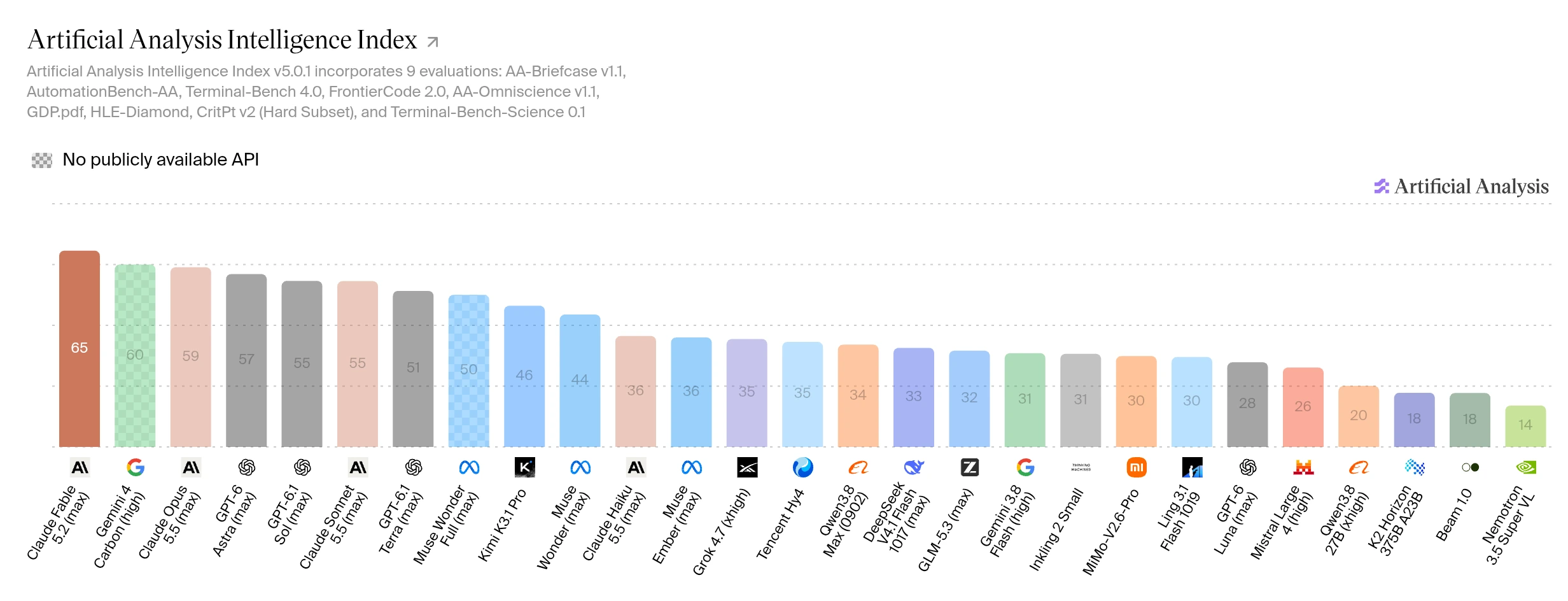
The evaluation also included the independent AA-Briefcase v1.1 benchmark, which measures AI agents’ ability to complete comprehensive professional projects. Fable 5.2 achieved a 66.1% score under the benchmark’s detailed grading criteria and 1,785 Elo points across 91 complex tasks. These tasks covered financial modeling, presentation development, and in-depth corporate analysis.
Where Does Fable 5.2 Rank in the Vals Index?
The Vals Index measures how effectively AI models perform real-world economic work across industries such as finance, software development, and law. It assigns weights to these areas based on their share of the actual economy.
While the index prepares to update its economic leaderboard to include the latest generation of models, its existing data show Anthropic models holding the leading positions. Claude Opus 5.5 ranks first among the listed models with 69.69%, followed by Sonnet 5.5 at 69.22% and Fable 5.1 at 68.83%.
Given the coding improvements and strong efficiency demonstrated by Fable 5.2, the model could become a leading contender in the economic evaluation once its results are officially added to the index.
Mythos 5.2 and Advanced Vulnerability Discovery
Cybersecurity is one of the main areas Anthropic focused on when developing Mythos 5.2. The model scored 76.3% in the advanced cybersecurity defense benchmark CyScenarioBench. It also achieved 89.6% in CVE Rediscovery, an evaluation focused on rediscovering and analyzing the structure of real security vulnerabilities that have been publicly documented.
In biological research, Mythos 5.2 scored 85.1% in a 24-hour targeted protein design evaluation, opening further possibilities for pharmaceutical research and the development of biological compounds.
To support responsible use of these advanced capabilities, Anthropic has adopted a controlled enterprise access model for Mythos 5.2. This environment includes advanced security safeguards and is intended to help eligible defensive security organizations and critical infrastructure developers identify software vulnerabilities before they can be exploited, without exposing digital systems to the risks associated with dual-use capabilities.
Discoveries in Physics and Mathematics, and Electronic Device Design
The models’ experiments extended into scientific and engineering fields beyond software development.
- Theoretical physics: Fable 5.2 contributed to solving two open problems involving black holes and quantum gravity. Anthropic made these findings available as a preliminary research paper (preprint), allowing the international physics community to examine the proposed mathematical solutions. The work represents another example of how AI can contribute to investigating complex problems in theoretical physics.
- Formal proof of Fermat’s Last Theorem: The team used approximately 1,000 agents to formalize a proof of Fermat’s Last Theorem in Lean in just 30 hours. This converted the proof into a formal mathematical representation that can be checked automatically.
- Electronic device design: The models designed three working electronic devices from scratch: a home voice assistant, a USB headset, and an interactive handheld device. These projects demonstrate the models’ ability to connect software reasoning with physical hardware components.
- Robotics: Fable 5.2 reached 64.9% in the RoboDojo Sim robotic simulation environment, compared with 27.6% for the previous generation. This improvement highlights its progress in interpreting visual inputs and issuing real-time movement commands to robots in changing environments.
Claude Fable 5.2 Pricing and Access to Mythos 5.2
Anthropic reduced the API pricing for Fable 5.2 by 20% compared with the previous version, aiming to encourage wider adoption of autonomous agent workflows.
| Usage Type | Price per Million Tokens |
|---|---|
| Input tokens | $8 |
| Output tokens | $40 |
| Fast Mode input | $16 |
| Fast Mode output | $80 |
Fast Mode delivers generation speeds of up to 2.5 times the standard mode in exchange for double the price. This option is designed for applications that require faster responses and lower latency.
Fable 5.2 is available through APIs and Anthropic’s supported Claude channels, while Mythos 5.2 remains subject to the company’s security approval requirements and is restricted to eligible organizations.
Claude Fable 5.2 vs. Claude Mythos 5.2: Key Differences
| Comparison | Claude Fable 5.2 | Claude Mythos 5.2 |
|---|---|---|
| Target audience | Developers, businesses, and users worldwide | Security organizations, government institutions, and critical infrastructure operators |
| Main areas of focus | Coding, scientific research, systems engineering, and agent coordination | Defensive cybersecurity, vulnerability discovery, and sensitive research |
| Safety controls | Balanced safeguards for general use and development | Strict, specialized enterprise safeguards and access controls |
| Access | Available through APIs and supported platforms | Restricted to organizations participating in a security review and approval program |
Anthropic Expands Claude’s Capabilities in Engineering and Scientific Projects
The launch of Fable 5.2 and Mythos 5.2 reflects a broader shift in AI development, from models that primarily assist with individual tasks to systems capable of managing and completing long-running engineering and research projects with a high degree of autonomy.
From building operating systems and investigating scientific problems to achieving a leading position in global intelligence evaluations, Anthropic’s latest models combine improvements in efficiency and computational capabilities with strict governance measures intended to support responsible and secure AI deployment.