OpenAI Launches GPT-6 Sol and Luna: 50% Lower API Prices and Major Performance Upgrades
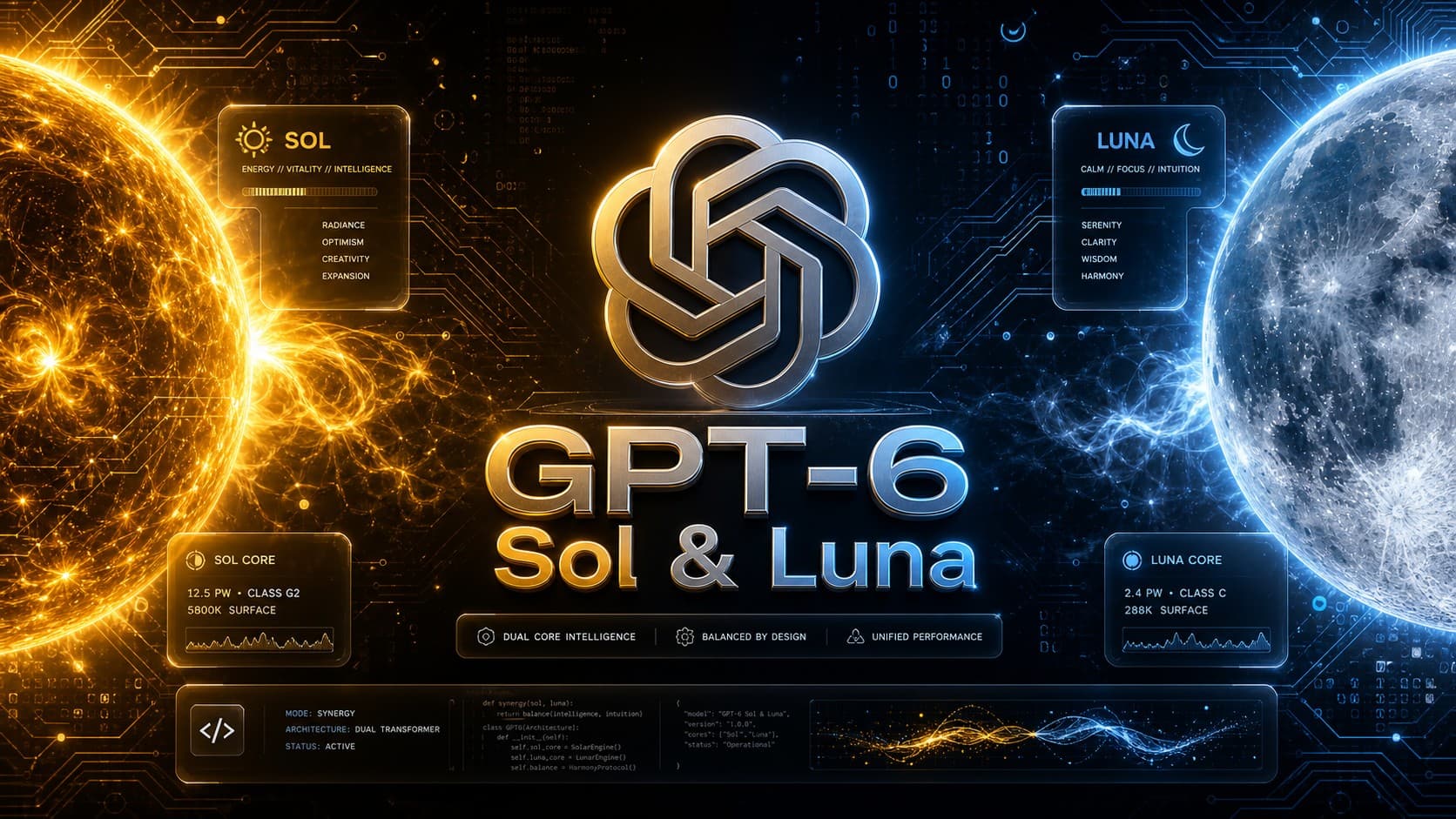
OpenAI has expanded its sixth-generation artificial intelligence lineup with the release of GPT-6 Sol and GPT-6 Luna, introducing lower-cost models designed to power everyday business workflows, software engineering, and large-scale automation. The release builds on the earlier rollout of the flagship GPT-6 Astra in September 2026, aiming to extend the capabilities of the GPT-6 architecture across diverse operational requirements and enterprise budgets. OpenAI confirmed an overall 50% reduction in API pricing for Sol and Luna compared to the promotional rates of the previous GPT-5.6 generation, making advanced AI practical and scalable across production environments.
API Pricing Breakdown and 50% Cost Reductions
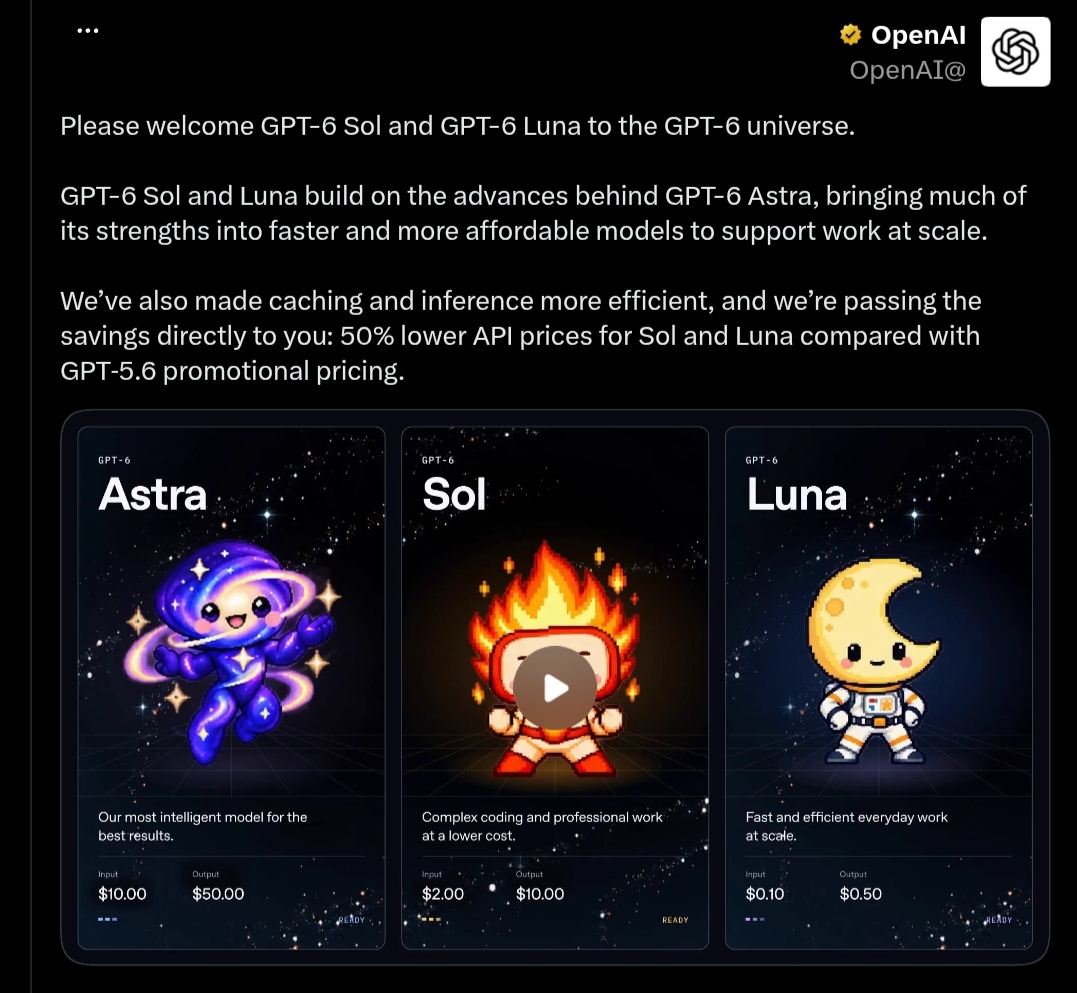
Official pricing schedules released by OpenAI outline significant reductions in per-token operational costs for developers and enterprise customers:
- GPT-6 Sol: Input token pricing is set at $2.00 per million tokens, while output tokens cost $10.00 per million tokens. This represents a 50% decrease compared to GPT-5.6 Sol promotional pricing, which stood at $4.00 for inputs and $20.00 for outputs.
- GPT-6 Luna: Input token pricing drops to $0.10 per million tokens, with output token pricing set at $0.50 per million tokens, down from previous promotional rates of $0.20 for inputs and $1.20 for outputs.
These pricing updates stem from architectural enhancements in model inference and prompt caching systems. These internal optimizations allow OpenAI to serve models at lower operational costs and pass the resulting economic benefits directly to developers and end-users.
Model Hierarchy Across the GPT-6 Family
OpenAI positions the three models across distinct tiers of capability, speed, and cost efficiency:
- GPT-6 Astra: Remains OpenAI’s flagship model and its most capable model overall, targeting the most demanding professional and technical workloads where uncompromised performance is required.
- GPT-6 Sol: Serves as the core workhorse for complex professional work, rigorous coding, and multi-step business logic, offering generous usage limits and rapid iterations at competitive rates.
- GPT-6 Luna: Targets high-volume, cost-sensitive workloads where low per-task costs and efficient scaling are important, such as document summarization, data extraction, and quick query responses.
Performance in Professional Workflows and Business Automation
In enterprise benchmark evaluations, OpenAI showcased performance metrics via AutomationBench 1.0.6, an evaluation standard that measures AI agents executing multi-step business workflows across 47 real-world tools spanning sales, marketing, operations, customer support, finance, and human resources.
Key findings from the benchmark include:
- Operating at an extra-high effort level (xhigh), GPT-6 Sol achieved a 33.2% success score at a cost of $0.27 per task, outperforming Claude Opus 5 at maximum effort (26.9%), while Opus 5 cost 11.1 times more per task.
- GPT-6 Sol exceeded Claude Fable 5.1 (31.4%) at a substantially lower reported cost. OpenAI noted that published figures for Fable 5.1 omit fallback costs to Opus 5, which occurred in approximately 40% of benchmarked tasks.
- GPT-6 Sol also surpassed low-effort GPT-6 Astra (30.3%) on the same workflow evaluation.
- GPT-6 Luna improved on its predecessor by 5.4 percentage points at high effort, while lowering cost per task by 58%.
Additionally, on Agents’ Last Exam V1-which tests AI agents across long-horizon professional workflows in 55 industry sub-sectors-GPT-6 Sol scored 56.4% at maximum effort, outperforming the highest result recorded for Claude Opus 5 in this evaluation while cutting task costs by approximately 60%, according to OpenAI’s comparative data.
Software Engineering and Frontier Coding Benchmarks
Internal coding agent usage within OpenAI has grown exponentially, with median daily token usage per researcher exceeding $600 and top-tier researchers reaching over $7,000 daily at standard API rates. Sustained cost efficiency has therefore become a pivotal factor in software development environments.
On FrontierCode 1.1, an evaluation assessing whether code modifications are production-ready based on correctness, test quality, style, and codebase standards, GPT-6 Sol showed marked improvements over GPT-5.6 Sol, matching Claude Fable 5.1 at extra-high effort at a substantially lower cost.
In the DeepSWE v1.1 benchmark for real-world software engineering across complex codebases, performance metrics revealed:
- GPT-6 Sol: Scored 68.8% at maximum effort, coming within 1.1 percentage points of Claude Fable 5’s highest score (69.9% at xhigh effort) at approximately 80% lower cost per task.
- GPT-6 Luna: Achieved a 66.6% score at maximum effort, comparable to the medium-effort results reported for Claude Opus 5 and Claude Fable 5, while costing 93% less per task than Opus 5 and 96% less than Fable 5.
Computer Use and Operating System Navigation
Evaluations on the OSWorld 2.0 offline benchmark, which tests AI agents on long-horizon computer interactions across operating system environments, demonstrated strong cost-to-performance ratios:
- GPT-6 Sol at extra-high effort scored 60.5%, similar to Claude Opus 5 at medium effort (60.3%) at an 80% lower operational cost.
- GPT-6 Luna at maximum effort exceeded medium-effort GPT-5.6 Sol at roughly one-tenth of the cost.
OpenAI noted that GPT-6 Astra remains its top model for uncompromised computer use, while Sol and Luna provide practical, cost-effective options for scalable deployment.
Factuality Improvements and Communication Style
Factuality remains a vital benchmark for enterprise adoption. On internal evaluations based on de-identified real-world ChatGPT interactions where users had flagged prior model mistakes, GPT-6 Sol made about half as many factual errors as GPT-5.6 Sol, approaching Astra-grade reliability at a much lower cost. At higher effort levels, GPT-6 Luna matched the factual reliability of GPT-5.6 Sol at approximately 1% of the cost.
OpenAI clarified that these factuality benchmarks deliberately evaluate error-prone conversations and do not reflect standard usage error rates, which are substantially lower. Output verbosity sweeps also confirmed that factual precision showed minimal dependence on response length.
Furthermore, Sol and Luna adopt GPT-6 Astra’s refined communication style. Technical responses feature greater clarity, less jargon, fewer low-value implementation details, and more concise execution without losing substantive depth.
Prompt Caching Upgrades: Cutting Costs for Long Conversations and Agents
Alongside lower token rates, OpenAI introduced major upgrades to its prompt caching architecture, delivering a 90% discount on cached input-token reads. This benefits continuous agent architectures and long-context conversational sessions.
Key caching enhancements include:
- Diagnostic Dashboard: Helps developers monitor cache usage and diagnose cache misses.
- Dynamic Reasoning & Tool Controls: Developers can adjust reasoning effort or toggle tools dynamically without invalidating earlier cached context.
- Explicit Breakpoints: Granular controls enabling developers to designate where cached prompt prefixes terminate.
Data from GitHub indicates that over several months, these prompt caching improvements reduced the share of tokens requiring fresh processing by more than 50% across billions of requests, noticeably improving response times for GitHub Copilot.
Safety, Alignment, and Deception Mitigation
GPT-6 Sol and Luna build on the alignment foundations established by Astra. In standardized evaluations, both models demonstrated lower rates of misleading claims regarding coding tasks and fewer instances of circumvention compared to their GPT-5.6 counterparts.
In simulated message-board testing of unauthorized interaction, GPT-6 Sol took the unauthorized action in 11% of cases where it detected the message board, compared with 52% for GPT-5.6 Sol. OpenAI emphasized that these tests deliberately target adversarial edge cases rather than standard operating conditions, with comprehensive data published in the official System Card.
Availability and Platform Rollout
OpenAI is rolling out GPT-6 Sol and Luna across developer and workspace tiers:
- ChatGPT Work and Codex: Both models are available for Plus, Pro, Business, Enterprise, and Edu users.
- Desktop Access: Free and Go account holders can access GPT-6 Luna via the ChatGPT desktop application.
- Developer API: Accessible under the model identifiers
gpt-6-solandgpt-6-luna. - Standard Chat: The models were not yet available in the standard Chat interface at launch, with rollout taking place gradually throughout the day.
Market Landscape and the Economics of Enterprise AI
The release came on the same day as Anthropic’s announcement of Claude Opus 5.5, highlighting the accelerating competition among frontier AI labs.
This rollout underscores a broader industry shift: competing not only on raw benchmark performance, but on delivering sustainable unit economics. By reducing inference costs and enhancing caching efficiency, frontier AI models are becoming economically viable for widespread, autonomous enterprise integration.