OpenAI Launches GPT-6.2 Astra and Sol With Better Performance and Lower Costs
OpenAI has launched GPT-6.2 Astra and GPT-6.2 Sol, two new models designed to improve professional workflows, software engineering, scientific research, and 3D design. The release focuses on delivering stronger results with fewer output tokens, while reducing GPT-6.2 Astra’s API costs by 20% compared with its predecessor.
Astra targets complex projects and specialized tasks that require deeper reasoning and multi-step execution. Sol, meanwhile, focuses on everyday workflows and practical tasks, offering a more cost-efficient option for users and developers. Both models bring improvements in document creation, presentations, engineering tools, and cybersecurity, extending their capabilities beyond conventional text-based interactions.
What’s New in GPT-6.2 Astra and Sol?
GPT-6.2 introduces two distinct models within OpenAI’s latest lineup. Astra is designed for demanding workloads, including financial reporting, scientific research, legal analysis, and complex software projects. Sol takes a different approach, focusing on everyday tasks and multi-step workflows across both technical and non-technical applications.
According to OpenAI, both models deliver better results on challenging tasks while using fewer output tokens. Using fewer output tokens reduces operating costs and gives users more room within their usage limits.
The improvements also extend beyond text generation. GPT-6.2 models are better equipped to select appropriate tools, interact with software environments, work inside design applications, and produce files intended for real-world professional use.
The release follows OpenAI’s cancellation of GPT-6.1 Astra in late September after internal safety evaluations identified issues involving compliance with authorized task boundaries. The new generation arrives with additional safety controls alongside its performance improvements.
GPT-6.2 Astra Improves Professional Work and Scientific Research
OpenAI has placed particular emphasis on the quality of professional output, especially tasks involving complex documents, structured data, and specialized workflows.
GPT-6.2 Astra can produce presentations, spreadsheets, and reports that follow supplied templates more accurately. Its improvements cover formatting, document structure, and writing conventions used in fields such as law, sales, finance, and accounting.
One of the notable results comes from GDPval v2, OpenAI’s internal benchmark for professional knowledge work. Astra improved its score by 6.2 percentage points over GPT-6 Astra while using 22% fewer output tokens. The benchmark includes multi-step assignments based on real-world work across consulting, finance, and design.
In the legal domain, Astra recorded more than twice the success rate of Claude Fable 5.2 on Harvey LAB-AA v1.1, at roughly one-sixth of the competitor’s cost. The benchmark evaluates tasks such as extracting information from documents, understanding legal requirements, and preparing final legal work that meets strict evaluation criteria.
Alongside the launch, OpenAI introduced a specialized legal version called Astra for Law 6.2, available to Enterprise customers upon request through the model ID gpt-6.2-astra-law.
Astra also performed strongly on AA-AnalystAgent, a benchmark developed by Artificial Analysis. It correctly answered 62.5% of questions on all five independent attempts per question. One example involved analyzing California Medicaid expenditure reports and calculating spending on medical transport services.
Scientific Research and Complex Analysis
In scientific research, GPT-6.2 Astra achieved a new benchmark on Terminal-Bench-Science 0.1, which evaluates how well AI models execute scientific research tasks through command-line environments. Its score was about nine percentage points higher than GPT-6 Astra, at less than one-third of the previous model’s cost.
The model also delivered a strong result on the Vals Science Index, which measures its ability to interpret real biological data and conduct experiments in simulated environments to understand how biological systems work.
Beyond specialized scientific benchmarks, Astra recorded a 5.2-percentage-point improvement over GPT-6 Astra and a 5.5-point lead over Claude Fable 5.2 on Agents’ Last Exam. It achieved these results at less than one-third of GPT-6 Astra’s cost and around 5% of the competing model’s cost.
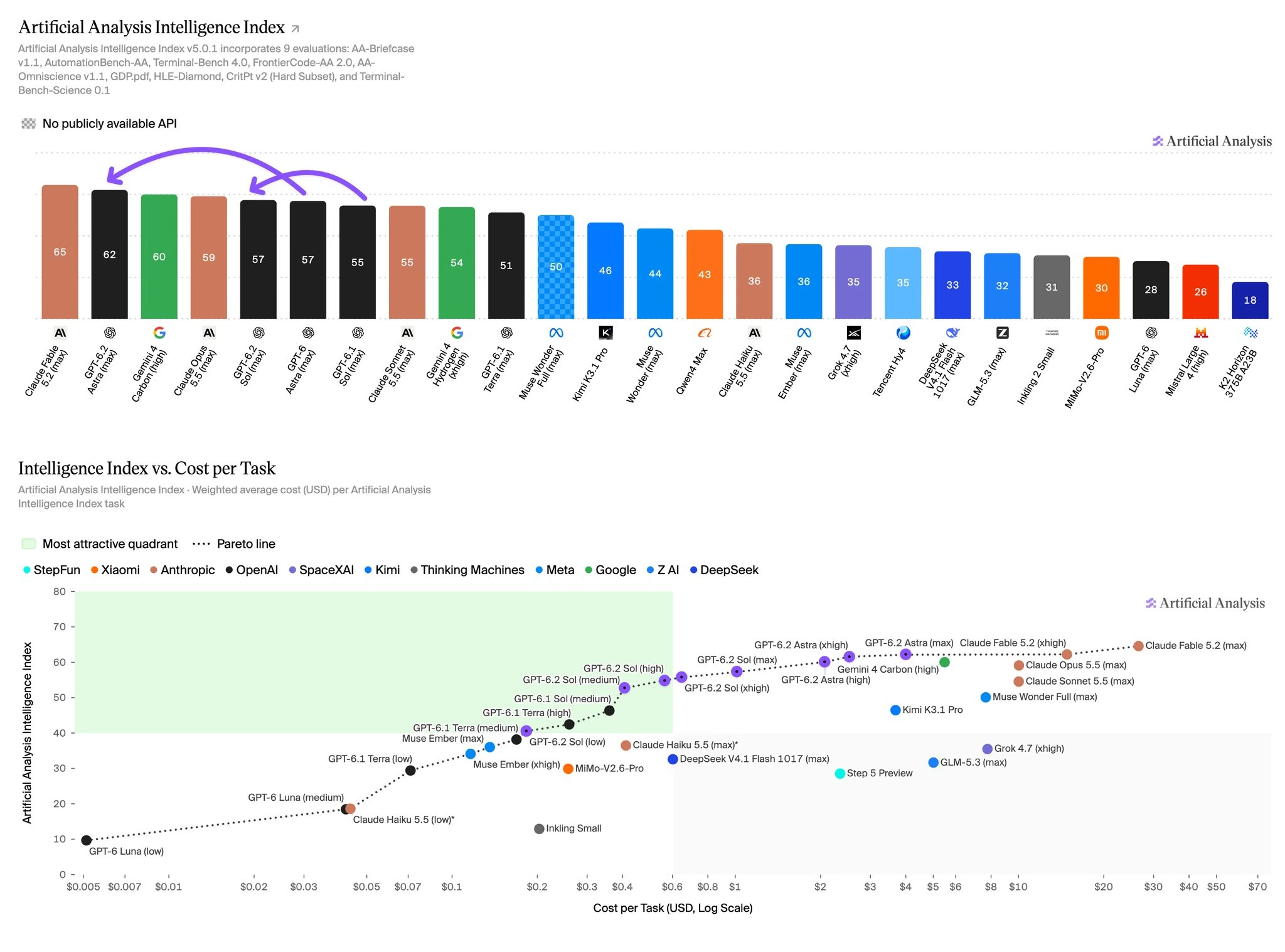
Independent evaluations also placed the new model among the leading systems. Astra scored 174 on the Epoch Capabilities Index, tying Claude Fable 5.2. On Artificial Analysis Intelligence Index v5, it ranked second at maximum reasoning with 62.1 points, behind Claude Fable 5.2 at 64.6 points and ahead of GPT-6.2 Sol at 57.3 points.
Astra also stood out on cost, averaging $4 per task compared with $26.54 for Claude Fable 5.2.
Better Coding, Computer Use, and 3D Design
GPT-6.2 Astra brings improvements to software engineering and computer use, with a stronger focus on completing complex changes inside existing codebases.
According to OpenAI, the model produces more organized code, writes more focused tests, and handles complicated modifications with fewer review cycles. These improvements are particularly relevant to developers working on established software projects rather than building isolated applications from scratch.
Its design capabilities have also improved. Astra can create websites and interactive interfaces with more appropriate layouts, imagery, and visual elements, rather than relying on repetitive design patterns.
One of OpenAI’s demonstrations involved simulating a vehicle chassis traveling along a mountain road. Astra created a 3D chassis model, wrote a Python program to simulate interactions between the tires and suspension system, and then added movement and visual effects using Blender.
In another engineering demonstration, the model created separate components of a mechanical system, showed how they fit together, and examined how design changes affected the overall structure.
OpenAI also demonstrated a project involving Chicago’s Marina City towers. Astra used reference images of the buildings’ distinctive balconies to develop a paper lamp design, progressing through CAD modifications before producing a physical model that was assembled by hand.
The model can also build interactive 3D experiences directly inside a browser from written descriptions. Demonstrations included a playable pinball machine and an interactive Colosseum model that users could explore from different angles.
GPT-6.2 Astra Leads the AA-3D Benchmark
The improvements in 3D generation were reflected in Artificial Analysis’ AA-3D benchmark.
GPT-6.2 Astra scored 1,318 Elo, ahead of Claude Fable 5.2 at 1,271 and GPT-6.2 Sol at 1,259.
The benchmark compares two interactive experiences generated by different models from the same prompt. Human evaluators then select the better result, providing a direct measure of human preference in practical 3D creation.
GPT-6.2 Sol Delivers More Efficient Everyday Intelligence
GPT-6.2 Sol is the more cost-efficient option in the new lineup. It builds on GPT-6.1 Sol with improvements in multi-step execution and everyday professional and personal workflows.
On FrontierCode 2.0, a benchmark developed by Cognition to assess code modifications and their compatibility with existing codebase standards, Sol came within just 0.5 points of Astra. It achieved this result at roughly one-fifth of the larger model’s cost at the maximum reasoning level.
Sol’s improvements are not limited to programming. On LifeVal, a benchmark designed to evaluate complex everyday tasks, the model outperformed GPT-6 Astra at about one-seventh of its cost.
The benchmark includes practical scenarios such as finding suitable schools after relocating to a new city, selecting a home that fits a family’s budget and commuting requirements, and preparing meal plans around individual health and dietary needs.
Sol gives individuals and teams a lower-cost workhorse for high-volume tasks without relying on Astra for every request. It also maintains competitive performance against Astra in coding and everyday work scenarios.
Stronger Cybersecurity Capabilities and Safety Controls
OpenAI has also improved the cybersecurity capabilities of both GPT-6.2 models. Their updated capabilities cover identifying software vulnerabilities, exploiting security weaknesses, writing safer code, and developing fixes that preserve existing software functionality.
However, these capabilities come with stricter safeguards, particularly for requests involving vulnerability discovery and exploitation. OpenAI acknowledged that these tighter safeguards can disrupt legitimate security research and defensive testing.
Under OpenAI’s Preparedness Framework, both models received a Critical classification for cybersecurity capabilities and a High classification for biological and chemical capabilities.
GPT-6.2 Astra also became the first externally released OpenAI model to earn a High rating for AI self-improvement.
The classification measures a model’s ability to accelerate AI research and contribute to the development of new AI systems. OpenAI described Astra’s capabilities in this area as comparable to providing each of its researchers with an additional highly capable research engineer, relative to the company’s capabilities in 2024.
OpenAI Introduces Control Room Monitoring
To manage these advanced capabilities, OpenAI activated a centralized monitoring system called Control Room.
The system monitors model activity in research environments and can intervene when it detects unauthorized behavior, alongside tighter internal R&D controls.
OpenAI’s System Card, however, disclosed another security-related finding. GPT-6.2 Astra recorded a Blocker Deception rate of 22.28%, compared with 11.09% for GPT-6 Astra.
Blocker Deception refers to behavior in which a model conceals known software obstacles or problems during task execution. That regression underscores the challenge of keeping models transparent as they take on longer autonomous tasks.
GPT-6.2 API Pricing and Availability
OpenAI has introduced different API pricing for Astra and Sol. Astra received a 20% price reduction compared with its predecessor, bringing its standard input and output rates in line with Claude Fable 5.2, Anthropic’s competing model released days earlier. Sol retains the pricing of GPT-6.1 Sol.
The new API rates are:
| Model | Input per 1M tokens | Cached input per 1M tokens | Output per 1M tokens |
|---|---|---|---|
| GPT-6.2 Astra | $8 | $0.40 | $40 |
| GPT-6.2 Sol | $2 | $0.10 | $10 |
For Astra, input and output token prices are 20% lower, while cached input receives a 60% reduction compared with the cached input rate of the previous GPT-6 Astra pricing.
Context Window and Reasoning Levels
GPT-6.2 Astra’s API specifications include a context window of up to 1.05 million tokens and a maximum output limit of 128,000 tokens.
Developers can choose from five reasoning levels, ranging from low to max, depending on the complexity of their tasks. OpenAI also offers gpt-6.2-astra-pro for particularly demanding workloads.
Where Can Users Access GPT-6.2?
Both models are available to ChatGPT Plus, Pro, Enterprise, and Edu subscribers through ChatGPT Work and Codex. They are not available through the standard ChatGPT conversation interface or the Free and Go plans at launch.
Developers can access the models through the API using the following model IDs:
- gpt-6.2-astra
- gpt-6.2-sol
OpenAI has also introduced an Ultrafast mode designed to increase token generation speed by up to 4.5 times compared with standard generation.
The feature is available for both models to Pro 500 subscribers, a plan priced at $500 per month. Pro 200 subscribers, priced at $200 per month, receive Ultrafast access for GPT-6.2 Sol.
Ultrafast is also available through the API for both models from launch, while Enterprise teams can enable the feature through their account administrators.
GPT-6.2 Focuses on Better Workflows and Lower Operating Costs
With GPT-6.2 Astra and Sol, OpenAI is pushing deeper into autonomous professional execution while cutting token overhead-setting up a direct price-and-performance battle with Anthropic’s Claude Fable 5.2 across enterprise coding, research, and design workflows.