Alibaba officially launched Qwen4-Max on November 16, the latest model in its Qwen family. The new model features a 2.4-trillion-parameter architecture, a context window of up to 1 million tokens, and native capabilities for understanding images and videos alongside text. It is designed to handle complex professional tasks, run agents over extended periods, and produce practical outputs across fields such as software development, design, manufacturing, and scientific research.
Meet Qwen4-Max, your new AI teammate for work, creativity, and discovery!
Qwen4-Max is built on a new MoE architecture with native vision and a 1M-token context window.
Highlights:
– Outperforms Qwen3.8-Max with up to ~50% fewer tokens, while average cost per task drops over… pic.twitter.com/2Rlkoc6Dm3
The full launch follows the release of a limited preview version, Qwen4-Max-Preview, on November 11. It also comes with benchmark results published by the company, showing improvements over the previous-generation Qwen3.8-Max, alongside reductions in the number of tokens required to complete tasks. In the Work360 benchmark, the average cost per task fell by 62%. Alibaba has also announced availability through QwenCloud, the Qwen Chat web interface (chat.qwen.ai), and the Qwen app, while planning to release smaller open-weight Qwen4 models at a later date.
Advertisement
Qwen4-Max: A Model for Professional Work and Long-Running Tasks
Alibaba presents Qwen4-Max as an AI assistant for professional and creative work, rather than simply a conversational model that answers questions. Its capabilities include working with 3D design tools, game development engines, and engineering manufacturing software, as well as analyzing financial data, legal documents, and medical records.
This approach combines multi-step reasoning, image and video understanding, external tool use, and the execution of tasks that require successive stages of planning, experimentation, and review. According to the company, Qwen4-Max can follow a long-running project, deliver initial versions of the work, and then refine them based on results and user feedback.
The 1-million-token context window allows the model to process large volumes of information in a single session-equivalent to approximately 1,500 pages of text or entire codebases. At the same time, the maximum output limit has increased to 393,216 tokens, three times the limit available in the previous generation. This is particularly useful for analyzing lengthy files and generating large outputs in a single pass.
Advertisement
Qwen4-Max Architecture: 2.4 Trillion Parameters and 71 Billion Active Parameters
Qwen4-Max is built on a new Mixture of Experts (MoE) architecture. It has 2.4 trillion total parameters, with only 71 billion parameters activated per token during processing. This approach allows the model to benefit from a broad knowledge capacity while keeping computational costs and processing times within practical limits. The model also includes an additional 328 billion parameters through its N-gram Embedding system.
According to the model’s technical documentation, the new design focuses on improving computational efficiency, expanding model capacity, and increasing training stability through three main components:
GDN and Qwen Sparse Attention: The architecture combines Gated DeltaNet layers with the Qwen Sparse Attention mechanism. GDN layers compress the information history into fixed-size states, while the QSA system selects the most relevant parts of the context through a lightweight indexing mechanism. This design is built to reduce the cost of processing long sequences.
Gated Residual: The model uses four parallel residual pathways with dynamic read and write gates, designed to improve information flow between layers and training stability.
N-gram Embedding: The system uses representations based on local token patterns, adding model capacity with a limited amount of additional computation.
Published training data also showed that training the model at this scale remained stable, with the loss value declining consistently and no sudden spikes or major disruptions throughout the training process.
Qwen4-Max Performance Benchmarks and Token Efficiency
Alibaba published comparison results between Qwen4-Max and its predecessor, Qwen3.8-Max, covering professional tasks, coding, and long-running execution. One of the main benchmarks was Work360, developed by Alibaba to measure model performance on professional tasks across 26 major fields, 182 subfields, and 721 specializations.
Qwen4-Max scored 52.69 points on the benchmark, compared with 47.74 points for Qwen3.8-Max, representing an improvement of approximately 10% on multi-stage work tasks.
The model also recorded lower token consumption compared with the previous generation:
Benchmark
Reasoning Effort
Token Usage Reduction
Work360
Xhigh
Approximately 24%
Work360
High
Approximately 35%
Terminal-Bench 4.0
Xhigh
Approximately 48%
Terminal-Bench 4.0
High
Approximately 49%
Alibaba also reported that the average cost per task in the Work360 benchmark fell from $4.43 with Qwen3.8-Max to $1.67 with Qwen4-Max, a reduction of approximately 62%.
The company also reported improved results for the Qwen4-Max-Base model on BPB measurements. These measurements assess data prediction accuracy across knowledge, programming, question-and-answer, science, and technology domains. According to Alibaba’s internal tests, the results showed a reduction of between 5% and 13% compared with its predecessor.
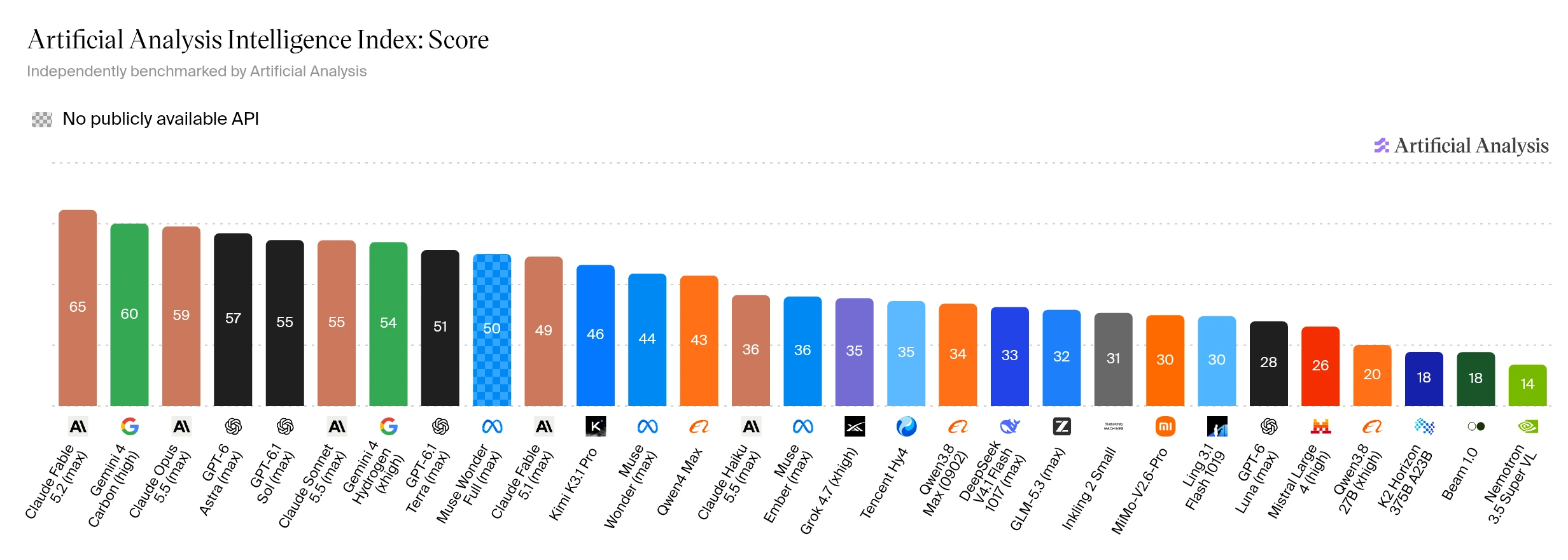
In early independent evaluations, the model scored 43 points on Artificial Analysis’ Intelligence Index, compared with 34 points for Qwen3.8-Max. The cost per task on the platform also fell from $10.02 to $3.27. While these independent results show clear gains in performance and cost over the previous generation, Qwen4-Max still trails the leading models from OpenAI, Anthropic, and Google.
Qwen4-Max scores 43 points on the Artificial Analysis Intelligence Index, up from 34 for Qwen3.8-Max (0902), while trailing leading models such as Claude Fable 5.2 (65), Gemini 4 Carbon (60), and GPT-6 Astra (57). Source: Artificial Analysis.
Using Qwen4-Max for 3D Design, Game Development, and Manufacturing
The launch demonstrations included practical applications across several engineering and creative fields, highlighting the model’s ability to work with specialized software and tools rather than simply generate text.
In 3D design, Qwen4-Max used Blender to create 3D models, assemble scenes, adjust materials and lighting, and perform rendering operations. Examples included architectural designs, landscapes, and fictional environments. The resulting assets can be exported for use in games or converted into physical models through 3D printing.
For game development, Alibaba demonstrated the model working with the Unity, Unreal Engine, and Godot game engines. One demonstration began with a text description and progressed through scene creation, gameplay logic, user interface design, and visual effects. The model then ran and tested the game, making adjustments to the camera, character movement, and lighting. One example was Meow of Magic, an adventure game featuring a wizard cat, developed using Unreal Engine.
In manufacturing, the demonstrations covered automotive production line planning, mechanical component design, and the preparation and simulation-based validation of machining paths. In one case presented by the company, the manual time required to program the machining of a single part fell from approximately 475 minutes to 24 minutes, a reduction of about 95%.
The demonstrations also included video production through a collaboration between Qwen4 and the WonderClip platform. The workflow began with storyboarding and the creation of static assets, followed by camera movement planning, clip generation, and the assembly of the resulting footage into a multi-scene film.
Financial, Legal, and Medical Tasks Using Specialized Tools
Alibaba demonstrated several use cases for Qwen4-Max in sectors that rely on large volumes of data and documents, with the model linking its outputs to their original sources.
In financial research, the model used 90 MCP tools to collect pricing data, financial statements, interest rates, and dividend information. The coverage included Chinese stocks, Hong Kong and US markets, bonds, funds, and derivatives. One example involved analyzing derivatives on the CSI 300 Index, calculating the theoretical basis of futures contracts, and comparing implied volatility with historical volatility. The workflow produced editable Excel files and PowerPoint presentations, with links to original sources and charts connected to the data used in the calculations.
For legal due diligence ahead of an initial public offering, Qwen4-Max processed 198 working documents with varying formats and naming conventions, organized them into 14 folders, and created an index. It then searched public records related to business registration, intellectual property, litigation, and credit information. The process resulted in an 86-page report covering 12 review areas and identifying 14 specific legal issues, with its conclusions linked to the underlying working documents.
In healthcare, Alibaba demonstrated an experiment in which the model analyzed a complex medical case containing dozens of laboratory results, more than 10,000 characters of medical notes, and 1,433 medical images. Qwen4-Max reviewed the patient’s progress over six days and used sub-agents to examine hundreds of segments from radiology images. It then produced four recommendations to support clinical decision-making, which were consistent with the treating physician’s orders in the demonstrated case. Alibaba presents this capability as a tool to assist physicians, not as a replacement for professional evaluation or clinical judgment.
Long-Running AI Agents With Progressive Result Delivery
One of the main features highlighted in the announcement was Live Delivery, a system designed for long-running, multi-stage tasks.
Instead of making users wait until an entire task is complete before receiving any results, the agent delivers an initial usable version at an early stage. It then continues developing and refining the work through successive versions. Users can review progress and intervene to correct errors or change the direction of the work while execution is still underway.
Qwen also announced that it was open-sourcing the Qwen-Live-Delivery-Plugin extension to support this continuous work delivery approach.
Qwen4-Max for Scientific Research and Materials Discovery
The demonstrations also extended to research experiments in chemistry and molecular discovery. In collaboration with the Mira platform from Deep Principle, the model conducted an experiment lasting 48 hours. It began by creating a research space containing 2.7 million candidate molecules, then moved on to structural screening, property prediction, scientific calculations, and experiment planning.
The system directed an automated laboratory through preparation, synthesis, separation, purification, and testing steps. After four cycles of design, experimentation, and refinement, the process produced a sample of a new refrigerant material that underwent experimental validation.
In another experiment with the PharmMaster platform from DP Technology, the model worked on research related to the NLRP3 protein, which is associated with neuroinflammation in the context of Alzheimer’s disease research. It made 454 tool calls, performed 3,239 computational evaluations, and designed and optimized 24 candidate molecules. Relative binding free-energy calculations estimated that the final candidate molecule had approximately 3.6 times the binding affinity of the reference molecule.
This result remains preliminary at the computational level. Experts from DP Technology emphasized that laboratory testing is still required to verify it experimentally.
Qwen4-Max Pricing and How to Access the Model
Qwen4-Max is available to developers through the QwenCloud platform via an API with pay-as-you-go billing or through a Token Plan subscription. It is also available in coding and agent tools such as Cursor, Cline, Claude Code, and Qwen Code, as well as through QwenWork, Qoder, and QwenStudio. Individual users can access and try the model directly through the Qwen Chat web interface (chat.qwen.ai) and the Qwen app.
The QwenCloud pricing page lists the standard rates for the international region as follows:
Usage Type
Price per Million Tokens
Input tokens
$1.50
Output tokens
$4.50
Implicit cache reads
$0.075
These prices vary depending on the server region and cache type. A separate rate applies to cache creation, reaching up to $1.875 per million tokens for a five-minute cache duration.
At the API configuration level, the model supports tool calling and structured outputs, and is compatible with OpenAI and Anthropic formats. Deep thinking mode is enabled by default, with options to adjust the reasoning effort to low, high, or xhigh, or turn it off.
Developers should note that the max_tokens limit now includes both reasoning tokens and final response tokens within the overall limit of 393,216 tokens. This requires appropriate configuration to avoid interrupted responses. Higher reasoning effort levels also increase response times on complex tasks.
Regarding the future of the model family, Qwen confirmed that smaller Qwen4 models will be released with open weights and will use the same underlying technical foundation. The announcement did not specify release dates or model sizes.
What Does the Qwen4-Max Launch Mean?
The Qwen4-Max launch reflects a shift in AI models from handling short requests toward managing complete professional workflows. These workflows involve using software and tools, analyzing files, executing successive stages of work, and delivering results that users can review.
Alibaba is combining a 1-million-token context window, a high output limit, a large-scale MoE architecture with lower operating costs compared with the previous generation, and agents capable of working continuously for extended periods.
This positions Qwen4-Max as a competitive option on cost efficiency and context capacity for long-running agent tasks as developers begin putting its workflows to the test in production.