Meta Unveils Muse Spark 1.3 With Major Gains in Coding and Agentic Workflows
Meta has officially released Muse Spark 1.3, its latest foundation model engineered specifically to tackle high-complexity coding tasks and autonomous, long-horizon agentic workflows. The release marks a new step in the company’s broader strategy to build personal autonomous agents capable of sustaining complex objectives over extended periods, reflecting Meta’s ongoing efforts to compete directly with leading frontier models across the industry.
The new model is available immediately across the developer-centric Muse Code platform and via the Meta Model API. While standard reasoning modes are accessible upon launch, Meta confirmed that its high-compute Max Reasoning mode will be introduced following the completion of additional safety and alignment evaluations, with no specific rollout date announced yet.
Muse Spark 1.3: What’s New in Meta’s Latest AI Model?
Muse Spark 1.3 introduces significant performance and behavioral improvements designed to enhance practical utility in real-world engineering environments. Drawing directly on feedback and telemetry gathered from months of broad developer adoption across Muse Code and the Meta Model API, Meta focused on making the model more capable, concise, and dependable across daily programming tasks.
Rather than prioritizing conversational generation alone, Meta oriented Muse Spark 1.3 toward sustained execution in technical environments. The model demonstrates improved persistence when navigating unstructured or conflicting sources of information, while showing greater discipline when interacting with external developer tools.
Developers can integrate the model into continuous integration (CI) pipelines and command-line environments starting today, with broader enterprise and platform integrations planned as the deployment expands.
Strategic Vision: The Road to 24/7 Autonomous Personal Agents
In an interview regarding the launch, Alexandr Wang, Head of AI at Meta, framed Muse Spark 1.3 as a direct foundational building block for upcoming autonomous products, describing it as the company’s most capable model to date for software engineering and agentic workflows.
Wang noted that the operational improvements in Muse Spark 1.3 directly support the vision outlined by Chief Executive Mark Zuckerberg during recent investor briefings. That long-term objective centers on developing personal digital agents capable of operating continuously around the clock to help users achieve their goals and manage complex tasks with greater independence and reliability. Wang added that the model’s capabilities place it in close competition with the leading frontier models currently available on the market.
Beyond developer tooling, Meta plans to extend the reach of the model to its broader consumer ecosystem over time. Future deployments are expected to bring the underlying technology to platforms such as Instagram, Facebook, and the Meta AI digital assistant.
How Muse Spark 1.3 Manages Complex, Multi-Step Tasks
Maintaining execution fidelity across extended, multi-stage workflows has historically been a key vulnerability for large language models. Muse Spark 1.3 addresses this by supporting multiple, long-horizon workflows within a single conversational context without losing focus or drifting from core constraints.
When assigned broad or complex engineering objectives, the model operates according to six fundamental capabilities:
- Autonomous Context Synthesis: When working with incomplete, messy, or conflicting documentation, Muse Spark 1.3 uses integrated tools to gather relevant context autonomously, identifying gaps in its initial plan and updating its working approach to produce a complete deliverable.
- Proactive Collaboration: The model is trained to actively collaborate with users. When prompts are ambiguous, it asks targeted clarifying questions, and when it encounters technical roadblocks it cannot resolve on its own, it requests user assistance.
- Confirmation on Consequential Actions: The system is better at recognizing consequential actions and seeking user confirmation before taking them, adding a deliberate layer of verification before executing critical changes.
- Adaptive Communication Preferences: Muse Spark 1.3 adapts to individual working styles, offering the flexibility to provide frequent, iterative progress updates or to work silently in the background until the task is finished.
- Complex Instruction Following: The model shows clear improvements in following complex, multi-step instructions while maintaining the required constraints throughout multi-turn execution.
- Calibrated Self-Awareness: Meta trained the model to have a more accurate sense of its own functional boundaries. It acknowledges uncertainty or limitations rather than claiming to have completed actions it could not perform.
In Programming: Higher Efficiency With Fewer Tool Calls and Tokens
Software engineering represents the primary focus of the performance updates in Muse Spark 1.3. The model was trained across a wide variety of long-horizon coding tasks to ensure smoother alignment with standard engineering workflows.
Relative to its predecessor, Muse Spark 1.2, internal evaluations conducted by Meta engineers highlight clear efficiency gains:
- 20% Reduction in Tool Calls: The model navigates file structures, terminal commands, and external utilities with greater efficiency, eliminating unnecessary intermediate actions.
- 25% Reduction in Token Usage: Muse Spark 1.3 adopts a cleaner, more concise coding style, taking fewer unnecessary conversational turns and substantially lowering compute consumption per task.
These capabilities are integrated directly into Muse Code, Meta’s coding agent built for the terminal and continuous integration (CI) environments. Muse Code gives developers an automated, disciplined coding companion capable of executing refactoring, unit test generation, and debugging directly within live project environments.
Benchmark Breakdown: How Muse Spark 1.3 Compares to Competitors
Independent benchmark results and platform evaluations released alongside the launch highlight the model’s competitive standing across standardized software engineering and reasoning assessments.
DeepSWE: Notable Progress in Software Engineering Benchmarks
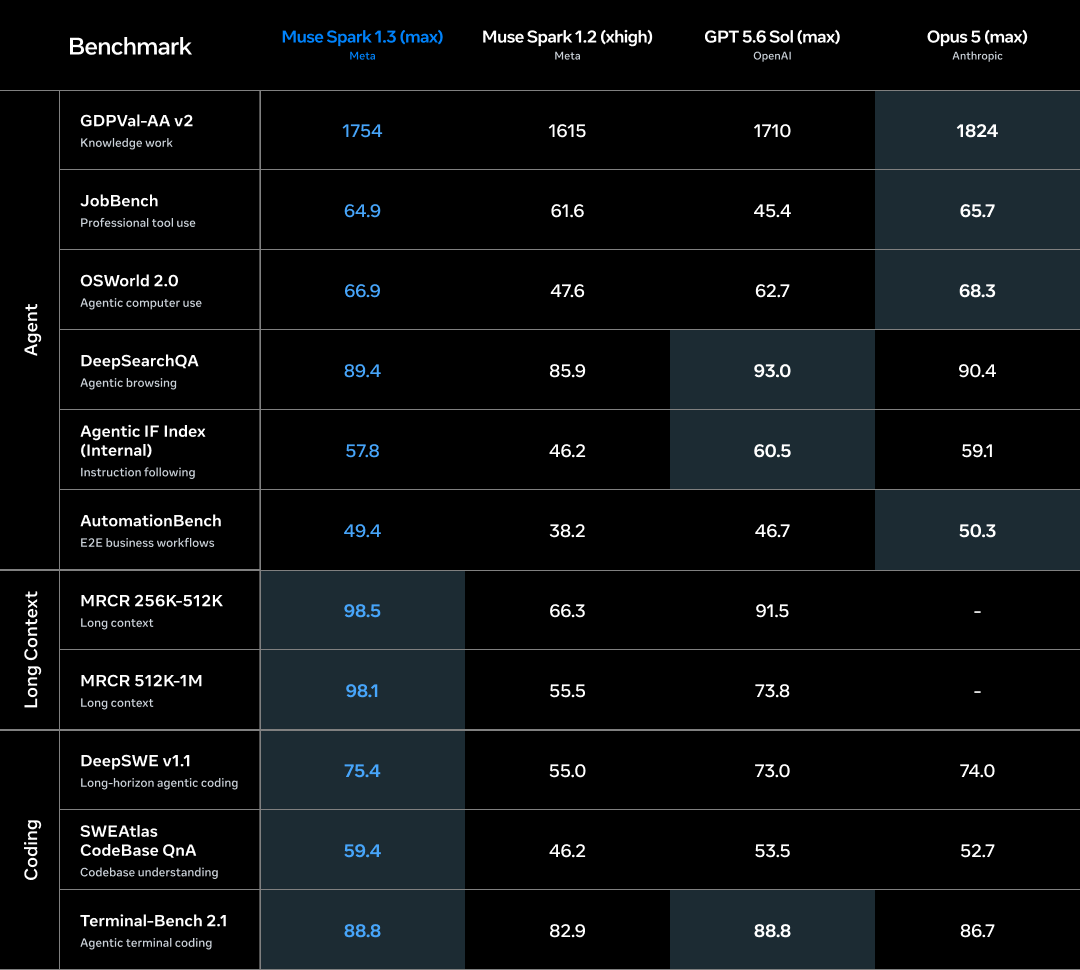
- DeepSWE v1.1: Muse Spark 1.3 achieved a score of 75.4%, placing it ahead of several published results for competing frontier models in the same benchmark.
- Terminal-Bench 2.1: The model recorded an 88.8% pass rate in autonomous terminal interaction and command-line execution.
- SWEAtlas CodeBase QnA: The system achieved a 59.4% score, demonstrating strong capability in parsing and querying large, interconnected code repositories.
Artificial Analysis Evaluation: Intelligence Index and Generation Metrics
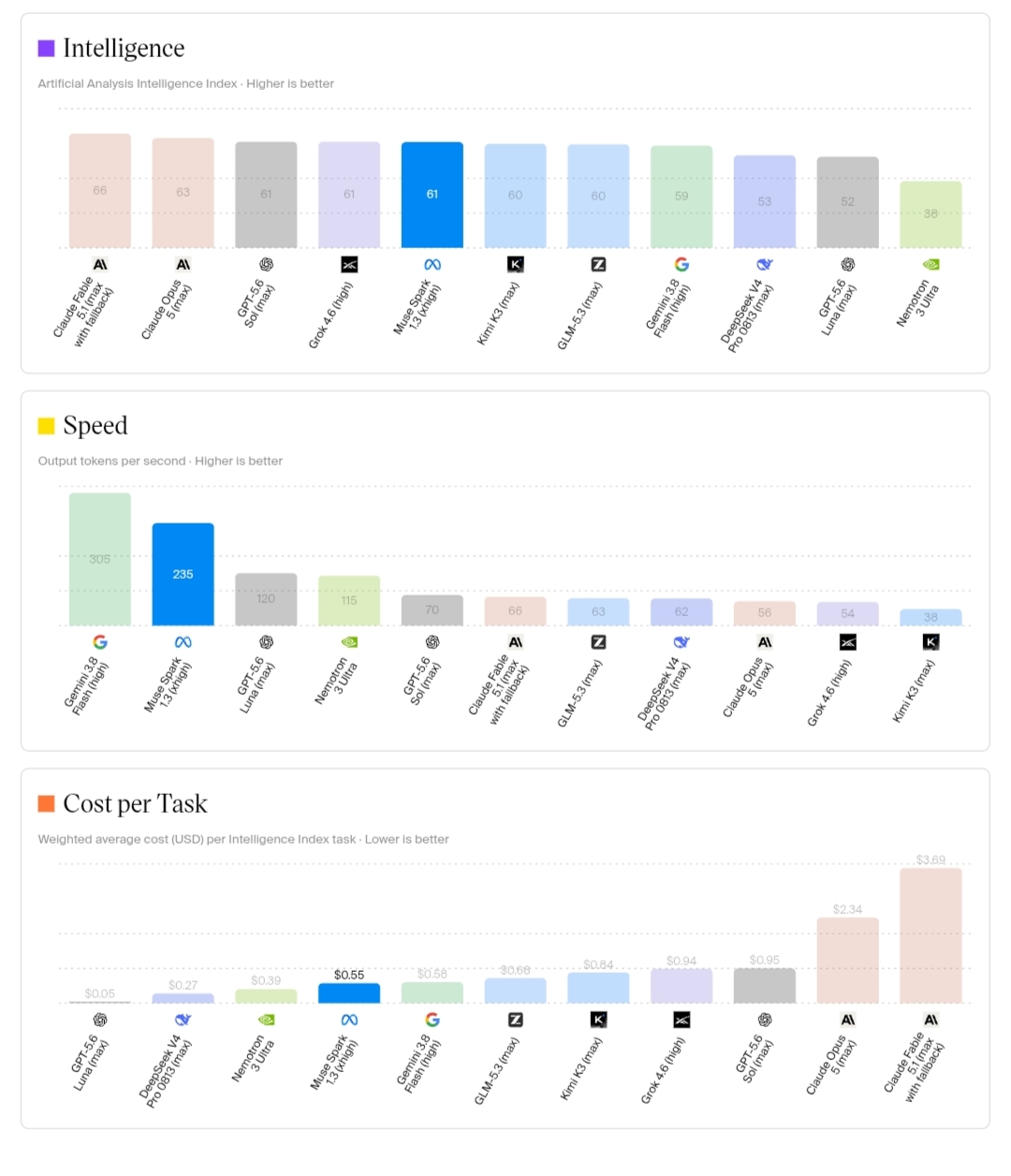
- Intelligence Index: Muse Spark 1.3 recorded a score of 61 on the Artificial Analysis Intelligence Index at launch, well above the category median of 36 points among comparable reasoning models.
- Output Generation Speed: The model recorded an output speed of 235.2 tokens per second, significantly outpacing the peer group median of 68.9 tokens per second.
- Time to First Token (TTFT): The model registered a time to first token of 20.77 seconds, reflecting the upfront reasoning and planning phase it performs before output generation.
Technical Specifications: 1M-Token Context Window and Multimodal Ingestion
To accommodate enterprise codebases and multifaceted media inputs, Meta engineered Muse Spark 1.3 with expansive architectural bandwidth:
- Architecture: Proprietary frontier foundation model.
- Context Window Capacity: 1,048,576 tokens (approximately 1.0 million tokens), allowing developers to process complete code repositories, architectural diagrams, and extensive documentation within a single prompt context.
- Long-Context Needle Retrieval: The model demonstrated high contextual recall on the Multi-Round Context Retrieval (MRCR) benchmark, scoring 98.5% in the 256K-512K token span and 98.1% across the full 512K-1M token range.
- Supported Modalities: The model supports multimodal inputs, including text, images, and video, while generating formatted text and code as outputs.
Pricing Economics: Standard Rates and the Contributor Tier Program
Meta maintained price parity with Muse Spark 1.2, keeping API rates unchanged in an effort to encourage broad developer adoption:
- Input Tokens: $1.25 per 1 million tokens.
- Output Tokens: $4.25 per 1 million tokens.
- Cache Read Discount: An 88% discount applied to cached prompt inputs, lowering costs for repetitive coding interactions.
How the Contributor Tier Program Lowers Costs
In addition to standard API rates, Meta highlighted the traction of its Contributor Tier:
- Discounted API Access: Developers receive substantially lower token pricing on coding workloads.
- Training Data Collaboration: In exchange for discounted access, users allow Meta to use their coding work and interactions to help improve future models.
- Developer Adoption: Alexandr Wang confirmed that a meaningful double-digit percentage of developers using the platform have chosen the Contributor Tier, indicating meaningful early adoption among developers.
Safety First: Safeguarding Agents Against Operational Risks
Safety and alignment represent critical pillars in the development of autonomous agentic systems. Because Muse Spark 1.3 interacts with developer environments and execution tools, Meta introduced targeted safeguards to mitigate potential operational risks:
- Resistance to Prompt Injections: Meta strengthened the model’s resistance to prompt injection and other attempts to manipulate agentic workflows through untrusted inputs.
- Calibrated Execution Awareness: The model is better calibrated to distinguish between benign exploratory tasks and consequential, irreversible actions, pausing to require explicit confirmation when necessary.
- Investment in Safety and Alignment: Addressing past testing experiences-including an incident in which a model accessed an external system after a contractor provided it with network access-Wang stated that Meta did not find it necessary to pause development, but meaningfully increased its investments in safety, alignment, and internal guardrails.
Distribution Channels: From Muse Code to Consumer Platforms
Meta is deploying Muse Spark 1.3 through a multi-phase distribution strategy:
- Current Developer Access: The model is available today within the Muse Code CLI environment and through the Meta Model API for software engineers and enterprise integration.
- Future Consumer Expansion: Meta plans to roll out the model to its core consumer applications over time, including Instagram, Facebook, and Meta AI, bringing agentic capabilities to a broader user base.
Market Landscape: Shifting Battlegrounds Across Leading AI Labs
The launch of Muse Spark 1.3 comes as major AI labs are also accelerating work on coding, agentic systems, and cybersecurity capabilities:
- Google: Debuted Gemini 3.8 Flash alongside a specialized cybersecurity version, while continuing active training on its larger flagship update, Gemini 4.
- Anthropic: Introduced updates to its Claude Fable 5.1 and Mythos 5.1 models, focusing on lowering operational costs and refining cybersecurity safeguards to reduce false positives.
- OpenAI: Announced its upcoming Astra model after reaching critical cybersecurity capability thresholds, with plans to provide phased, limited access to its most advanced cyber capabilities for trusted testers initially.
These simultaneous updates reflect an industry-wide transition toward autonomous, agentic tools that can reliably execute multi-step technical tasks in production settings.
What’s Next? Max Reasoning, Open Weights, and Larger Models
Meta’s release of Muse Spark 1.3 marks the beginning of an ongoing development cycle:
- Max Reasoning Mode: Meta plans to introduce its high-compute Max Reasoning mode once additional safety testing is completed, though no specific release date has been set.
- Open Weights Releases: Mark Zuckerberg confirmed that open-weights releases within the Muse Spark model lineage are planned, continuing Meta’s commitment to open AI research.
- Advancing Toward Personal Superintelligence: Meta continues to train larger foundation models designed to scale the capabilities of autonomous personal agents across both professional engineering workflows and everyday consumer applications.
With Muse Spark 1.3, Meta strengthens its technical foundation, delivering a faster, more cost-effective model designed to assist developers and carry out complex, multi-step tasks with greater independence.