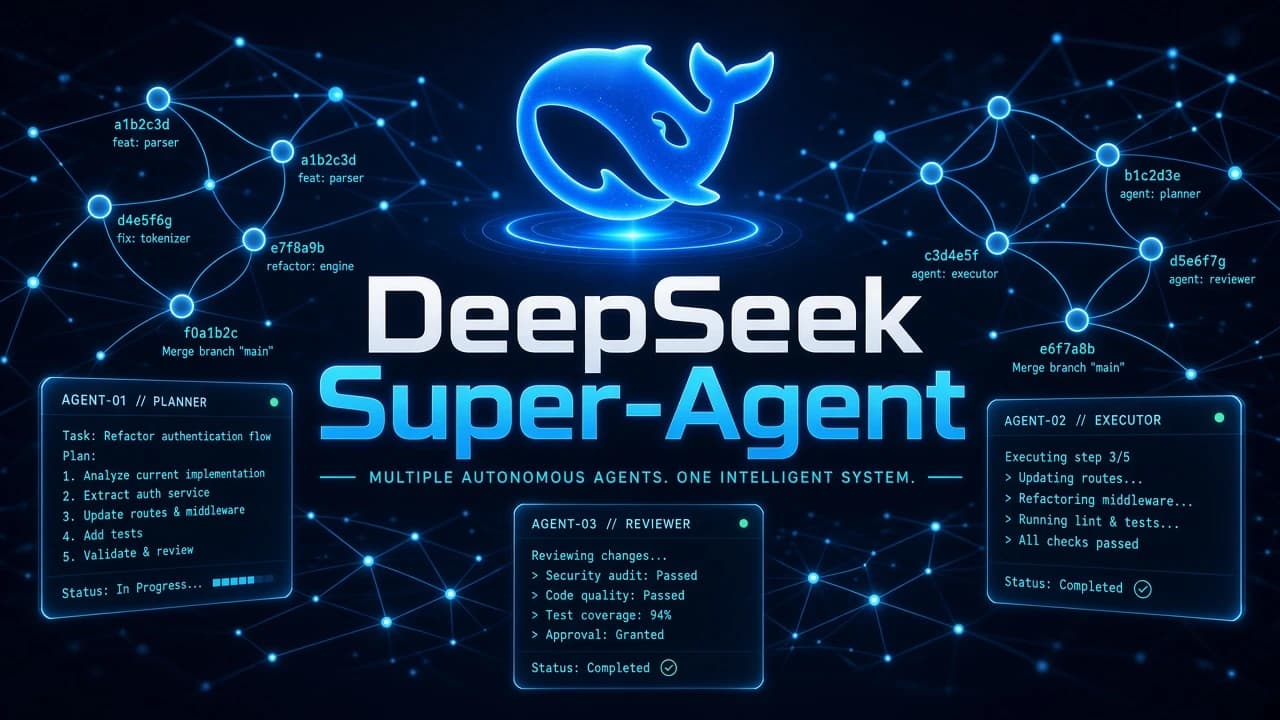
DeepSeek Releases Super-Agent for Autonomous Coding Tasks
DeepSeek has released dsh-superagent, an open-source AI agent prototype that automates software development tasks through GitHub and Feishu. The system receives requests from developers, assigns them to independent AI agent sessions, and handles multiple coding tasks in parallel. Once a task is complete, it sends the results back to the original conversation and can submit code changes through GitHub pull requests.
Published by the DeepSeek team under the MIT license, the project introduces an approach to managing AI-powered development workflows, allowing coding agents to handle assigned tasks while developers oversee progress and review the results.
How DeepSeek Super-Agent Handles Coding Tasks
DeepSeek Super-Agent connects directly to a team’s development workflow instead of operating as a conventional coding assistant that waits for instructions in a single chat session.
It monitors activity in a connected GitHub repository and can also receive requests through Feishu, the workplace collaboration platform. When an authorized developer submits a task, the system creates a separate work item and launches an agent session to handle it.
Each task runs in its own session and working directory. This separation keeps assignments independent and allows the system to process several requests simultaneously. Developers can assign different coding tasks without combining their instructions, files, and results in one shared workspace.
After completing the assigned work, the agent returns its response to the conversation where the request originated. When the task involves code changes, the workflow can produce a GitHub pull request for the development team to review.
The project also includes a web dashboard that displays tasks requiring human attention. Developers can use the interface to follow ongoing work and handle situations that need their intervention.
A Main Agent Coordinates Multiple Coding Agents
The system organizes its work around a main orchestration session and separate worker sessions.
The main session receives incoming requests, checks whether they meet the authorization rules, and manages task distribution. It handles coordination rather than carrying out every coding assignment itself.
Worker sessions take responsibility for the actual development tasks. Each one operates independently within its assigned workspace, keeping its files and execution separate from other active tasks.
This structure allows multiple agents to work on different assignments at the same time. For example, a development team can send separate requests involving code changes or bug fixes, with each task handled in its own session. The main agent coordinates the workflow and returns the completed results to the relevant conversations.
By separating coordination from execution, DeepSeek gives the system a way to manage several development requests without relying on one continuous coding session.
Authorization and Developer Oversight
DeepSeek Super-Agent includes access controls that determine who can submit tasks and trigger agent activity.
The system checks incoming requests against configured authorization rules before assigning work. Teams can restrict access to approved users, helping prevent unauthorized messages from triggering development operations.
Human oversight is also part of the workflow. The dashboard highlights tasks that require attention, while completed coding work can return to GitHub for review through pull requests.
These features keep developers involved in important stages of the process. Agents handle assigned work independently, while team members retain control over access, review, and tasks requiring intervention.
Open-Source Release and Technical Requirements
DeepSeek published dsh-superagent on GitHub under the MIT license. Developers can access its source code, modify the implementation, and use it as a starting point for their own agent-based development workflows.
The project is built around DeepSeek Harness, the company’s agent framework, and comes with documentation covering its architecture, setup, authorization rules, and task execution process. Running the system requires configuring the necessary environment and connecting the supported services, including GitHub and Feishu where applicable.
DeepSeek identifies the public release as a research prototype rather than a production-ready product. The repository provides the implementation available to developers, while the team’s internal version may include additional capabilities that are not part of the published code.
Security also deserves attention during deployment. The documentation describes execution permissions that can give the agent access to local files and the ability to run programs under its operating system account. Developers should therefore run the prototype in a controlled environment and limit its access to sensitive files and systems.
DeepSeek Explores a More Autonomous Coding Workflow
With dsh-superagent, DeepSeek brings together task management, parallel agent execution, and GitHub integration in a single development workflow.
Instead of handling every coding request as an isolated conversation, the system assigns work to independent agents, tracks their progress, and returns the results to developers. This architecture puts AI agents closer to the day-to-day operations of software development teams.
The open-source release gives developers access to the project’s implementation and an opportunity to experiment with coordinating multiple coding agents across real development tasks. While the current version remains a research prototype, it demonstrates DeepSeek’s approach to moving AI coding tools beyond individual prompts and toward automated software development workflows.