Between Cybersecurity Edge and Coding Hurdles: What Does DeepSeek V4 Pro Actually Deliver to Users?
On August 13, 2026, Chinese AI pioneer DeepSeek officially released the production-ready version of its flagship model: DeepSeek V4 Pro. Following its preview phase launched in April, the model is now broadly available across web, mobile apps, and developer APIs. In a market flooded with marketing hype, evaluating real-world performance against raw numbers is essential. Based on post-launch technical specifications and early testing, this comprehensive review explores what V4 Pro delivers, its core strengths, practical limitations, and its actual cost of implementation.
Where to Access DeepSeek V4 Pro
For everyday users looking to test the model, DeepSeek has made the final version accessible through primary user channels, rather than limiting it to developer APIs. The main access options include:
- Web Interface: Available for direct chat at chat.deepseek.com, where the system is ready to operate upon login.
- Mobile Applications: The official mobile apps available on iOS and Android app stores (users must ensure they update to the latest version to access the new model).
- Developer API: Designed for developers aiming to integrate the model’s capabilities into their own applications and pipelines.
Advanced Reasoning and Context Window Capabilities
Standard casual prompting may not fully demonstrate the model’s capabilities. To leverage its autonomous agent and deep-thinking powers, users can toggle on “Expert Mode” in the chat interface. This forces the system to execute advanced reasoning steps for complex tasks instead of relying on fast, surface-level responses.
For general users and enterprise applications, the massive 1-million-token context window allows the system to process exceptionally long documents, enabling comprehensive summarization or targeted query answering without losing the broader semantic context.
Under the Hood: Mixture-of-Experts (MoE) Architecture
Technically, V4 Pro utilizes a Mixture-of-Experts (MoE) architecture. This approach houses a massive 1.6 trillion total parameters within the model but only activates approximately 49 billion parameters during any given inference run. This design strikes a balance between the model’s overall capacity and the computational overhead required to run it.
From a developer’s perspective, the API offers highly robust features, including:
- A massive 1M-token input context window.
- A maximum output limit of 384,000 tokens per single generation.
- Granular control over reasoning effort (Thinking Effort).
- Support for native tool calling and structured JSON output.
- Seamless API compatibility with OpenAI and Anthropic SDK protocols, drastically lowering migration friction for developers.
Benchmark Breakdown: Official Leaps vs. Independent Audits
Post-launch reactions to the model have varied between high praise and technical criticism. To understand this divide, we must evaluate both DeepSeek’s official metrics and independent third-party assessments.
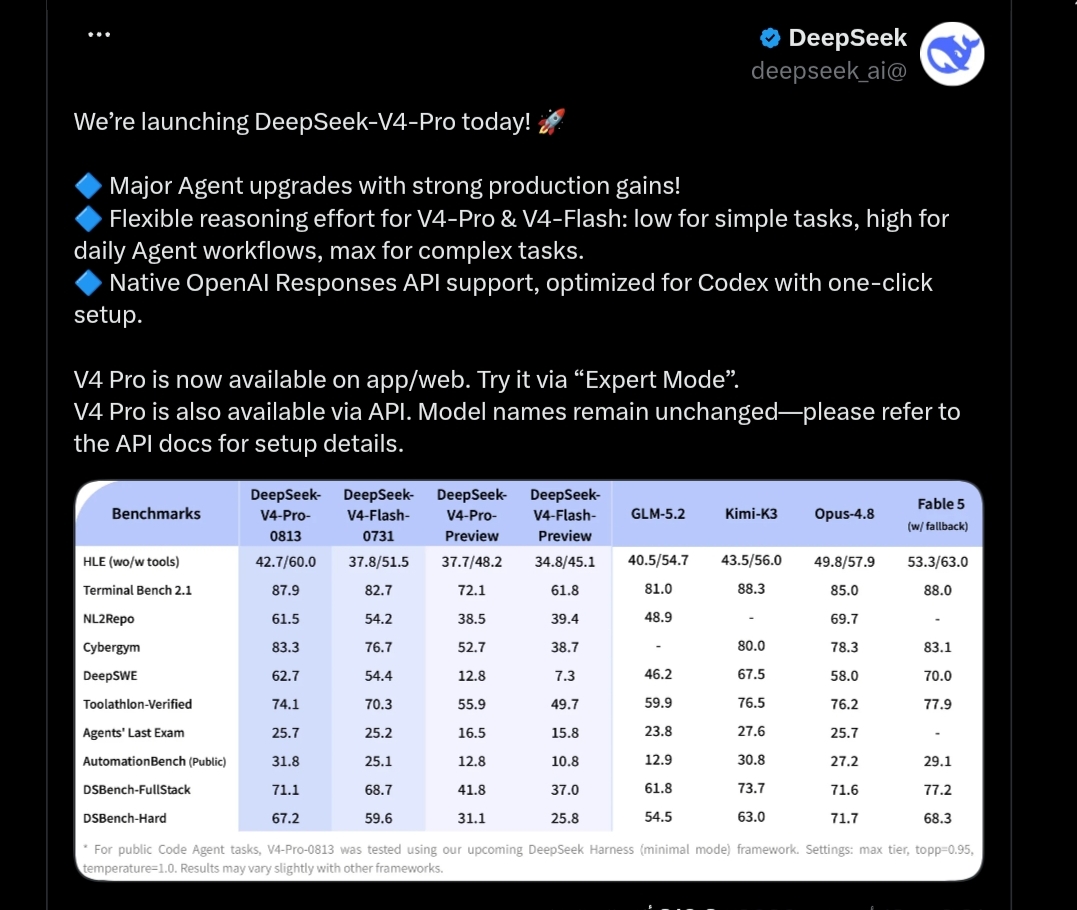
According to data published by DeepSeek, V4 Pro achieved substantial gains over its preview version:
- Performance on Terminal Bench 2.1 rose from 72.1 to 87.9 points.
- Scores on the software engineering benchmark DeepSWE surged from 12.8 to 62.7 points (nearly a five-fold increase).
- When compared to competitor Claude Fable 5, official tests showed Fable 5 holding a slim 5.3% lead in certain composite benchmarks-an impressive feat for DeepSeek given the enormous price disparity.
Conversely, independent third-party evaluations painted a slightly different picture:
- According to the Artificial Analysis intelligence index, V4 Pro scored 53 points, putting it on par with Zhipu AI’s GLM-5.2 but placing it behind Moonshot AI’s Kimi K3.
- The model fell short of the top spots on the Vals Index, ranking 12th overall behind other major frontier models.
- Early developer testing revealed difficulties in constrained sandbox terminal environments, as well as struggles with generating complex financial models in Excel.
- On developer forums and social media, some programmers reported issues with premature halts and execution timeouts during long, multi-step coding generation tasks.
Additionally, early discussions are emerging around specific Harness tools designed for building autonomous agents with DeepSeek models. However, as these frameworks are still evolving alongside the model’s rollout, it is premature to view them as finalized consumer products.
DeepSeek V4 Pro in Cybersecurity: A Notable Vulnerability Detection Performance
Despite some coding limitations, V4 Pro has drawn positive attention from cybersecurity researchers. According to Belgian cybersecurity firm Aikido Security, the model outperformed several competitors in detecting system vulnerabilities.
Evaluations showed that V4 Pro flagged a higher volume of code vulnerabilities compared to other tested models, though researchers noted that it suffered from lower precision (resulting in a higher rate of false positives). While this makes V4 Pro a highly promising tool for initial code scanning and vulnerability research, it remains an isolated test and does not guarantee absolute cybersecurity superiority in all scenarios.
The Economic Advantage: Current Pricing vs. the Upcoming Rate Hike
Pricing remains one of the model’s strongest selling points. The current official pricing is set at $0.435 per million tokens for inputs and $0.87 per million tokens for outputs, with cached inputs priced at $0.0036 per million tokens.
In comparison, Claude Fable 5 costs $10 per million input tokens and $50 per million output tokens. This creates an enormous price gap; depending on the input-to-output ratio, using Fable 5 can be up to 4500% to 5700% more expensive than V4 Pro, presenting a massive financial incentive for high-volume enterprise pipelines.
However, developers must navigate some concurrency bottlenecks. V4 Pro limits concurrent requests to 500, compared to 2500 requests on the cheaper V4 Flash model, requiring developers to carefully manage high-traffic loads.
Furthermore, a major pricing shift is on the horizon. Reuters reported that DeepSeek announced a transition to a dynamic billing structure starting August 16, 2026 (at 16:00 UTC). The new system introduces peak and off-peak rates; during peak hours, V4 Pro rates will increase significantly, reaching up to $1.32 per million input tokens and $3.96 per million output tokens. This upcoming rate hike means the extreme cost-efficiency currently enjoyed by early adopters may soon be adjusted, making it critical for businesses to recalculate their long-term project budgets.
The Broader Chinese AI Race
The release of V4 Pro must be viewed within the context of China’s highly competitive AI landscape. Reports indicate that DeepSeek is aggressively positioning itself against domestic rivals like Moonshot AI, Zhipu AI, and Alibaba. The company is reportedly seeking new funding at a valuation close to $74 billion (500 billion yuan) after securing billions in prior funding rounds. Concurrently, DeepSeek is investing in custom computing infrastructure to decrease its long-term reliance on hardware supply chains from external chip manufacturers.
Final Verdict
In summary, DeepSeek V4 Pro represents a notable milestone in accessible, high-performance AI. Its availability via web, mobile, and API channels makes it an easy option to test, while its massive context window and competitive pricing offer clear practical value. While the model excels in security audits, its limitations in highly complex coding environments and sandbox setups suggest it should be used strategically. Finally, while the current pricing is highly attractive, the upcoming dynamic rate hike starting August 16 means that long-term enterprise deployments must be modeled under the new pricing guidelines.