OpenAI Rolls Out GPT-6 in ChatGPT with Interactive Intelligent UI
OpenAI has started rolling out GPT-6 in ChatGPT, bringing faster processing, stronger performance on complex tasks, and improved web search. The global rollout kicked off on October 7 for paid subscription tiers, before expanding the following day to Free and Go users worldwide.
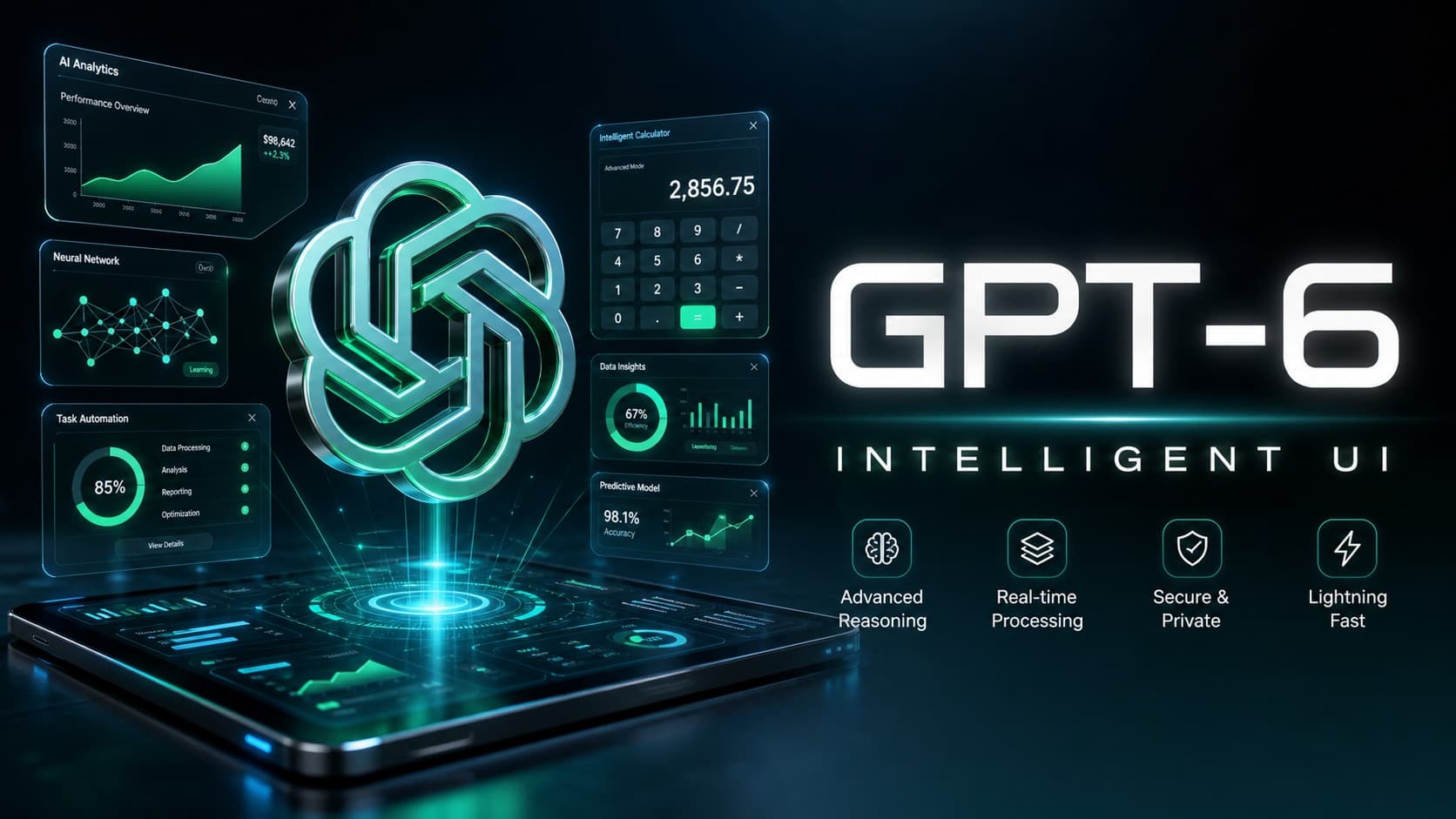
But the model itself isn’t the only major change in this release. Alongside GPT-6, OpenAI debuted Intelligent UI-a new way to display answers inside ChatGPT that makes interactions more dynamic. Instead of returning text alone, the model can generate interactive tables, charts, clickable buttons, and small tools directly inside the conversation, choosing the format based on the nature of each question.
Together, GPT-6 and Intelligent UI give ChatGPT a more interactive way to handle tasks, moving beyond simple text-based answers and allowing users to work with the results directly.
How Intelligent UI Changes the Way ChatGPT Presents Answers
The idea behind Intelligent UI is simple: some questions are easier to answer with something other than a block of text.
If an inquiry calls for a comparison, GPT-6 can present the information side-by-side in clean columns. If an explanation benefits from visual clarity, it can generate an interactive diagram or chart. In some cases, it can build a live tool that users can work with directly inside the thread.
Crucially, GPT-6 does not turn every answer into a complicated interface. OpenAI notes that the model chooses the most appropriate format for each question, using a simple text response whenever that remains the best way to answer.
From Explaining Information to Interacting with It
Intelligent UI is particularly useful for concepts that are difficult to understand through text alone.
Rather than explaining a statistical principle across multiple paragraphs, ChatGPT can provide an interactive visualization where users adjust values and see the impact on a graph in real time. This lets users interact with the information instead of simply reading about it.
OpenAI highlighted several examples, including interactive explanations of the Central Limit Theorem, simulations of the Monty Hall problem, breakdowns of macroeconomic concepts, and dynamic visuals showing how camera systems work in drone photography.
GPT-6 Can Build Interactive Tools Directly Inside Chat
The feature is not limited to charts and diagrams; ChatGPT can also create small, task-specific tools based on what the user asks for.
For example, a user can ask for a savings calculator to see how their money might grow over time, or a bill-splitting tool for a group dinner. Users can even ask the model to generate a simple classic game and play it directly in the conversation.
Users can therefore handle many small tasks without leaving ChatGPT to open another app, spreadsheet, or website. The model can build and run the tool directly in the conversation.
How Intelligent UI Works Under the Hood
To support this approach, OpenAI trained GPT-6 to decide not only what information to provide, but also how to present it. The model learns how to organize content, select suitable design components, and determine when interactive elements are helpful and when a simple text answer is enough.
Technically, the capability relies on a library of native, streamable interface components paired with a compiler that builds the interface as the model generates the response, evaluating each element for clarity, usefulness, and completeness.
The system is modular, so responses do not have to follow a fixed template. GPT-6 can change the format depending on the task.
GPT-6 Starts Answering Before It Finishes Processing
The update also focuses on performance, with improvements to latency and reasoning speed alongside the new visual features.
GPT-6 can now begin showing an answer while it continues thinking or using tools in the background, adding new information to the conversation without requiring the user to send another prompt. This helps reduce the wait time on longer, more complex answers.
According to OpenAI, GPT-6 Instant begins answering questions that require web search roughly 44% faster on average compared to GPT-5.6 Instant. In company benchmarks, GPT-6 Extra High began responding at roughly the same speed as GPT-5.6 Medium, while achieving better overall scores on demanding agentic tasks than GPT-5.6 Extra High.
Smarter Web Search and Better Query Judgment
Web search capabilities have also been refined in GPT-6. OpenAI says the model is better at deciding when it actually needs to search the web, and more reliably finds sources that support its answers.
This matters most for time-sensitive questions, where a web search can provide information that is newer and more reliable than the model’s existing knowledge.
Stronger Safeguards and Clearer Self-Awareness
OpenAI has also made changes to GPT-6’s safety systems as the model becomes more capable.
Drawing on safety work from the Astra project, the company improved the model’s resistance to multi-turn prompt-injection attacks. OpenAI also updated its safety training to strengthen protections against high-risk misuse involving cyberattacks, biological threats, and violence.
At the same time, GPT-6 is better at recognizing and communicating its limitations to users, including pointing out when it lacks the tools or information needed to answer accurately.
The company is also working to reduce unnecessary refusals, allowing the model to handle benign, normal requests without triggering unneeded restrictions.
When Will GPT-6 Reach Your ChatGPT Account?
The global rollout of GPT-6 with Intelligent UI began on October 7 across the Chat tab for Plus, Pro, Business, and Enterprise users.
On October 8, access expanded to Free and Go tiers, with Enterprise availability depending on organization admin settings.
Paid tiers are powered by GPT-6 Sol, while Free and Go users receive GPT-6 Luna. OpenAI noted that this release applies specifically to the Chat experience in ChatGPT; the models powering Codex and ChatGPT Work remain unchanged for now.
What GPT-6 Changes in ChatGPT
GPT-6 and Intelligent UI also change how users can interact with ChatGPT. A ChatGPT conversation can now include interactive tools and visual elements that let users test ideas, work with data, and complete tasks without relying on text alone.
Rather than making users adapt their workflow to a fixed interface, GPT-6 can adjust the way information and tools are presented based on what they are trying to do.
OpenAI describes Intelligent UI as an early version of a system that will continue to evolve. For ChatGPT, this means moving beyond a conversation-based interface toward one that can build a more suitable experience for each task.