OpenAI Unveils ChatGPT Images 2.5 with Up to 50% Faster Speed
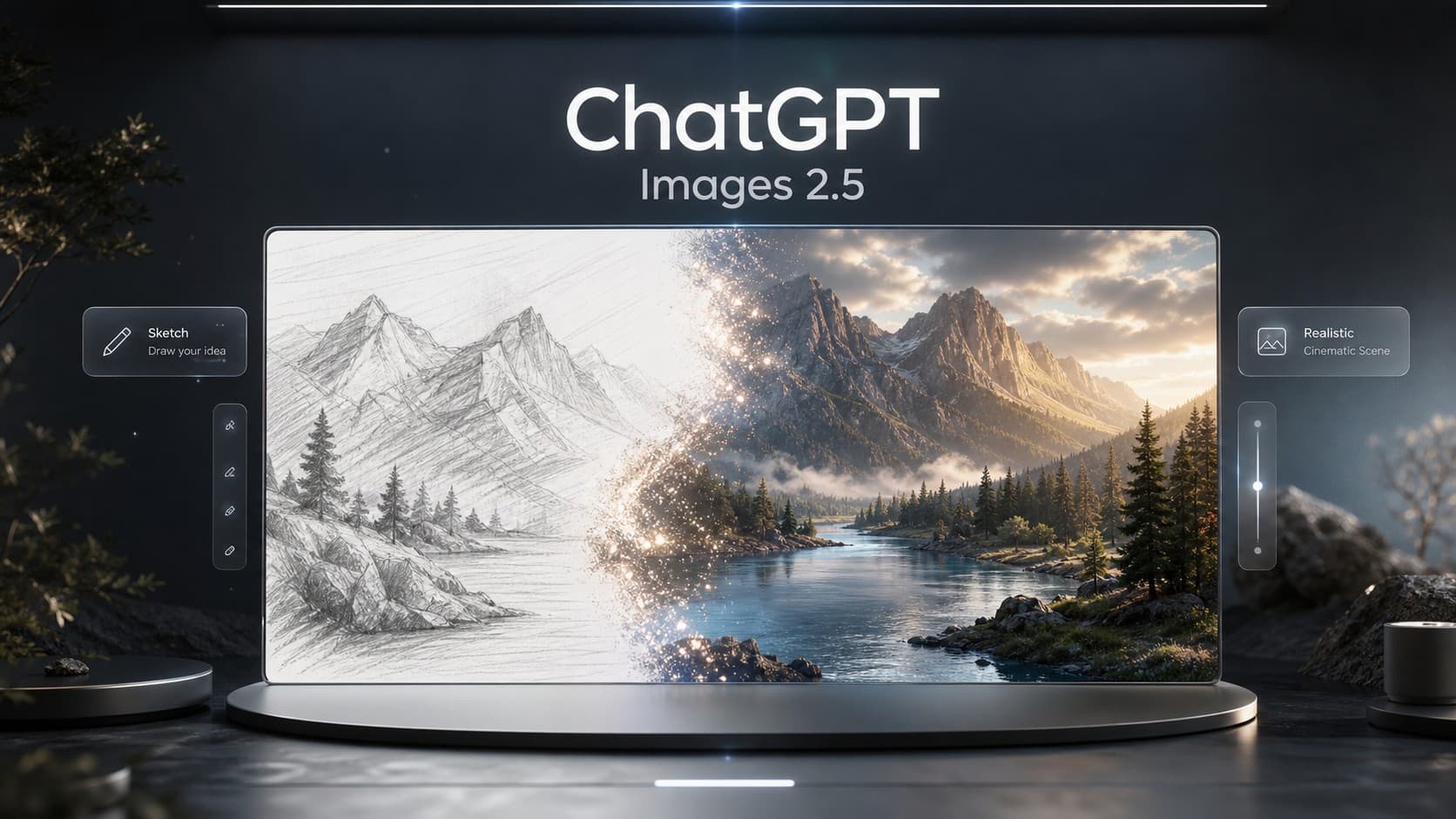
OpenAI officially announced the release of ChatGPT Images 2.5, an updated image generation model engineered to deliver sharper visual details, more accurate editing capabilities, and notable performance gains. According to the company, the new model cuts generation latency by up to 50 percent compared to Images 2.0 while introducing native creative tools, including direct sketching and in-image annotations.
The rollout comes as visual AI usage reaches unprecedented scale. OpenAI reported that users now generate more than 3 billion images every week across ChatGPT Images and its developer-facing API endpoints.
Enhanced Visual Fidelity and Subject Preservation
A primary focus of Images 2.5 is grounding generated imagery in real-world reference material. OpenAI stated that the model handles reference photos with significantly higher accuracy, preserving the distinctive facial features, expressions, and physical traits of subjects across varying settings, visual styles, and lighting setups.
The update introduces noticeable improvements in light rendering, surface textures, and material depth. Rather than applying uniform visual effects, the model better captures how natural and artificial light interact with complex scenes, producing more realistic shadows and contrasts. For professional designers and marketing teams, this improved fidelity helps ensure that characters and branding elements remain recognizable when adapted across multiple visual contexts.
Precision Multi-Turn Editing and Consistency
Editing accuracy has historically been a friction point in generative imaging workflows. With Images 2.5, OpenAI addressed this by refining how the model interprets targeted adjustment prompts.
Users can modify specific elements-such as altering a product color, swapping out a background, or revising text-without disturbing the surrounding layout, lighting, or compositional balance.
Crucially, the update significantly improves consistency during extended ChatGPT conversations:
- Multi-Turn Reliability: Earlier adjustments are more likely to stay consistent across successive conversation turns.
- Incremental Refinements: Each new modification builds directly upon previous changes rather than rebuilding the entire asset from scratch.
- Asset Stability: Production teams can execute targeted iterations without degrading visual quality over time.
Complex Layouts and Artistic Versatility
Images 2.5 demonstrates a deeper contextual understanding of complex creative briefs and intricate visual instructions. The model supports transparent backgrounds natively and maintains visual hierarchy when handling detailed graphical compositions.
From vintage 1950s space illustrations and mid-century typographic posters to impressionist cityscapes and intricate mosaic patterns, the model adheres closely to requested aesthetics without drifting. For enterprise environments, this stability allows teams to generate brand-compliant design concepts, presentation slides, and user interface wireframes that follow specific structural guidelines.
New Creative Tools in the ChatGPT Interface
Alongside the underlying model updates, OpenAI introduced several workflow features directly inside the ChatGPT interface to streamline user input:
1. Direct Sketching via @Sketch
Users can draw basic rough layouts and concepts directly within the chat window to serve as visual blueprints. By typing @Sketch, creators can outline a room arrangement, sketch a fashion silhouette, or draft a compositional doodle. ChatGPT then uses that visual guide-alongside accompanying text prompts-to render a complete image.
2. Pre-Built Design Templates
To remove the barrier of starting from a blank canvas, the interface now includes pre-set templates for widely used creative formats, such as event posters, product photography, and merchandise mockups. Users select a template and customize the specific text, branding details, and visual styling.
3. Pinpoint In-Image Commenting
Instead of relying entirely on descriptive text prompts to explain where a change should happen, users can place comments directly onto specific regions of an image to guide targeted edits with pinpoint precision.
4. Prompt Sharing
When sharing generated images, users can include the exact prompt parameters used to produce the output. This allows others to reuse the same creative approach with their own images and details.
Dedicated Developer Models: Flare and Sunburst
To serve varied business needs, OpenAI introduced two distinct models within the Images API:
GPT-Image-2.5 Flare
- Performance Profile: Delivers 50% lower latency compared to GPT-Image-2, serving as the default, high-throughput model.
- Best Used For: High-volume image generation, social media creative production, e-commerce visual search, and rapid concept prototyping.
GPT-Image-2.5 Sunburst
- Performance Profile: Built for higher detail precision and more granular editing control, utilizing longer generation processing times.
- Best Used For: High-end commercial campaigns, polished product photography, and complex corporate branding assets.
Industry Reception and Partner Integrations
Early access partners highlighted the model’s discipline in keeping core visual identities intact during iterative adjustments.
Axultan Alimkulov, Head of Product at Higgsfield AI, emphasized this capability: “What impressed us most about GPT-Image-2.5 Flare is how well it understands what not to change. You can make a meaningful edit without losing the character, composition or visual identity of the original image. That’s incredibly important for the way creators and teams actually work across film, UGC and advertising. And when you combine that level of control with the speed, quality and cost, GPT-Image-2.5 Flare really stands out.”
OpenAI also confirmed that creative and software firms, including Adobe and Manus, have begun integrating the 2.5 model family into their production pipelines to enhance digital creative workflows.
Safety Standards, Metadata, and Provenance
In line with industry transparency initiatives, OpenAI reiterated its safety infrastructure for generative media:
- C2PA Metadata: Generated images include provenance metadata that can help identify their origin and editing history.
- Invisible Watermarking: Visual assets carry imperceptible watermarks to help detect content generated by OpenAI’s image systems.
- Proactive Content Filtering: Input prompts and output renders pass through automated safety checks designed to block harmful or abusive visual output.
Availability and Platform Access
ChatGPT Images 2.5 is rolling out to all users across all tiers of ChatGPT, ChatGPT Work, and Codex on web browsers, desktop applications, and mobile devices (iOS and Android).
Developers and enterprise clients can access GPT-Image-2.5 Flare and GPT-Image-2.5 Sunburst through the OpenAI API platform starting today.