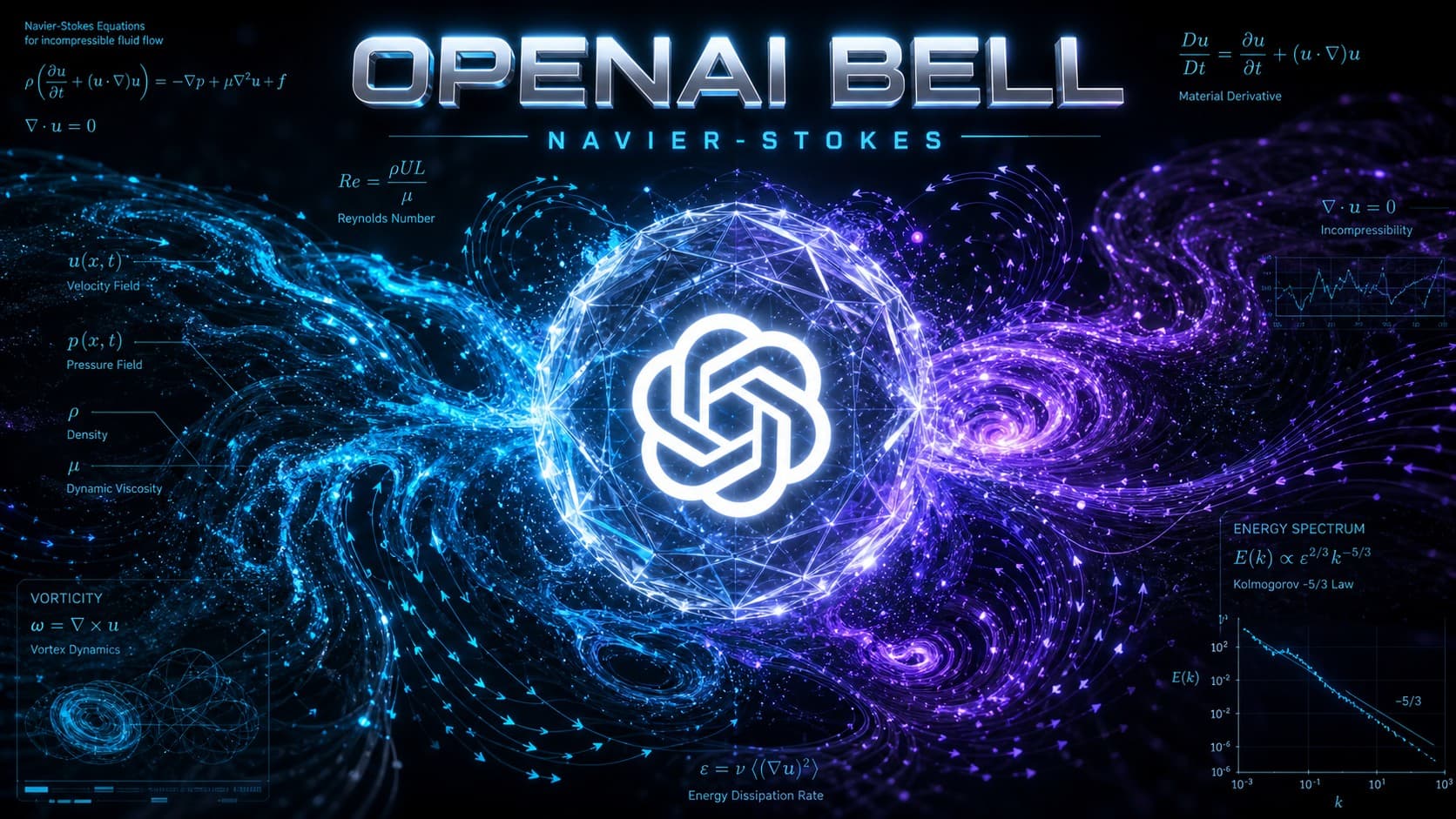
OpenAI Bell.. Is It GPT-7? The Frontier Model Outperforming GPT-6 Astra to Tackle a 90-Year-Old Math Mystery
The artificial intelligence landscape is shifting from conversational fluency toward long-horizon reasoning and automated scientific discovery. In a significant technical update, OpenAI revealed that an unreleased internal model-demonstrating capabilities substantially beyond those of its current flagship, GPT-6 Astra-was deployed to produce a candidate solution for one of the most stubborn open challenges in mathematical physics: the Navier-Stokes existence and smoothness problem.
Following the announcement, technology outlets and online communities widely discussed the name OpenAI Bell, with reports speculating that this system could serve as the foundation for a future GPT-7 or ChatGPT 7. However, examining the published findings alongside verified reporting makes it essential to separate official technical details from industry speculation.
What Is OpenAI Bell? The Origin of the Name and Leaks
The moniker OpenAI Bell gained traction after coverage from publications such as Geeky Gadgets, which linked OpenAI’s mathematics announcement to an unreleased internal architecture codenamed “Bell.” These reports suggested that Bell might represent OpenAI’s next foundational generation, potentially succeeding GPT-6 Astra under the commercial name ChatGPT 7.
To keep the technical record clear, several key distinctions must be made. OpenAI did not use the name Bell in its official technical briefing or research publication; the company referred to the system strictly as an internal model. Furthermore, while some reports have speculated that Bell could be an early version or research precursor to a future GPT-7-class system, OpenAI has not confirmed this connection. Historically, OpenAI has utilized internal project codenames-such as Strawberry and Orion-during experimental phases before developing public-facing products. Consequently, while “OpenAI Bell” has become a popular search term and industry label, it refers to an internal frontier model that remains restricted to research environments.
What OpenAI Officially Confirmed About the Internal Model
According to OpenAI’s published technical documentation, the internal system represents a notable step forward in automated reasoning. The confirmed facts include:
- Significantly More Capable Than GPT-6 Astra: In comparative mathematical benchmarks and theorem exploration, the internal system demonstrated reasoning and proof-generation capabilities that noticeably exceeded those of GPT-6 Astra.
- Active Development Timeline: Training for the model began in late August 2026, and the system was still undergoing active training and optimization while the mathematical experiments were conducted.
- Internal Research Asset: The model has not been deployed across public ChatGPT tiers or developer API endpoints; it remains an internal experimental asset.
- Multi-Agent Optimization: The architecture was specifically evaluated within large-scale, concurrent multi-agent workflows, maintaining focus across long computational horizons.
The Navier-Stokes Millennium Problem Explained
To understand the scope of the experiment, it is helpful to examine the Navier-Stokes Existence and Smoothness Problem. In 2000, the Clay Mathematics Institute designated it as one of the seven Millennium Prize Problems, establishing a $1 million award for a validated solution.
The Navier-Stokes equations describe the motion of incompressible fluids, providing the mathematical foundation for modeling ocean currents, atmospheric weather patterns, arterial blood flow, and aerodynamic turbulence around aircraft.
While applied scientists and engineers routinely approximate these equations through numerical simulation, the fundamental mathematical question has persisted: Do smooth, physically reasonable solutions always exist in three dimensions for all initial conditions, or can the fluid velocity grow without bound in finite time (a phenomenon known as a singularity or blowup) while kinetic energy remains finite?
For nearly 90 years of modern analytical study, mathematicians have sought a definitive proof establishing whether such finite-time singularities can form in three-dimensional fluid flows.
Engineering the Experiment: How 10,000 AI Agents Produced a Solution in 88 Hours
Rather than relying on a single prompt submitted to an isolated model, OpenAI constructed a distributed multi-agent system coordinating approximately 10,000 concurrent AI agents running in parallel.
The agent population was organized into distinct, complementary operational workflows:
1. Proof-Oriented Groups (Variants A and B)
These agents explored constructive mathematical pathways, working on lemmas, structural assumptions, and nonlinear partial differential equations to build sequential steps toward a proof.
2. Disproof-Oriented Groups (Variants C and D)
Operating in parallel, these groups focused on challenging emerging hypotheses, attempting refutations, and searching for potential counterexamples or logical inconsistencies.
3. Consolidation via Codex
Codex was used to consolidate the most useful insights from the different agent groups and feed those insights back into subsequent rounds of exploration.
After approximately 88 continuous hours of iterative generation, debate, and synthesis, the multi-agent system produced a unified candidate solution detailing conditions under which fluid velocities grow without bound in finite time.
By the Numbers: The Computational Scale of OpenAI’s Experiment
The technical metrics released by OpenAI highlight the substantial compute resources dedicated to the project:
- ~10,000 Concurrent AI Agents: Deployed simultaneously within a distributed compute cluster.
- ~88 Hours: Total continuous runtime required by the multi-agent system to synthesize the candidate solution for Navier-Stokes.
- 2.7 Million Messages: Volume of internal reasoning dialogues exchanged among agents focused on the fluid dynamics problem.
- ~130 Billion Output Tokens: Computational context generated specifically during the Navier-Stokes investigation.
- 17 Hours: Compute time dedicated to subsequent formalization and verification.
- 4.9 Million Messages and ~300 Billion Output Tokens: Aggregate compute volume generated across all mathematical challenge problems evaluated during the broader research program.
What Was GPT-6 Astra’s Actual Role in the Discovery?
Some initial media reports conflated the roles of the systems involved, suggesting that GPT-6 Astra produced the initial mathematical proof. The technical documentation outlines a clear division of responsibility.
The unreleased internal model generated the creative proof strategies and mathematical arguments during the 88-hour multi-agent run. GPT-6 Astra was utilized during the subsequent verification phase.
Over a 17-hour run, GPT-6 Astra was tasked with formalization and formal verification using Lean, an interactive theorem-proving system. Astra translated the informal mathematical text into machine-checked code, allowing the logical steps to be verified programmatically without unstated assumptions.
Did OpenAI Solve Navier-Stokes? The Academic Reality and Clay Rules
In its announcement, OpenAI stated that the produced candidate solution resolves the Millennium Prize problem by demonstrating a finite-time blowup mechanism. However, the company also explicitly noted: “We do not intend to claim the Millennium Prize for this result.”
Within the academic mathematics community, formal validation of a Millennium Prize problem follows strict protocols governed by the Clay Mathematics Institute:
- The complete mathematical work must be published in a recognized, peer-reviewed journal of international standing.
- At least two years must pass following publication.
- The proposed solution must achieve general acceptance within the global mathematics community.
OpenAI’s announcement does not by itself establish eligibility for the Millennium Prize. Under Clay’s rules, any result must undergo formal publication and standard community review before its mathematical standing is officially determined.
The September 10 Update: Addressing Independent Research Inquiries
On September 10, OpenAI published a formal update addressing questions regarding whether external research inputs or prompts-specifically related to prior work by mathematician Tristan Buckmaster and colleagues-might have influenced the experimental results.
OpenAI confirmed that it conducted an internal review and determined that the Codex prompts in question could not have influenced the system’s output. The company further clarified that its research team had not seen the work of Buckmaster or Alpöge prior to its publication, reinforcing the independence of the experimental run.
Detailed Comparison: OpenAI’s Internal Model vs. GPT-6 Astra
To clarify the differences between the two systems without relying on formatting tables, the breakdown below outlines their respective roles and characteristics:
1. Current Status and Availability
- Internal Model (Reportedly “Bell”): A closed, experimental research system operating within high-performance clusters; not publicly accessible or available via commercial APIs.
- GPT-6 Astra: A commercially deployed flagship model available across OpenAI’s developer and enterprise platforms.
2. Official Identity
- Internal Model: Referred to officially as an “internal model”; the name “Bell” comes from unofficial media reports and leaks.
- GPT-6 Astra: The official commercial product name for OpenAI’s current production frontier model.
3. Capability Profile
- Internal Model: Demonstrated capabilities significantly beyond GPT-6 Astra in complex, long-horizon mathematical reasoning.
- GPT-6 Astra: Optimized for high-throughput, low-latency performance across general-purpose conversational, analytical, and coding applications.
4. Role in the Navier-Stokes Experiment
- Internal Model: Provided the core reasoning engine for the 10,000-agent swarm, generating the candidate solution over 88 hours.
- GPT-6 Astra: Served as the formal verification engine, translating the proof into the Lean theorem-proving language over a 17-hour period.
5. Primary Deployment Target
- Internal Model: Research-oriented testing of multi-agent reasoning, deep exploration, and scientific discovery.
- GPT-6 Astra: Broad production workloads, interactive chat, enterprise automation, and software engineering.
Is the Internal Model Destined to Become GPT-7?
From an engineering perspective, raw research architectures are rarely transitioned directly into consumer products without substantial modification:
- Compute Cost and Latency: An architecture that generates hundreds of billions of tokens across thousands of agents to address a single problem is impractical for real-time consumer chat interfaces requiring sub-second response times.
- Safety and Alignment: Deploying a model widely requires extensive reinforcement learning, safety evaluations, policy guardrails, and latency optimization.
Whether the internal system eventually contributes to a future GPT-7-class model remains unknown. OpenAI has not announced that Bell is GPT-7, nor has it provided a public roadmap connecting the internal research model to a future product.
Three Major Implications for the Future of AI Research
Beyond the immediate mathematical findings, OpenAI’s experiment highlights three notable methodological trends:
1. Long-Horizon Autonomous Research
AI workflows are expanding from short-turn question-and-answer interactions toward multi-day reasoning tasks, where systems maintain context and pursue structured goals across extended runtimes.
2. Scaled Multi-Agent Coordination
Deploying thousands of agents with distinct objectives-such as construction and refutation-can reduce the risk of undetected errors by subjecting candidate solutions to independent attempts at refutation before consolidating insights.
3. Neuro-Symbolic Integration (LLMs + Formal Verification)
Pairing the generative exploration of large neural networks with the rigorous checking of formal proof assistants like Lean provides a much stronger layer of verification for mathematical claims by checking formalized proofs mechanically.
Release Outlook
As of now, OpenAI has not announced a public release date for GPT-7, nor has it indicated plans to make the internal research model publicly accessible.
Industry observers expect OpenAI to focus on improving inference efficiency and distillation techniques. Before the advanced reasoning demonstrated in this experiment can be deployed at scale, the underlying approaches will require optimization to operate within viable commercial and computational budgets.
Final Takeaway
OpenAI’s latest mathematical research provides a clear look at how frontier AI development is evolving. Rather than focusing solely on parameter scale or conversational features, the frontier is increasingly defined by multi-agent coordination, formal verification, and extended problem-solving.
Whether future releases carry the name OpenAI Bell, ChatGPT 7, or an entirely different designation, the Navier-Stokes experiment demonstrates how distributed AI systems can be applied to rigorous scientific exploration.