Kimi K3: What the Open-Weight Launch Delivers for Developers and Everyday Users?
On July 27, 2026, Moonshot AI made the full weights of Kimi K3 available on Hugging Face, transforming what was already a headline-grabbing API into a tool anyone can download and run on their own infrastructure. A 2.8-trillion-parameter model that rivals the best closed-source systems is no longer locked behind a corporate gateway. Developers and casual users alike now have a new, powerful option at their fingertips.
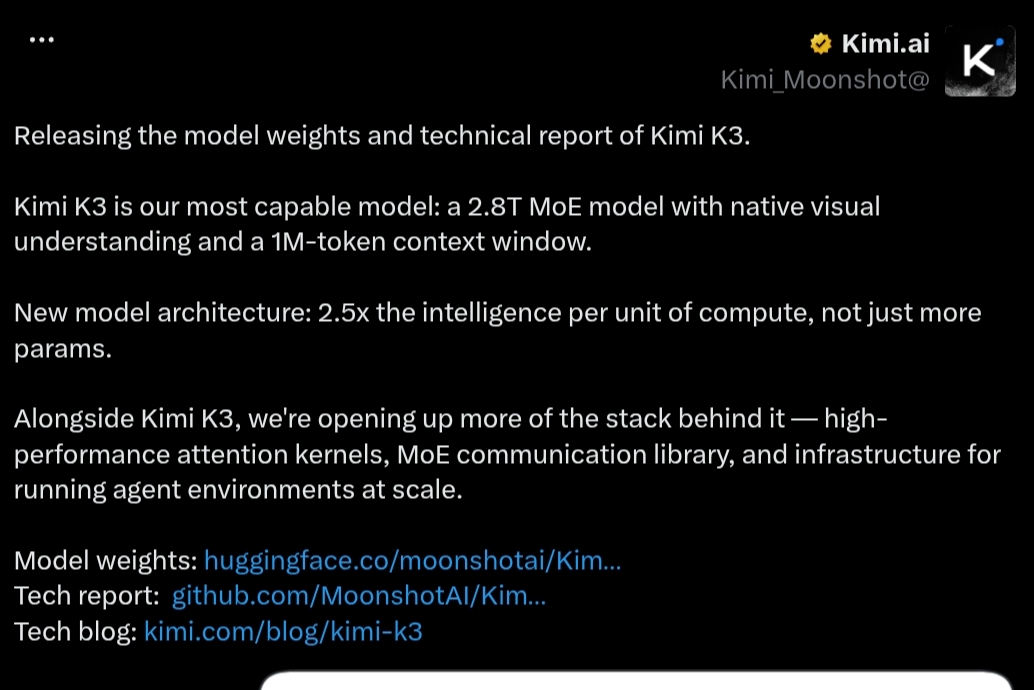
From Download to Operation: What the Open Release Means Practically
Visiting the model’s Hugging Face page today presents the files under a Modified MIT license. The terms allow commercial use, modification, and redistribution, with one boundary: any product surpassing 100 million monthly active users or $20 million in annual revenue must negotiate a separate agreement with Moonshot.
For small and mid-size teams, this translates into three immediate freedoms:
- Running a 2.8T-parameter model entirely on private infrastructure.
- Fine-tuning the model on internal data without sending anything to external servers.
- Building applications and agentic tools without rate limits or recurring per-request charges.
That said, early community feedback highlights a practical hurdle. Moonshot recommends supernode configurations with 64 or more accelerators. The hardware investment is substantial, but for teams already operating high-volume workloads, the long-term economics can justify the upfront cost.
Coding Performance That Shook Silicon Valley
Before the weights were released, Kimi K3 was available only through the API, but it wasted no time making an impression. In a blind evaluation on the Frontend Code Arena, where developers vote on outputs from anonymous models, K3 took first place with 1,679 Elo. Claude Fable 5 followed with 1,631, and GPT-5.6 Sol with 1,618. The result caught many off guard, given Fable 5’s reputation as one of the most capable and expensive closed models on the market.
Early reviews from users who downloaded the model and shared their experiences on forums and video platforms point to several standout strengths:
- Long coding sessions that span hundreds of files and thousands of lines.
- Autonomous agent tasks that run for hours without human intervention.
- Complex front-end development and interactive web applications.
- CLI tool creation and management of large repositories.
In one documented example, Moonshot showed the model building a mini compiler from scratch, named MiniTriton, which rivaled OpenAI’s Triton and even outperformed it in certain scenarios. In another case, the model designed an entire chip in 48 hours without any human input.
Price Comparison: A Difference That Drives Decisions
Cost remains a decisive factor. The official Kimi K3 API pricing is:
- $3.00 per million input tokens (or $0.30 on a cache hit)
- $15.00 per million output tokens
- Flat pricing across the full 1-million-token context window
By contrast, Claude Fable 5 costs $10.00 per million input and $50.00 per million output. On paper, K3 is about three times cheaper. However, early community experiments have revealed that the model often consumes more tokens to complete the same task because it always operates in “max thinking” mode. In some extended coding tests, the real cost advantage shrank below 2×, and in rare cases the two models ended up costing nearly the same.
First Impressions: What Users Felt in Their First Hours with K3
With the open weights now available, a wave of independent testing has begun. Based on reports from developer communities and recorded reviews, several recurring observations stand out:
- For well-defined, scoped tasks, the code quality from K3 competes fiercely with Opus 4.8 and Fable 5.
- The biggest weakness is reliability. The model tends to execute instructions literally, without exploring enough context or warning the user about potential mistakes in the request itself.
- Frequently reported issues include: jumping to “fix” a non-existent problem, ignoring instructions stored in external project files, and forgetting directives from earlier in a conversation.
- The model ships with no built-in safety filters or content moderation layers, making additional guardrails essential for sensitive production environments.
On the positive side, many users praised the freedom that comes with local deployment. “My data never leaves my servers” is the most common refrain among developers working in regulated sectors like healthcare and finance.
How You Can Benefit from Kimi K3
While the headlines focus on developers, the model’s range extends far beyond coding. Here are the most notable use cases that surfaced in early testing:
- Generating rich summaries and reports after the model autonomously scours dozens of sources.
- Building editable presentations complete with timelines, charts, and Gantt diagrams.
- Editing short videos, from clip selection to beat synchronization, within minutes.
- Turning a concept sketch or description into an interactive 3D scene or a playable browser game.
- Assembling multiple interactive widgets into a personal dashboard using the Widgets and Dashboard features in Kimi Work.
Where To Find The Model And Start Using It
No deep technical background is needed to begin. The model is available today through:
- Web: kimi.com, directly from the browser
- Mobile: The Kimi app for iOS, Android, and HarmonyOS
- Desktop: Kimi Work on Windows and Apple silicon Macs, ideal for reports and presentations
- Monthly subscriptions start at $19, with the option to rely entirely on the cloud service without downloading weights or managing servers
The Hybrid Strategy: A Mix That Combines Power and Cost
After days of real-world experimentation, a pragmatic consensus is taking shape in developer circles: no one is abandoning closed models entirely, and no one is ignoring what open models now offer. The most discussed approach looks like this:
- Use Claude Fable 5 or GPT-5.6 Sol for planning, understanding complex requirements, and customer-facing dialogue.
- Hand off code execution, long-running sessions, and deep analysis tasks to Kimi K3.
- Build a lightweight routing layer that directs each request to the right model based on task type.
This hybrid setup gives teams the best of both worlds: high reliability where it matters most, and much lower cost where the volume is highest. It’s a combination already appearing in engineering teams, according to public discussions across developer platforms.
Where Things Go From Here
The open-weight release of Kimi K3 is more than a technical milestone. It signals that the gap between open and closed models is no longer primarily about raw capability, but about trust and polish. The Chinese model proves that cutting-edge performance is available for download today. The open question is: who will build the reliability layer on top of that performance that real-world projects demand?
For now, the equation is straightforward. If you’re a developer looking for a fierce, affordable coding tool you can run on your own machines, Kimi K3 is ready. If you manage a product where mistakes carry a high cost, the closed models remain the safer bet. Between these two poles, hybrid strategies are emerging as the most realistic way to work with AI in 2026.