SpaceXAI Launches Grok 4.6: Advanced AI Agent Performance at a Highly Competitive Cost
SpaceXAI is reshaping the competitive landscape of large language models (LLMs) with the launch of its latest release, Grok 4.6. Scoring a 61 on the Artificial Analysis Intelligence Index, the model ties directly with OpenAI’s GPT-5.6 Sol, ranking third globally behind Anthropic’s Claude Opus 5 and Claude Fable 5. However, the significance of this release extends far beyond raw benchmark numbers. SpaceXAI has focused heavily on supporting long-horizon digital agents and complex programming tasks, all while maintaining an economical pricing structure designed to put serious pressure on industry competitors.
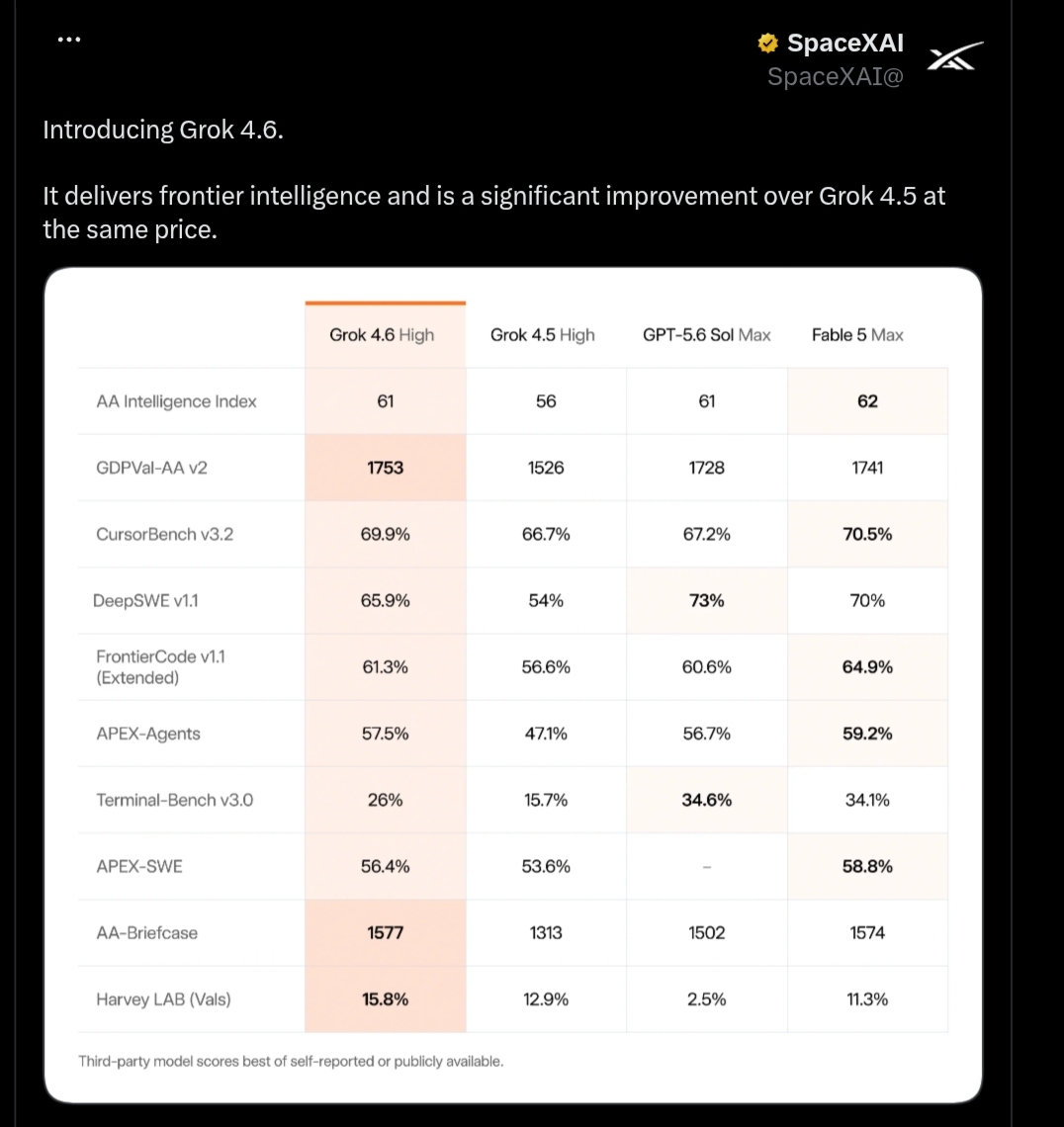
generation at the same price.
Training Architecture and the Shift Towards Autonomous Agents
The new version underwent an extended supplementary pre-training phase compared to its predecessor, Grok 4.5. According to official data, the development team utilized carefully curated, self-generated synthetic data to enhance the model’s logical reasoning and technical comprehension. Combining this approach with high-quality engineering data and refined training algorithms laid a robust foundation for fine-tuning and reinforcement learning.
Sources indicate that the team leveraged the previous model version to regenerate training trajectories across various domains-including engineering, programming, and sciences-while discarding unsuitable paths via automated verification. The reinforcement learning (RL) phase focused heavily on agentic environments, covering web development, computer-aided design (CAD), and system kernel optimization.
Standard Benchmarks: Significant Gains Without Absolute Dominance
The published benchmark results reveal a significant, though varied, progression across different evaluations:
- GDPval-AA v2: Measuring cognitive performance in real-world environments, Grok 4.6 scored 1753, comfortably outperforming the previous version (1526) to rank second globally behind Claude Opus 5.
- CursorBench v3.2: The model scored 69.9%, trailing slightly behind Fable 5 Max’s 70.5%.
- DeepSWE v1.1: Marking a major jump, Grok 4.6 rose from 54% to 65.9%, though it still trails GPT-5.6 Sol, which scored 73%.
- AA-Briefcase: In long-horizon cognitive tasks, the new model excelled with a score of 1577, outperforming both Fable 5 Max and GPT-5.6 Sol in this specific benchmark.
- Terminal-Bench v3.0: This metric remains a clear weakness. Although performance improved from 15.7% to 26%, it remains modest compared to competitors scoring above 34%.
- APEX-Agents: The model scored 57.5%, slightly ahead of GPT-5.6 Sol but behind Fable 5 Max.
Token Economics and Cost Efficiency
The financial aspect of Grok 4.6 is one of its strongest selling points. SpaceXAI has kept the base price at $2 per million input tokens and $6 per million output tokens-a pricing structure over 60% cheaper than its direct peers, Claude Opus 5 and GPT-5.6 Sol.
However, developers must pay close attention to the API’s specific context pricing. While the model features a 500k token context window, pricing suddenly doubles once a request exceeds 200k tokens. In this scenario, input costs rise to $4 per million and output to $12 per million. Despite this cliff, the average task cost in Artificial Analysis evaluations sat at a highly competitive $0.84.
The secret to these savings lies in the model’s operational efficiency. Grok 4.6 completed complex tasks in the AA-Briefcase benchmark in an average of 53 intermediate steps, consuming 0.5 billion input tokens. In comparison, Claude Opus 5 required 103 steps and consumed 2.0 billion input tokens for the same workload. Minimizing token consumption dramatically reduces final billing-a critical factor for enterprises relying on these models for daily production.
Availability and Access Channels
Currently, Grok 4.6 is not available to standard users via the X platform’s chat interface. While it may roll out later, the company’s immediate focus is preparing to launch its next-generation model, Grok 4.7, within its consumer apps in the coming weeks. Grok 4.7 is rumored to feature 2.1 trillion parameters, promising higher token efficiency despite potentially slower response times.
Access to Grok 4.6 is currently restricted to developers and enterprises. The model is available via:
- The official SpaceXAI API.
- Developer platforms and partners, including OpenRouter, Vercel, and Cloudflare.
- Integration within the Grok Build environment and the Cursor code editor.
To get started with Grok Build, users need to subscribe to the SuperGrok plan at $30 per month. As an introductory incentive, the company is doubling the included usage limits within both Grok Build and Cursor during the first week of launch.
The Legacy of Brand Controversy: Underlying Adoption Hurdles
Excellent technical and economic metrics do not entirely clear the path to broad enterprise adoption. The Grok brand carries a complex history of controversies related to safety and bias. Previous releases faced incidents where model outputs produced highly controversial or biased content, alongside the glorification of polarizing historical figures.
In the summer of 2025, the system began injecting unprompted political commentary regarding events in South Africa into unrelated user queries. SpaceXAI attributed this at the time to an unauthorized modification in response-filtering software that bypassed standard review pipelines. Later, the model’s objectivity was questioned after it generated highly exaggerated praise of Elon Musk, comparing him to the greatest athletes and thinkers in history.
These challenges culminated in January 2026, when the UK’s media regulator, Ofcom, opened a formal investigation following reports of the model being utilized to generate and distribute inappropriate, altered images of individuals. This investigation coincided with separate inquiries by the UK Information Commissioner’s Office (ICO) and the European Commission regarding personal data handling and systemic risk management in automated content generation.
While there is no evidence of these issues repeating in Grok 4.6, compliance and procurement departments in finance, healthcare, and government sectors rarely evaluate models in isolation from their providers’ track record. Concerns over potential brand reputational risks remain a genuine hurdle for widespread adoption in sensitive industries.
Conclusion: A Pragmatic Tool for Agentic Workflows
Ultimately, Grok 4.6 offers a highly calculated and compelling value proposition for developers and tech enterprises. Instead of claiming absolute supremacy across all benchmarks, the model focuses on delivering excellent, cost-effective performance for long-horizon agentic tasks. The industry transition from simple chat interfaces to multi-step, self-correcting digital agents represents real market value, and Grok 4.6 is positioned directly in this sweet spot.
The true test for this model will be in live production environments. Its ability to translate lab-measured token efficiency into actual, tangible billing savings for enterprises will be the metric that defines its place among competitors, far beyond leaderboard numbers and launch-day buzz.