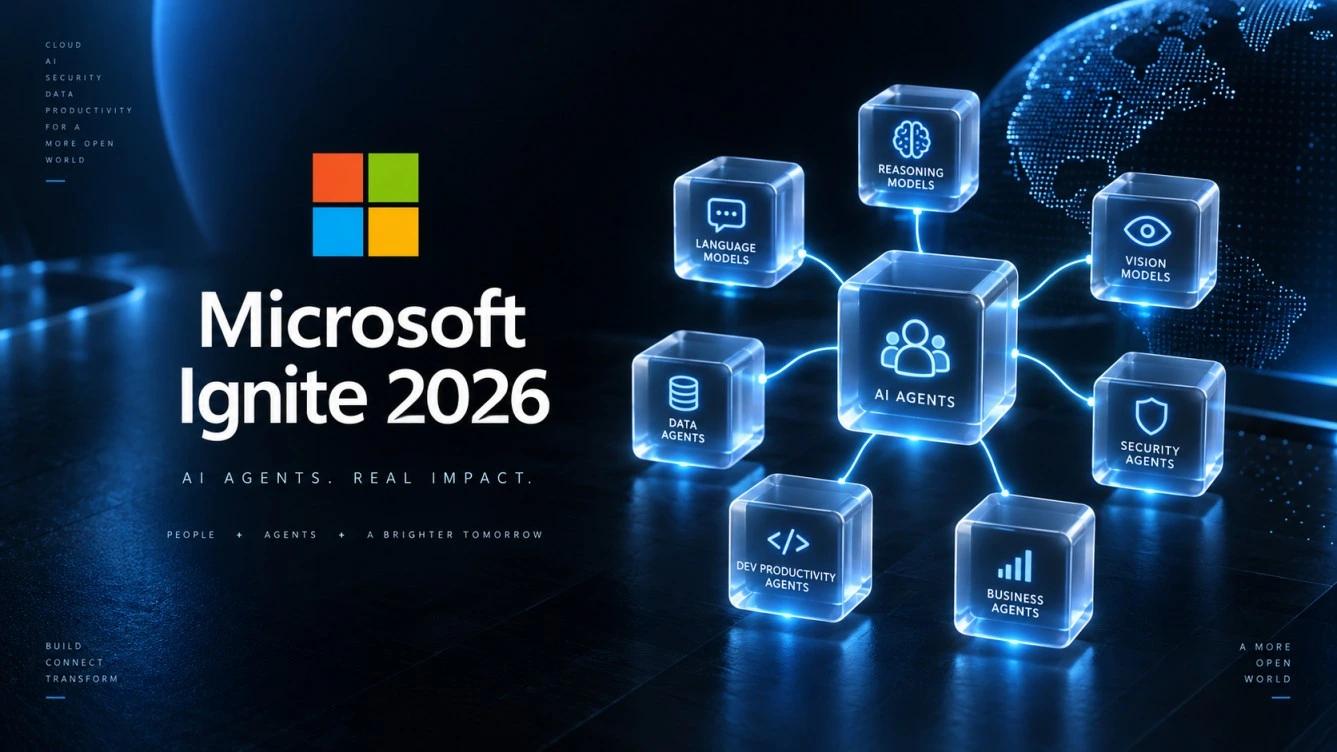
Microsoft Ignite 2026: Microsoft Unveils 7 AI Models and Expands Its Agent Ecosystem
Microsoft announced seven new artificial intelligence models at Microsoft Ignite 2026, alongside major updates to Copilot, Agent 365, and its Microsoft IQ platform. The announcements also covered cybersecurity tools, cloud services, and improvements to Windows and Azure-all aimed at moving AI agents out of pilot programs and into daily enterprise workflows.
The new models target specialized tasks ranging from software development and cybersecurity to image generation, speech, medical transcription, and decision-making. Yet Microsoft’s real play isn’t just releasing more models; it is tying them directly to enterprise data, security controls, and scalable infrastructure.
Microsoft Ignite 2026: Key Announcements
Running from November 17 to 20 in San Francisco and online, Microsoft Ignite 2026 has focused on three main areas: AI models, agent platforms, and the infrastructure required to support them.
The major announcements include:
- New MAI models for coding, cybersecurity, image generation, and speech.
- Microsoft IQ, a platform designed to organize enterprise knowledge and connect it with AI agents.
- Expanded Agent 365 capabilities for monitoring agents and managing their permissions and costs.
- New Copilot capabilities, including Copilot Workspaces and Autopilot.
- Azure updates covering Cobalt 200, Azure Catalyst, and HorizonDB.
- Expanded tools for securing AI agents across Windows and cloud environments.
Seven New AI Models for Specialized Tasks
Microsoft AI introduced a new family of models focused on specialized workloads, with particular attention to performance and operating costs. Rather than relying on a single model for every task, the new releases address different enterprise and developer needs.
MAI Cyber 2 Flash for Cybersecurity
MAI Cyber 2 Flash is designed to identify security vulnerabilities and help cybersecurity teams respond to attacks. In CyberGymE2E tests, the model demonstrated performance comparable to GPT-6 Astra, while its operating cost was no more than 2% of the cost of the competing model.
The release supports Microsoft’s broader effort to deploy AI agents that can continuously examine systems, detect security issues, and assist with remediation.
MAI Code 2 and MAI Code 2 Flash for Software Development
Microsoft introduced two coding models: one designed for complex software engineering tasks and another aimed at faster, everyday development work.
Microsoft’s benchmarks emphasize lower operating costs while keeping performance competitive with rival coding models. Both versions are available through GitHub Copilot and connect directly to Microsoft Foundry, allowing engineering teams to balance speed and budget by splitting workloads between MAI Code 2 and MAI Code 2 Flash-assigning deep architectural tasks to the flagship model while routing routine edits and rapid completions to the Flash variant.
MAI Image 2.7 and Flash for Image Generation
Image generation and editing are another part of the new MAI family. MAI Image 2.7 tops Artificial Analysis’s image-editing leaderboard, and Microsoft’s internal benchmarks show it outperforming GPT Image 2.6 Sunburst Max at one-fifth of the latter’s cost.
The Flash version targets high-volume image generation, with Microsoft pricing it at $10 per 1,000 images. Both models are available through Microsoft Foundry, while Canvas provides an interactive workspace for creating and editing images.
MAI Realtime 1 for Voice Conversations
MAI Realtime 1 is a speech model built around Speech-to-Speech technology. It processes spoken conversations and responds directly, without relying on separate stages for converting speech into text and then generating an audio response.
Microsoft’s published performance figures show the model outperforming GPT-Realtime 2.1, with operating costs starting at $0.01 per audio minute. The model is aimed at real-time conversational applications and enterprise services that require fast responses.
Dragon Copilot Transcribe for Medical Transcription
Microsoft also updated its medical transcription capabilities with Dragon Copilot Transcribe, built on the MAI Transcribe 2 model.
The system processes conversations between doctors and patients and supports multilingual workflows. According to Microsoft, it handles approximately 10 million medical encounters each month, while multilingual transcription errors have been reduced by half.
Doctors and healthcare organizations in the United States use the technology through the Dragon Copilot suite.
Microsoft-Decision-1.1 for Decision-Making
Microsoft announced the general availability of Microsoft-Decision-1.1, a model designed for tasks such as data classification, request routing, prioritization, result verification, and workflow control.
According to Microsoft’s official performance data, the model is 50 times faster than GPT-Sol 6.1 and reduces costs by a factor of 79. The company also reported that more than 4,000 customers use the model, which supports multimodal inputs.
Microsoft IQ Connects Enterprise Knowledge With AI Agents
One of the conference’s major announcements was Microsoft IQ, a platform designed to collect and organize enterprise knowledge and connect it with applications and AI agents.
This knowledge includes work data, documents, emails, meetings, and information stored across an organization’s internal systems.
Microsoft IQ connects data from Microsoft 365, Fabric, and Foundry, as well as external services. Microsoft also announced hundreds of new connectors to give agents broader context about how an organization operates.
A model’s raw intelligence alone isn’t enough for complex enterprise tasks; agents also need access to internal documents and business context. Microsoft IQ is designed to make that knowledge manageable and reusable across agents and applications.
Agent 365 and Copilot Bring AI Agents Into the Workplace
Agent 365 received new capabilities for managing AI agents and monitoring their activity. The platform helps organizations identify each agent, determine who is responsible for it, review its permissions, and track the systems it can access.
Microsoft reported that more than 50 million agents had been registered through the platform since its launch in May 2026. The company also introduced Agent 365 Business Analytics, a tool for tracking agent operating costs and connecting spending with outcomes and completed tasks.
In Copilot, Microsoft introduced Copilot Workspaces as a shared environment where employees and agents can collaborate on tasks and projects. Autopilot can also handle recurring work and longer-running projects without requiring a new prompt at every step.
The company also introduced Copilot Code, which can create dashboards, applications, and tools using natural language, with enterprise security and management controls. The expansion includes a preview integration with Salesforce featuring more than 38 ready-made sales skills.
New Tools for Securing Enterprise AI Agents
Once agents start taking actions rather than just answering questions, permission control and data protection become critical.
Microsoft announced the general availability of Microsoft Perception, a platform that brings together specialized agents to simulate attacks, detect threats, and address vulnerabilities. Different agent groups handle different stages of the process: some simulate attacks, others identify risks, and another group works on remediation.
Microsoft also announced improvements to Microsoft Execution Containers, which isolate agents and control the files and networks they can access.
Windows 365 for Agents allows organizations to assign cloud PCs to agents. These environments let agents interact with applications, files, and work interfaces while remaining subject to enterprise controls.
Microsoft also announced the AI Transparency Initiative, developed in collaboration with 40 organizations. The initiative aims to help establish shared standards for AI transparency, security, and verification of system actions.
Azure, Windows, and Infrastructure Updates
On the cloud infrastructure side, Microsoft announced the general availability of Azure Cobalt 200 virtual machines. The new CPUs deliver up to 50% higher performance compared with the previous Cobalt 100 generation.
The company also introduced Azure Catalyst, which uses agents to help modernize legacy applications and databases. Other announcements included Azure HorizonDB for demanding PostgreSQL workloads and Fabric HorizonDB, which connects PostgreSQL applications with analytics and AI services.
In Windows, Microsoft focused on Hybrid Intelligence, an approach that distributes workloads between local models running on a user’s device and cloud-based services, depending on the task.
GitHub Copilot Fusion also appeared in preview, allowing developers to route lightweight coding tasks to local models on their own machines. Other updates included the public preview of Windows Server 2028, improvements to Windows 365, and additional tools for isolating agents and managing their identities and permissions.
On the processor front, Microsoft highlighted Maia 200, its custom AI accelerator, which entered production before the conference. The chip powers workloads that include MAI models and Copilot services. Microsoft says it delivers up to 1.7 times as many tokens per watt compared with a reference GPU infrastructure used in its performance measurements.
What Microsoft Ignite 2026 Reveals About Microsoft’s AI Strategy
Taken together, the Ignite 2026 announcements show Microsoft building a full-stack operating layer for enterprise agents-uniting MAI models, Microsoft IQ, Agent 365, Copilot, and Azure. By focusing on lower operating costs and stricter governance, the company is betting that organizations are ready to manage AI agents as a scalable digital workforce rather than standalone assistants.