Meta’s Muse Voice Transcribe Hits 3.1% WER at Just $0.18/Hour
What Is Muse Voice Transcribe? Meta’s Next-Generation Real-Time Audio Model
Meta Superintelligence Labs (MSL) has officially introduced its first real-time audio perception model: Muse Voice Transcribe. Developed under Meta’s broader “Muse Spark” model family, this release marks a strategic entry into low-latency conversational artificial intelligence, offering an autoregressive multimodal system capable of converting streaming speech into text with low latency.
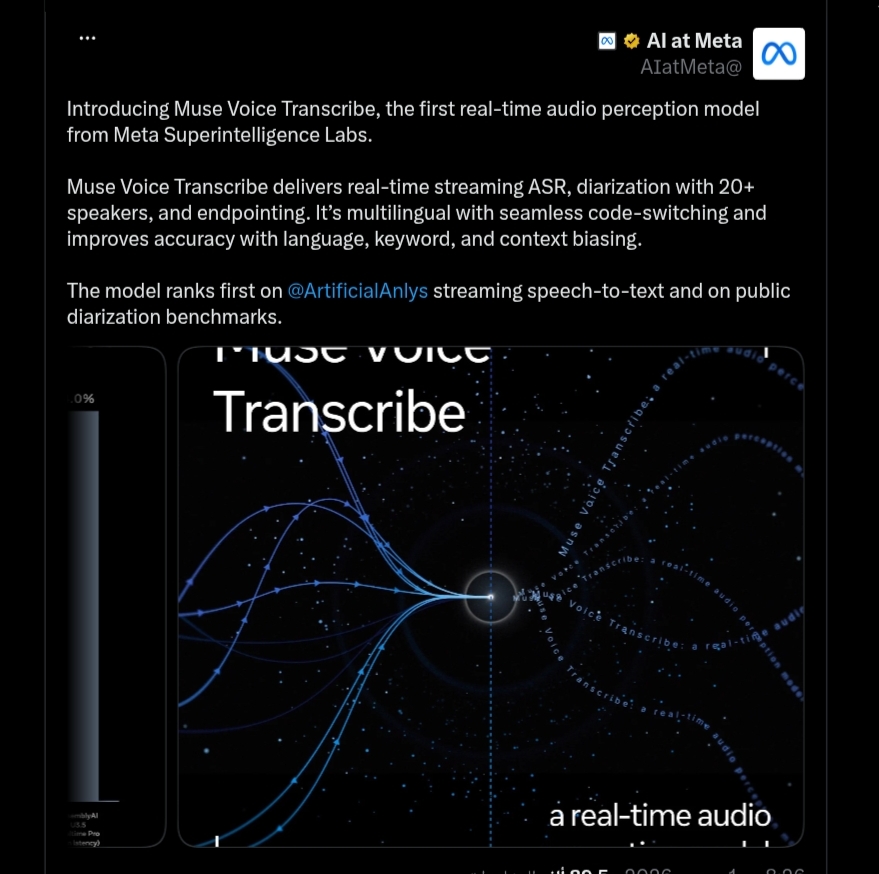
Rather than building an offline batch transcription pipeline or a complex reasoning engine, Meta has focused its engineering efforts on solving a persistent bottleneck in real-time communication: live, conversational speech understanding. Muse Voice Transcribe is designed to handle continuous audio input while simultaneously transcribing speech, separating distinct voices, and detecting when a speaker finishes talking. The model is accessible through the Meta Model API, integrated directly into the Meta AI for Mac desktop application for system-wide dictation, and embedded inside Meta’s software engineering environment, Muse Code.
How Does Muse Voice Transcribe Work? One Model for Speech, Speakers, and Endpoints
Traditional real-time speech-to-text systems often rely on multiple components chained together in complex pipelines. In standard production architectures, developers frequently deploy three distinct subsystems: an Automatic Speech Recognition (ASR) engine to transcribe raw audio, an endpointing model to guess conversational turns, and an independent speaker diarization service to determine who spoke.
Muse Voice Transcribe unifies these three distinct tasks into a single native model:
- Streaming Automatic Speech Recognition (ASR): Continuously decodes incoming audio into structured text in real time, delivering transcript segments as words are articulated without waiting for full sentence breaks.
- Native Live Speaker Diarization (20+ Speakers): Identifies and tracks vocal shifts across multiple participants in real time. It is worth emphasizing that speaker diarization in this context refers to separating and clustering vocal signatures (such as labeling Speaker A, Speaker B, and Speaker C) rather than identifying an individual’s real-world biographical name.
- Integrated Endpointing (Turn-Detection): Accurately detects conversational boundaries by distinguishing between momentary mid-sentence pauses (such as taking a breath or organizing thoughts) and genuine speech completion. This is designed to reduce premature cut-offs in automated voice assistants, enabling more natural conversational pacing.
Adaptive Delay: How Meta Makes Real-Time Transcription Faster Without Sacrificing Accuracy
At the architectural core of Muse Voice Transcribe is an autoregressive token emission pipeline that processes audio in 80-millisecond chunks (at a frame rate of 12.5 Hz). Each 80ms chunk of incoming sound is compressed into a single soft token.
As each audio chunk enters the model, the system dynamically evaluates two primary options:
- Emit Text Token: When the phonetic and acoustic signals provide strong confidence, the system commits the transcribed text token immediately.
- Emit <|next_audio|> Placeholder: When a word is complex, ambiguous, or masked by acoustic noise, the system buffers its decision and requests the subsequent 80ms chunk to gather broader linguistic context before committing to the final text.
When the input stream goes silent, an <|empty_audio|> token signals the decoder to flush all remaining text held in the internal buffer.
Meta terms this dynamic scheduling mechanism Adaptive Delay. By controlling how much acoustic context it consumes prior to finalizing a word, the model establishes an adaptive trade-off between execution speed and transcription accuracy.
Meta CEO Mark Zuckerberg outlined the mechanics of this system:
“The model decides when to listen. It waits a little longer on hard words and commits faster on easy ones, using adaptive delay to predict each token and increase accuracy. It holds up on messy, real audio too – trained across 70+ languages (with 25 validated at launch), handles mid-sentence code-switching, and manages hour-long sessions with 20+ speakers.”
This balance is trained during a reinforcement learning (RL) stage, where word error rate rewards and latency reduction rewards are multiplied in a unified mathematical objective rather than optimized independently.
3.1% WER: Where Does Muse Voice Transcribe Rank Against Leading Models?
According to benchmark results published on the independent Artificial Analysis Streaming Speech-to-Text Leaderboard, Muse Voice Transcribe achieved the top rank in real-time English transcription, recording a 3.1% Word Error Rate (WER).
It is important to emphasize that this 3.1% figure represents performance on a specific streaming English benchmark under standardized conditions. It should not be interpreted as an absolute error rate across every language, accent, or acoustic environment.
Selected Standings on the Artificial Analysis Streaming Leaderboard:
- Meta Muse Voice Transcribe: 3.1% WER (1st Place)
- Cartesia Ink-2: 3.4% WER (2nd Place)
- ElevenLabs Scribe v2 Realtime: 3.6% WER (3rd Place)
- OpenAI GPT Live Transcribe: 3.9% WER (4th Place)
- Google Gemini 3.5 Transcribe Live: 4.0% WER (5th Place)
Beyond WER: Latency and Speaker Diarization Performance
Evaluating real-time speech systems requires looking beyond word accuracy to latency characteristics and multi-speaker separation:
- Final Transcript Latency: In benchmark evaluations, Muse Voice Transcribe delivers the final transcript string approximately 0.16 seconds after speech endpoint detection. This figure measures the computational duration required to flush the final transcription buffer once silence is detected, rather than the complete end-to-end response latency of an interactive conversational AI agent.
- Speaker Diarization Error Rate (DER): Meta reported that the model achieved an average 17.5% Diarization Error Rate across standard public benchmarks, including AMI-IHM, AMI-SDM, and VoxConverse. Meta reported that this result placed the model at the top of the diarization comparison it presented, while the 17.5% DER also highlights the need for human review in high-stakes applications where attribution accuracy is critical.
70+ Languages, Code-Switching, and 20+ Speakers: What Muse Can Handle
To accommodate complex conversational workflows, Meta incorporated several specialized capabilities into the model:
- Multilingual Training and Validation: The system was trained on audio data spanning more than 70 languages, with 25 languages extensively verified at launch.
- Real-Time Code-Switching: The model natively handles code-switching, allowing speakers to switch between multiple languages mid-sentence without desynchronizing the transcription stream.
- High-Density Speaker Tracking (20+ Speakers): The model can track and separate more than 20 distinct speakers in a single meeting, while supporting continuous audio sessions exceeding one hour.
- Contextual and Keyword Biasing: Developers can supply pre-defined vocabulary lists-such as proprietary product names, specialized terminology, and other domain-specific vocabulary-to prevent the decoder from substituting uncommon terms with phonetically similar everyday words.
How Much Does Muse Voice Transcribe Cost? Meta vs. AssemblyAI and Deepgram
Meta has introduced an aggressive pricing structure on the Meta Model API, setting a flat rate of $3.00 per 1,000 audio minutes (equivalent to $0.003 per minute, or $0.18 per hour).
This pricing puts Meta in a highly competitive position against existing commercial speech APIs, particularly because speaker separation and turn-detection are handled within the unified model rather than billed as separate add-ons:
- AssemblyAI: Lists its Universal-3.5 Pro Realtime tier at $0.45 per hour, with an additional $0.12 per hour for real-time diarization, bringing the combined total to $0.57 per hour.
- Deepgram: Offers Nova-3 streaming at a standard rate of approximately $0.0077 per minute, which equals roughly $0.46 per hour.
- Meta Muse Voice Transcribe: Combines real-time streaming, speaker diarization, and endpoint detection in a single unified API endpoint at $0.18 per hour.
Meta Model API: How Developers Can Integrate Muse Voice Transcribe
Meta has structured the Meta Model API to maintain broad compatibility with the OpenAI SDK standard.
This architectural compatibility may allow engineering teams to reuse substantial portions of their existing client codebases. By updating the base URL and pointing the model parameter to muse-voice-transcribe-1.0, developers can evaluate and deploy the model with minimal migration overhead, depending on their specific application setup and integration requirements.
Where Can You Use Muse Voice Transcribe? Meta AI, Muse Code, and API
Muse Voice Transcribe is deployed across three primary access points:
- Meta Model API: The primary programmatic gateway for developers building conversational agents, automated note-taking tools, and live captioning infrastructure.
- Meta AI for Mac: Provides desktop-level voice input, enabling users to dictate text across any macOS application by holding down the
Fnkey without paying API fees. - Muse Code: A developer-focused environment that integrates voice transcription for real-time coding assistance, documentation, and system commands.
Meta has indicated that the model will remain accessible exclusively through its hosted cloud services, with no current plans to release the model weights for independent local hosting.
Who Should Use Muse Voice Transcribe – and Who Shouldn’t?
While unifying ASR, diarization, and endpointing into an affordable streaming model offers significant advantages, technical suitability depends on the specific use case:
Recommended Use Cases
- Interactive Conversational AI Agents: Voice bots and customer support platforms that require rapid turn-detection to minimize awkward pauses during user interactions.
- Live Meeting Documentation: Applications that display real-time captions with speaker attribution directly on screen while conversations are underway.
- Cost-Sensitive, High-Volume Pipelines: Organizations processing thousands of hours of live audio monthly that need to reduce API expenditure without sacrificing transcription accuracy.
Scenarios Requiring Alternative Solutions
- Strict Data Sovereignty and Air-Gapped Systems: Enterprises operating under strict regulatory mandates that prohibit sending audio to external cloud APIs should look to self-hosted open-weight models such as OpenAI’s Whisper.
- High-Stakes Legal and Medical Records: A 17.5% diarization error rate means automated speaker labels should not be used as authoritative records in courtroom depositions or medical charts without human editorial review.
- Static Offline Batch Processing: For transcribing legacy archives where real-time streaming is not required, standard asynchronous batch APIs from specialized providers may offer competitive volume pricing.
- Languages Outside the Validated Set: Workloads relying heavily on languages outside the 25 validated launch languages should undergo comprehensive internal evaluation before deployment in production.
Could Muse Voice Transcribe Change the Real-Time Voice AI Market?
The launch of Muse Voice Transcribe demonstrates Meta’s intention to establish a foundational presence in real-time audio perception. Beyond competing in the developer API marketplace, low-latency speech processing could play an important role in Meta’s broader hardware and platform strategy, particularly as the company expands its ecosystem of smart glasses, spatial computing devices, and ambient desktop assistants.
By combining a 3.1% WER streaming architecture with low latency, native support for 20+ speakers, and competitive API pricing, Meta has delivered a strong benchmark for real-time speech AI applications.